.svg)

.svg)



.png)
.webp)
A business rules engine takes business logic and turns it into decisions the system can actually use. It checks conditions, runs actions, and keeps a lot of the "if this, then that" work out of the application code. That part often gets ignored until the rules start piling up and the codebase becomes a mess.
What Is a Business Rules Engine?
A business rules engine is software that evaluates rules against data and triggers the right outcome. Simple in theory. Not always simple in practice.
Instead of hardcoding decision logic into an app, teams put those rules in a separate layer. That makes changes easier to manage, especially when rules keep shifting because of compliance, pricing, risk checks, or internal policy updates.
Examples of Business Rules?
Rules show up everywhere. Usually in places where people want consistency but don't want to keep checking things manually.
- E-commerce platforms: Product recommendations based on browsing or purchase history.
- Insurance providers: Claims checks against policy terms and coverage limits.
- Healthcare systems: Prescription validation against medical history and current medications.
- Banking institutions: Fraud checks based on thresholds and transaction patterns.
- Telecommunications companies: Billing adjustments tied to usage and promo eligibility.
These are the kinds of decisions that break down fast if they stay buried in code.
Comparison of Top Business Rules Engines
Top 10 Business Rules Engine
Now, let us see the best business rule engines available in the market. Below we have this curated list that highlights each engine's key features and suitability for different project needs, aiming to equip you with the knowledge to select the ideal engine for your development challenges.
1. Nected
Nected is a low-code/no-code decision platform built for rule execution, workflow automation, and experimentation. It's the strongest pick here if you want something usable by both technical and non-technical teams without turning every rule change into a dev task.
Key Features:
- User-friendly interface: Lets teams define and manage business rules without much coding.
- Seamless integration: No-code connectors for databases, APIs, and other systems.
- Flexible deployment: Supports SaaS, private managed cloud, and self-hosted setups.
- Real-time rule execution: Rules can change without slowing down operations, with sub-50ms P95 latency.
- Workflow automation: Handles more than just rules — decision tables, decision trees, rule chaining, and multi-step workflows in one place.
- AI Copilot: Built-in AI-native decisioning, from plain-language rule generation to full flow authoring.
Pros:
- Speeds up rule changes and product iteration.
- Reduces dependency on engineering for routine updates.
- Ships governance (maker-checker approvals, RBAC, audit trails) on all plans, not as a custom build.
- Scales without making the setup feel heavier than it needs to be.
Cons:
- Teams new to structured decisioning may need a short onboarding period.
- Very old or messy legacy systems may need extra integration work.
In summary, Nected stands out as one of the best BREs as it provides a versatile and efficient business rules engine. It offers a user-friendly interface, no-code integration capabilities, and robust features that cater to both technical and non-technical users. Its focus on accelerating development cycles, reducing costs, and enhancing scalability makes it a compelling choice for organizations seeking to optimize their decision management and workflow automation processes.
2. IBM ODM
IBM Operational Decision Manager (ODM) is an enterprise decision management platform that helps teams model, govern, and automate decision logic across systems. It's built for scale, and that's usually the reason people choose it — along with the licensing bill that comes with it.
Key Features:
- Centralized decision repository via Decision Center.
- DMN support and rule versioning.
- Testing and simulation tools.
- On-premise and Cloud Pak-based deployment.
- Business-user-friendly interfaces, though they still need training.
Pros:
- Strong governance and auditability.
- Good fit for regulated industries with compliance obligations.
- Supports collaboration between business and IT once teams are ramped up.
Cons:
- Licensing, tied to Passport Advantage and Cloud Paks, runs $120K–$325K/year before implementation.
- Requires expert configuration — business teams still need training, and setup is non-trivial even for simple models.
- Rule changes take weeks once deployments, testing, and team coordination are factored in.
- Integrating with non-IBM systems adds friction and cost.
IBM ODM offers a robust solution for enterprises that need certified governance and are prepared to pay enterprise pricing for it. By bridging the gap between business requirements and technical implementation, ODM empowers organizations to maintain agility and compliance — but the licensing burden and ramp-up time are real costs teams should plan for before committing.
3. Decisions
Decisions.com bundles a rules engine inside a full low-code BPM suite — case management, forms, dashboards, and a workflow canvas that rules are authored inside of. It's a strong option if you genuinely need BPM and rules together, and a heavier one if you only need the rules.
Key Features:
- Low-code workflow/BPM canvas for building end-to-end processes.
- Rules authored as nodes within the broader process flow.
- Forms, case management, and reporting dashboards included.
- Cloud and Windows Server-based deployment options.
- Data services for connecting to external systems.
Pros:
- Genuinely useful when you need workflow orchestration and rules in the same place.
- Visual process modeling lowers the barrier for less technical builders.
- Broad feature set covers more than pure decisioning.
Cons:
- You're paying for a full BPM platform ($96K–$180K/year and up) even if you only need rule evaluation.
- Rules are designed around the workflow canvas, which makes lightweight, stateless rule APIs less flexible to build.
- Native maker-checker approvals and rule-level governance aren't available out of the box — most teams configure these through custom process design.
- Custom integrations and governance frameworks commonly require professional services, extending timelines and cost.
In summary, Decisions is a capable low-code platform for workflow automation, and it's a legitimate choice if BPM is genuinely part of your problem. But if what you actually need is decision logic — real-time rules, dynamic eligibility, conditional routing — you're carrying BPM overhead you didn't ask for.
4. GoRules
GoRules is an open-source, developer-first rules engine built for modern, API-driven microservice architectures. It's fast to start with and genuinely well-liked by engineering teams — the costs show up later, in ops and licensing for the commercial BRMS layer.
Key Features:
- JSON Decision Model (JDM) for defining decision tables, switches, and expressions.
- Stateless rule evaluation that scales horizontally.
- QuickJS-based custom functions for logic beyond the visual editor.
- REST evaluation API for calling rules from any stack.
- Self-hosted BRMS option with a visual editor on top of the open-source core.
Pros:
- Genuinely developer-friendly — fast to integrate into existing services.
- Free, open-source core with no license fee to get started.
- Stateless architecture scales horizontally without much fuss.
Cons:
- Not SOC 2 Type 2 or ISO certified, which is a blocker for many enterprise security reviews.
- No built-in workflow engine — orchestration across systems still needs external tooling.
- The commercial BRMS is self-hosted only: you manage Postgres, license-server connectivity, and your own scaling clusters.
- JDM is less portable than DMN, creating a degree of format lock-in.
GoRules is a solid choice for engineering teams that want to own their rules engine end-to-end and don't mind running the infrastructure themselves. The free license is real, but the ops, licensing, and missing workflow layer add up fast once you're past a pilot.
5. DecisionRules
DecisionRules is a cloud-native Business Rules Management System built for teams that want a visual rule editor without the JVM overhead of Drools. It's SOC 2 Type 2, ISO 27001, and GDPR certified, and most teams reach a working rule in production within days.
Key Features:
- Visual rule editor: decision tables, decision trees, scorecards, and rule flows.
- Scripting rules in JavaScript for logic beyond the visual editors.
- AI Assistant that bootstraps rules from plain-language input (capped at 10-row tables).
- MCP server for integration with external AI agents.
- Deployable as SaaS, private managed cloud, or self-hosted Docker.
Pros:
- Business analysts can genuinely author and publish rules without filing engineering tickets.
- Clean REST API integrates into any stack without engine-specific SDKs.
- Recognized by G2 as High Performer, Best ROI, and Fastest Implementation across multiple quarters.
Cons:
- Processes one rule set per API call — multi-step decisions that mix rule evaluation with workflow steps still need the calling application to manage state.
- No Maker/Checker approval routing; anyone with publish access can push straight to production.
- Usage-based pricing means every API call adds cost — at 100 TPS, Year 1 runs ≥$200K fully loaded.
- Log retention defaults to 7 days on basic plans, short of what most regulated audits require.
DecisionRules is a genuinely better experience than most legacy rule engines for teams migrating away from custom-coded logic. The visual editor is clean and accessible, and the certifications open procurement conversations that open-source alternatives can't. The ceiling shows up at production throughput, where usage-based pricing and governance gaps become real constraints for regulated industries.
6. Pega
Pega is a heavyweight enterprise platform for case management, workflows, and decisioning. It combines rules, workflows, and case handling in one ecosystem with AI and automation capabilities across the platform — extremely capable, and extremely complex to run.
Key Features:
- Rules, workflows, and case management unified in one platform.
- Strong governance and controls for enterprise environments.
- Extensive ecosystem and integration options.
- Platform-wide AI and automation capabilities.
- Cloud, on-premises, and hybrid deployment.
Pros:
- Powerful enterprise platform for workflows, cases, and decisioning together.
- Strong governance and controls suited to large, regulated organizations.
- Broad ecosystem and integrations across enterprise systems.
Cons:
- Rule changes often require check-ins, approvals, deployments, and DevOps pipelines — even minor updates can take days to weeks.
- Proprietary rule types, case structures, and flow models demand specialized training and certifications (CSA, CSSA) to operate confidently.
- High licensing costs plus dedicated infrastructure, scaling nodes, and certified developers push total cost of ownership up significantly.
- Keeping the platform healthy requires ongoing investment in upgrades, integrations, and SSO management.
Pega is a genuinely powerful choice for large enterprises that want case management, workflow, and decisioning unified in one ecosystem and have the budget and specialist talent to run it. For teams that mainly need decision logic rather than a full case-management platform, the complexity and cost are hard to justify.
7. Taktile
Taktile is a well-funded, fintech-specific decision platform — $110M Series C led by Goldman Sachs, with ARR growing 3.5x YoY. It covers the full financial customer lifecycle: onboarding, KYC/KYB, credit underwriting, fraud, transaction monitoring, and dynamic pricing.
Key Features:
- Low-code Decision Flow Builder for risk analysts.
- Champion/challenger testing for validating new decision strategies before rollout.
- ML and GenAI integration directly inside decision flows.
- Human-in-the-Loop routing for complex or borderline cases.
- Full audit and explainability logging for regulatory review.
Pros:
- Risk teams can update credit and fraud logic without filing engineering tickets.
- Champion/challenger testing is built in, not a bolt-on feature.
- Governance — approval flows, RBAC, audit trails, SSO — was designed around financial compliance from day one.
Cons:
- Built exclusively for financial services — not a general-purpose decisioning platform for other industries.
- The low-code interface assumes fintech domain expertise; it's not accessible to general business users outside risk teams.
- No public pricing, no self-serve trial — onboarding is a sales-led process, typically $80K–$200K+ annually.
- No native no-code connector catalog outside fintech data providers; broader integrations need custom engineering.
Taktile is a genuinely strong platform for its intended audience: fintechs and banks that need automated risk decisioning operated by risk teams with domain expertise. The limitation is the vertical boundary — teams outside financial services, or those wanting decisioning across multiple business functions, will hit the edge of what Taktile was built for.
8. InRule
InRule is an enterprise Business Rules Management System with a strong heritage in .NET and on-premises deployments. It provides rule authoring, versioning, and deployment for business logic, with support for decision tables and rule flows.
Key Features:
- Enterprise rule authoring and deployment for business analysts and IT.
- Versioning and audit trails, with some limitations.
- .NET-centric architecture with cloud and on-premises deployment options.
- Support for predictive and external data inputs.
- Analytics and reporting.
Pros:
- Mature enterprise BRMS with real governance credentials.
- Familiar and comfortable for teams already standardized on .NET.
- Helps reduce IT bottlenecks for organizations that adopt it fully.
Cons:
- Little to no AI-native decisioning — no built-in Copilot or AI Agents comparable to modern platforms.
- Limited workflow orchestration; end-to-end workflows typically need additional tooling.
- Complex interface limits genuine business-user self-serve.
- .NET-centric architecture creates lock-in for non-.NET services, and total cost of ownership runs $400K–$800K/year in many enterprise deployments.
InRule provides a mature, credible path for automating business rules within a .NET enterprise — its focus on rule authoring and governance makes it a workable choice for organizations already standardized on the stack. Outside that context, the limited AI capabilities, thin workflow support, and high TCO are worth weighing against newer decision intelligence platforms.
9. Drools
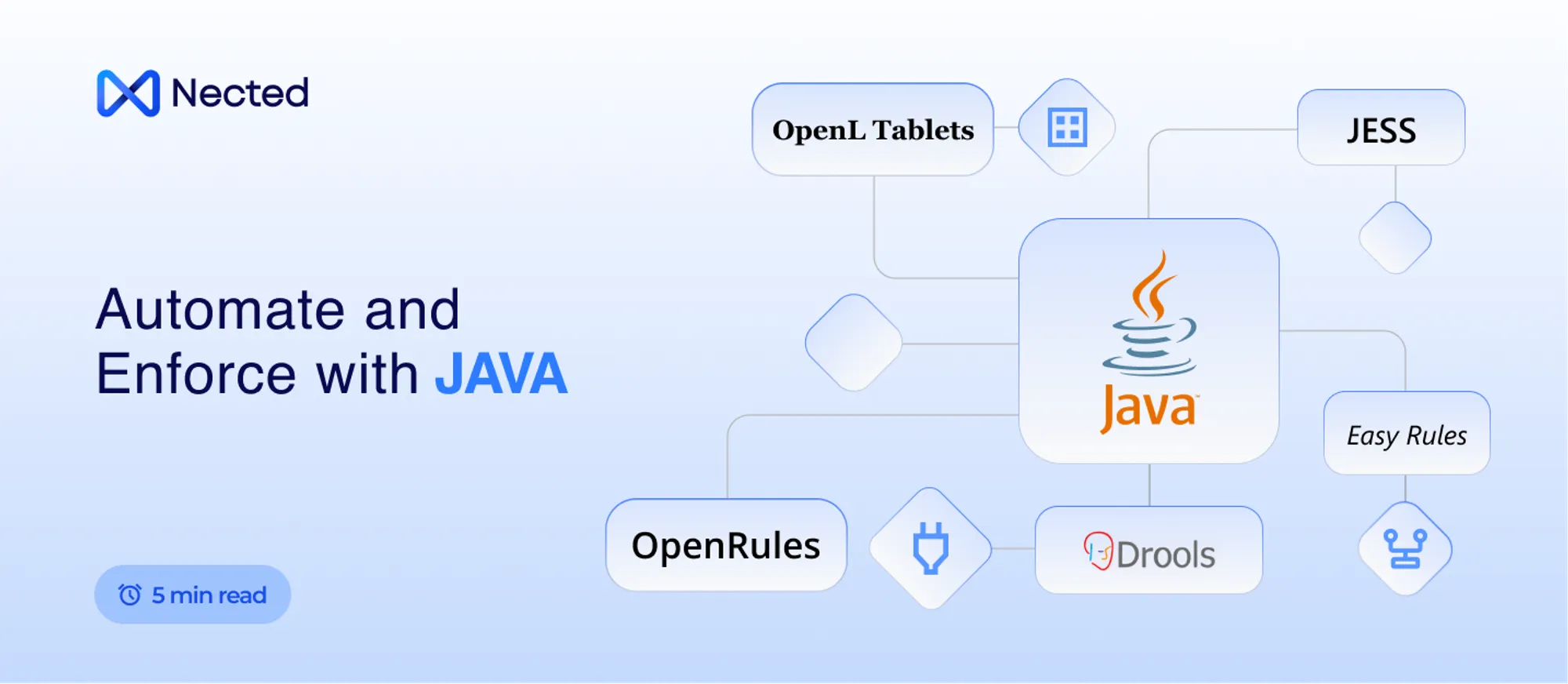
Drools is one of the most battle-tested business rules engines in the Java ecosystem. Built by Red Hat under the Apache 2.0 license and in active use since the early 2000s, it uses a Rete algorithm to evaluate complex rule sets, with rules authored in DRL (Drools Rule Language).
Key Features:
- Rete-algorithm-based rules engine with native stateful sessions.
- DMN support at Conformance Level 3.
- jBPM integration for optional workflow orchestration.
- Kogito for cloud-native, container-based deployment.
- Business Central workbench for rule authoring and testing.
Pros:
- Handles very complex, interdependent rule logic that would strain simpler engines.
- Zero license cost — genuinely free and open-source under Apache 2.0.
- Mature ecosystem with a large, active community and extensive documentation.
Cons:
- Every rule change requires a developer who knows DRL and Java — business teams cannot self-serve, even for trivial updates.
- Zero governance out of the box: no approval workflows, RBAC, or audit trails. Teams typically spend 3–6 months building these before a compliance audit is possible.
- No auto-scaling or managed cloud option — your team owns infrastructure, tuning, and reliability entirely.
- Fully loaded Year 1 TCO at 100 TPS runs ≥$588K once middleware, implementation, training, and ops are counted — despite the $0 license.
Drools remains a technically credible choice for organizations with deep Java expertise, existing KIE platform investment, and the engineering bandwidth to build the governance and observability layers it doesn't ship with. For most teams evaluating rule engines today, the real question isn't whether Drools can evaluate rules — it's who can change them, how fast, and what it costs to govern them properly. On those dimensions, the DRL-only authoring model and manual governance add up to real time and cost.
Read Also:- Top 7 Java Rule Engines for your Business Decisions
10. FICO Blaze Advisor
FICO Blaze Advisor is a decision rules system built for high-volume environments. It's often used where risk, compliance, and precision matter a lot — banking, insurance, and healthcare are its natural home turf.
Key Features:
- High-performance rule execution built for high-volume decisioning.
- Rule authoring and testing tools, including decision tables and scorecards.
- Governance and versioning for regulated environments.
- Integration with FICO's broader analytics and scoring ecosystem.
- Cloud and on-premises deployment.
Pros:
- Strong for large-scale decisioning in banking, insurance, and healthcare.
- Deep integration with FICO's analytics and scoring stack for teams already in that ecosystem.
- Proven governance controls for regulated environments.
Cons:
- Non-technical friendly UI and self-serve are limited — the platform is more developer- or analyst-centric.
- AI-native authoring (Copilot/Agents-style decisioning) is far less central than in modern decision intelligence platforms.
- Enterprise-level pricing and implementation effort push total cost of ownership high.
- Maker-checker and approval flows often require custom setup rather than shipping natively.
FICO Blaze Advisor stands as a robust and proven decision rules management solution for organizations already invested in FICO's analytics and scoring stack. Its ability to automate and optimize decisions across high-volume, regulated use cases makes it a defensible pick for risk and compliance-heavy teams — though the AI-native gap and enterprise pricing are worth weighing against newer decision intelligence platforms.
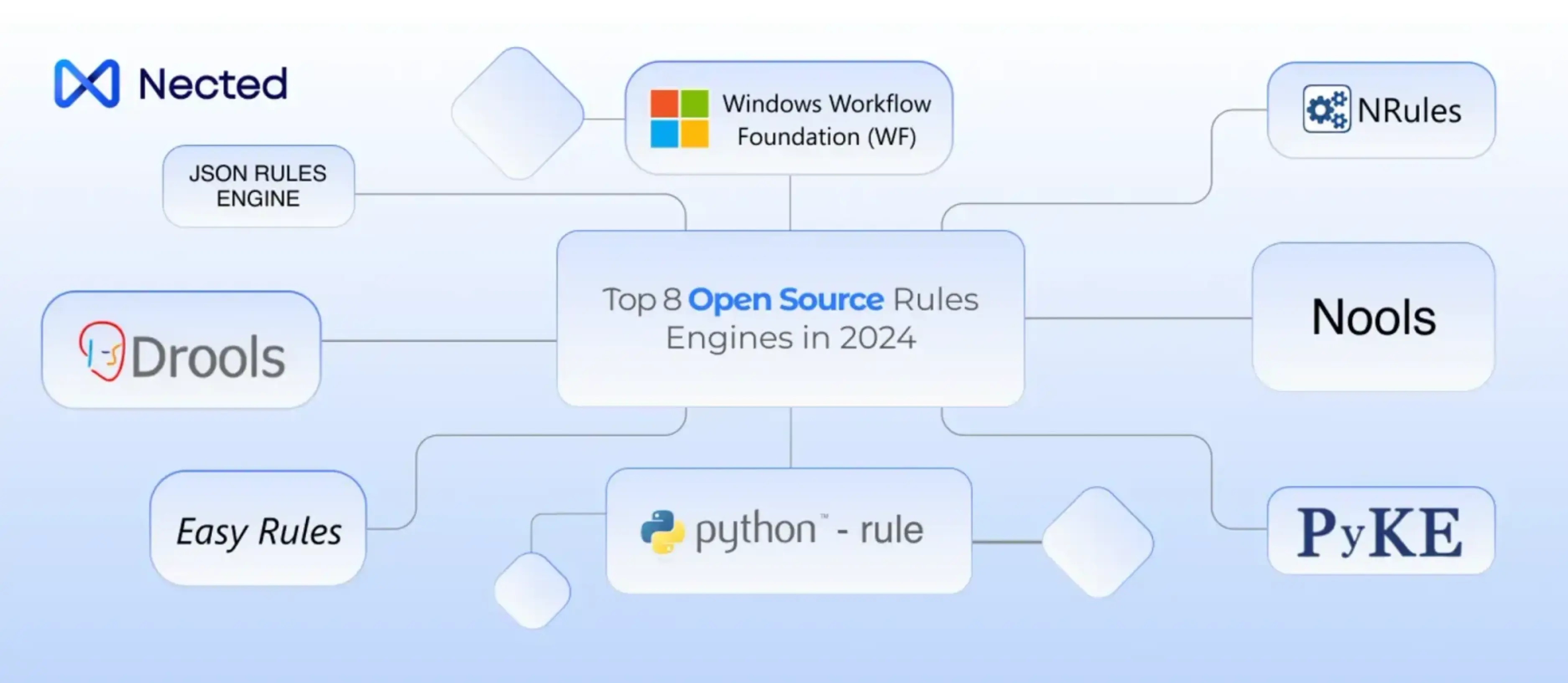
We cover the best open source rule engines in detail in our open source rule engine comparison.
Use Cases of Business Rules Engines
Business rule engines show up in the same places over and over because the problems are similar. High volume. Lots of edge cases. Not much room for error.
- Financial risk evaluation
- Insurance underwriting
- Pricing engines
- Fraud detection
- Workflow automation
These use cases are usually where teams first feel the pain of hardcoded logic. This is where things usually break.
How to choose the best business rules management system?
Picking the right BRMS usually comes down to a few practical things: how the rules get deployed, how easy it is to maintain them, and whether the tool fits the way your team already works.
- Rule deployments: Check whether it supports manual, service-based, web-based, or no-code deployments.
- Import/export features: Excel, XML, CSV, and JSON support can save a lot of time.
- Performance: The engine should stay reliable when rule volume grows.
- Integration: It needs to fit into your current systems without too much glue work.
- Scalability: Useful now, but also usable later when things get bigger.
- Ease of use: Non-technical users should be able to manage basic changes.
- Support: Documentation and actual support both matter.
- Pricing: Cheap tools can get expensive after integration and maintenance.
- Vendor reputation: A stable vendor is less likely to leave you stuck later.
- User reviews: Real feedback usually tells you more than feature lists do.
That's usually the point where teams realize the "best" tool is the one they'll actually keep using.
Read Also:- SQL Rule Engine | PHP workflow Engine
Comparison of Traditional vs Advanced BREs Workflow
Contrastingly, advanced BREs, such as Nected, introduce a more dynamic and flexible approach to handling business logic. They leverage modern technologies like AI and machine learning to adapt and learn from data, making real-time decisions without the need for constant manual updates. This evolution in technology addresses many of the limitations inherent in traditional BREs:
- Complexity Management: Advanced Business Rules Engines (BREs) like Nected employ adaptive algorithms that simplify rule definition and maintenance, adjusting rules based on real-world outcomes and interactions.
- Customizability and JS Code: Modern BREs offer flexibility through customizable JavaScript code, enabling developers to tailor rules and workflows to specific business needs.
- Performance and Scalability: Advanced BREs are optimized for performance, leveraging distributed computing and modern architectures to ensure scalability and responsiveness, even under high load or with complex rule sets. To learn more about Nected's performance and scalability, visit our blog for a detailed analysis of load testing and performance benchmarking.
- Actions and Workflow Compatibility: Modern BREs are designed to be compatible with a wide range of actions and workflows, ensuring seamless integration with existing systems and processes.
- User-Friendly Interfaces: Advanced BREs feature intuitive, non-technical interfaces that reduce the learning curve and dependence on specialized expertise.
- Data Integration: Modern BREs support data integration from multiple sources, enabling more informed decision-making and efficient processes.
- Integration Methods: Advanced BREs offer various integration methods, such as API, event queues, and schedulers, ensuring compatibility with a wide range of technologies and platforms.
- On-Premise Access and Audit Trails: Modern BREs provide on-premise access control and audit trails, ensuring security and accountability.
- Data Fetch: Advanced BREs enable efficient data fetching, reducing the time and effort required to gather and process information.
- Rule Definition: Modern BREs simplify rule definition, allowing for more efficient and accurate decision-making.
- Sector Agnostic: Advanced BREs are versatile and can be used across multiple sectors, enabling a wide range of use cases to be built.
Before moving towards an advanced BRE like Nected, organizations should assess their specific needs against these considerations. This includes understanding the intricacies of their operational processes, integration requirements, and the potential for scalability and flexibility offered by modern solutions. Moreover, evaluating vendor support, community presence, compliance capabilities, and the overall cost-benefit analysis remains crucial.
In summary, while traditional BREs have served well in the past, the dynamic nature of today's business environment calls for more adaptable, efficient, and user-friendly solutions. Advanced BREs like Nected offer an evolution in managing business logic, promising enhanced decision-making, operational efficiency, and strategic alignment with future technological landscapes. This shift not only addresses the limitations of traditional systems but also opens new avenues for innovation and growth.
Read Also:- How to choose the Best Workflow Automation Software?


.svg.webp)

.webp)



.webp)