.svg)

.svg)
.webp)


.png)
.webp)
Rule-based inference engines or simply inference engines form a foundational pillar in the realm of knowledge-based systems. At their core, these engines operate on a set of explicit rules—encoded knowledge that dictates how conclusions or decisions are derived from given data or facts. These engines offer several advantages and help organizations increase their operational efficiency.
Rule-based inference engines rely on predefined rules and logical reasoning to derive conclusions or recommendations from input data. They provide transparency and interpretability, making decision-making processes clear and understandable. They are characterized by modularity and scalability, allowing rules to be added or modified independently. This flexibility facilitates system growth over time.
These engines excel in domain-specific reasoning, where decisions must adhere to specific rules tailored for applications like medicine or finance. They enable real-time decision-making capabilities by efficiently executing rules, ensuring quick responses to dynamic inputs.
If you're developing your rule-based inference engine, it's crucial to understand its various aspects thoroughly. This article will guide you through exploring rule-based inference engines, covering their mechanics, benefits, and practical uses.
Additionally, you'll discover Nected, a no-code/low-code rule-based inference engine tool. This tool simplifies the creation of rule engines, making it easier to automate your tasks effectively.
What is a Rule-Based Inference Engine?
Inference Engine of a Rule-Based System is a decision-support system that uses the specified rules to process certain information and automatically come up with a result. It represents the reasoning element in rule-based systems because it evaluates conditions and implements logic based on the information provided.
Rule-Based Reasoning Explained
Rule-based reasoning follows logical IF-THEN statements.
Example:
IF customer_age < 18
THEN reject_application
The inference engine evaluates available facts against defined rules and generates outcomes automatically.
Rule-Based Systems vs Traditional Programming
Conventional systems include the decision-making logic within the source code.
The rule-based systems separate the decision-making logic from the application logic, enabling users to modify the decisions without affecting the basic application.
How a Rule-Based Inference Engine Works
A rule-based inference engine uses a well-defined reasoning process where facts are evaluated and matched to rules, and actions are taken automatically.
Facts and Knowledge Base
Facts represent the current state of information available to the system.
Examples:
- Customer age
- Account balance
- Loan amount
- Transaction value
If there is a match, the rule is eligible to be executed.
Rule Matching Process
The engine matches the facts with the set rules.
Example:
IF loan_amount > 500000
AND credit_score < 650
THEN mark_high_risk
When conditions match, the rule becomes eligible for execution.
Inference and Decision Execution
After identifying matching rules, the engine generates conclusions and triggers actions such as:
- Approval decisions
- Risk scores
- Alerts
- Workflow actions
- Policy validations
Core Components of a Rule-Based Inference Engine
Some key features of a rule-based inference engine are necessary to perform tasks involving data evaluation, business rules application, and the generation of decisions. The following is a list of some major components of a rule-based inference engine.
Knowledge Base
The knowledge base is the starting point for building an inference engine. Business facts and domain knowledge, as well as any other relevant information needed for decision making is stored in this repository. This component provides the necessary context that the inference engine uses to evaluate conditions and make conclusions. Changes in the business environment can be incorporated into the knowledge base through the use of new data.
Rule Repository
This component provides for the central storage and management of the business rules. In addition, it makes it possible for different teams to update the decision logic without having to change application code.
Inference Engine
The inference engine is the reasoning component of the system. It evaluates available facts against predefined rules, identifies applicable conditions, resolves conflicts when multiple rules are triggered, and generates decisions or recommendations. Through the automation of the reasoning process, the inference engine facilitates decision-making on a continuous basis.
Working Memory
The Working memory is a temporary storage place where all facts, data, and intermediate outcomes are stored when evaluating rules. Facts and data are added to the Working memory as rules get evaluated, and more facts can be derived and stored as well.
Forward Chaining vs Backward Chaining
Rule-based inference engines use different reasoning approaches to evaluate facts and generate decisions. The two most common methods are forward chaining and backward chaining. While both rely on predefined rules, they differ in how they process information and arrive at conclusions.
Forward Chaining
Forward chaining is a data-driven reasoning approach that starts with known facts and works toward a conclusion. The inference engine evaluates available data against predefined rules and continues applying matching rules until no further conclusions can be derived.
For example, in a fraud detection system, a transaction may trigger multiple fraud rules based on transaction value, location, and user behavior. As new facts are generated, additional rules may be evaluated until a final risk decision is reached.
Forward chaining is commonly used in real-time decision-making systems, workflow automation, event processing, and monitoring applications where new data continuously enters the system.
Backward Chaining
Backward chaining is a goal-driven reasoning approach that starts with a desired outcome and works backward to determine whether the available facts support that conclusion. Instead of checking all possible rules, the algorithm will attempt to prove or disprove a particular goal.
For instance, in a lending decision-making process, the inference engine can start from the goal of checking whether a client is eligible for the loan based on the specified parameters. These include such factors as the credit score, income level, and liabilities.
Backward chaining is widely applied in expert systems, diagnosis, troubleshooting, and recommendations when the result needs to be proved.
When to Use Each Approach
It is important to determine which approach to choose depending on the business case. Forward chaining works well when there is a need to trigger decisions automatically as new data becomes available. Backward chaining is better suited for the validation of a particular result or answering the target question.
Forward chaining can be utilized by companies to detect fraud, automate workflows, and create event-driven systems, while backward chaining is widely employed in diagnosis, eligibility determination, expert systems, and recommendation engines.
Rule-Based Inference Engine Architecture
Rule-based inference engines have multiple layers working together in processing data, evaluating rules, making decisions, and integrating results into the business systems. The architecture allows companies to automate their decision-making while still having scalability and control.
Rule Evaluation Layer
The rule evaluation layer involves the assessment of incoming facts according to predefined business rules. The layer constantly assesses conditions, recognizes relevant rules, and identifies those actions that must be performed. In cases when multiple rules can apply to a certain situation, there are conflict resolution techniques that help to determine which rule to choose for execution.
This layer becomes the main reasoner of the entire system, making sure that consistent application of business logic takes place during each decision process.
Decision Processing Layer
After the rule evaluation has taken place, the decision processing layer transforms the outcome into a relevant business decision. This decision might involve an approval, recommendation, risk categorization, alerting, routing, or workflow action.
The transformation of a rule evaluation into a business output helps companies to make automated decisions while preserving their accuracy and consistency.
Integration Layer
The integration layer helps to connect the inference engine to other systems such as applications, APIs, databases, workflow engines, and third-party services. Thanks to this connection, the inference engine is able to exchange data, trigger actions, and share decision outcomes with other parts of the technology infrastructure.
Read Also: Rule the Automation Realm with Cloud-based Rule Engine
Core Functionality and Workflow of Rule-Based Inference Engines
Rule-based inference engines operate through a systematic process of evaluating predefined rules against factual data to generate decisions or conclusions. This structured approach, bolstered by mechanisms for resolving conflicts and prioritizing rules, enables these engines to efficiently automate decision-making across diverse applications.
The inference process in a rule-based inference engine involves applying rules to facts to derive conclusions or make decisions.
Here's a step-by-step explanation:
- Input Facts: The process begins with a set of initial facts or data, known as the fact base. These facts represent the current state or conditions that the inference engine will evaluate.
- Rule Evaluation: The inference engine retrieves rules from the rule base. Each rule consists of a condition (if-part) and an action or conclusion (then-part).
- Matching Rules: The engine matches the conditions of each rule against the current facts in the fact base. Rules whose conditions are satisfied by the facts are considered applicable.
- Rule Application: Applicable rules are then executed. This involves triggering the actions or conclusions specified in the rules' then-part based on the conditions being met.
Output: The result of applying the rules is the generation of new facts or conclusions, which may be added to the fact base for further inference cycles or used as final decisions or outputs.
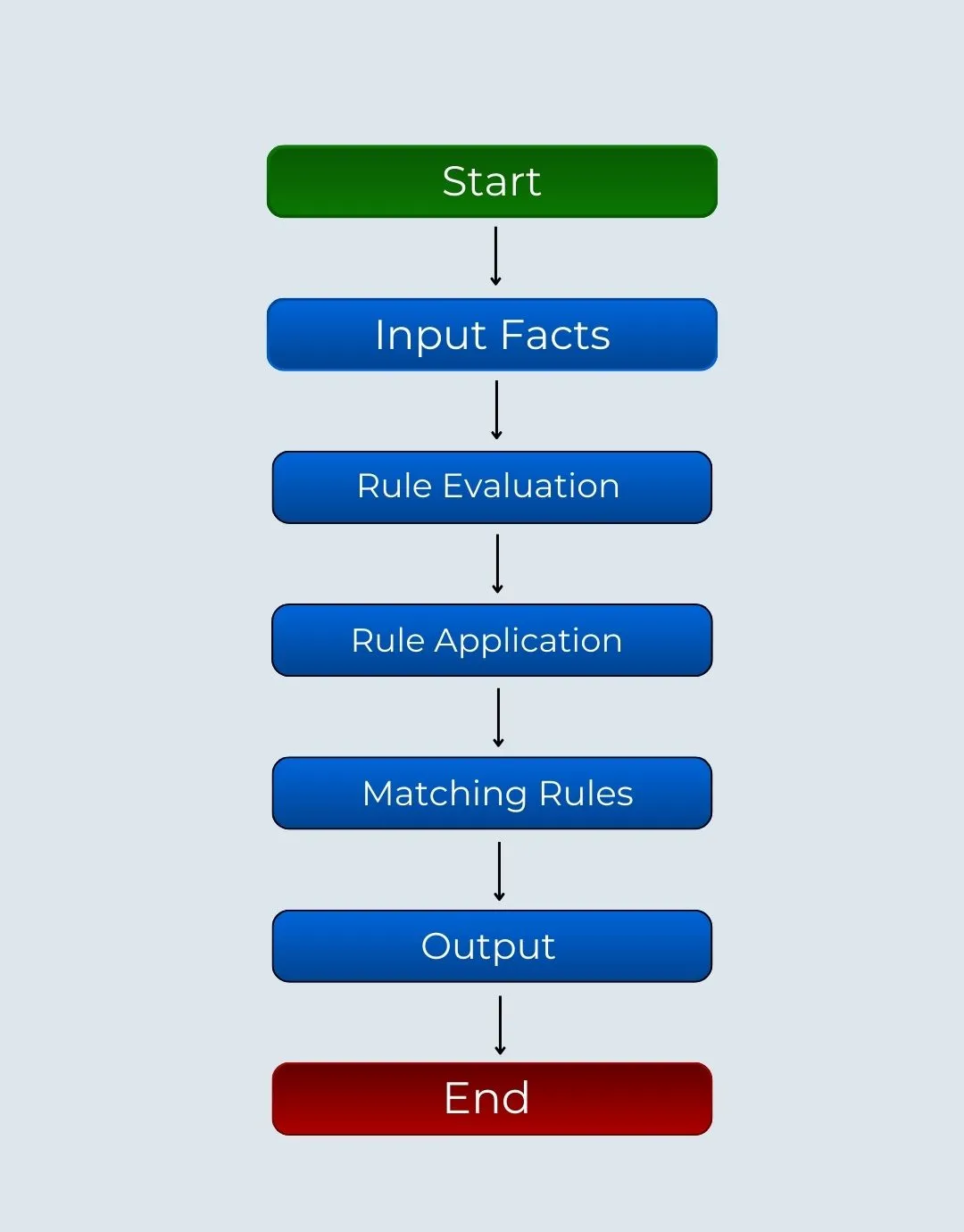
What is the Rule Execution Cycle?
The Rule Execution Cycle refers to the sequence of steps that a rule-based system follows to process input data, apply rules, and derive conclusions or actions. It outlines how the system interprets rules, evaluates conditions, and executes actions based on the current state of knowledge (facts) and the rules defined in its knowledge base.
The rule execution cycle encompasses the following steps:
- Rule Retrieval: The inference engine accesses the rule base to retrieve all relevant rules for the current inference cycle.
- Condition Evaluation: For each rule retrieved, the engine evaluates its conditions against the facts in the fact base. This determines if the rule's conditions are satisfied or not.
- Conflict Resolution: If multiple rules are applicable (conditions satisfied), a conflict resolution mechanism determines which rule takes precedence. This can be based on rule priorities, specificity, or other predefined criteria.
- Action Execution: The actions specified in the then-part of the selected rules are executed. These actions could include updating the fact base with new information, triggering external processes, or generating outputs.
- Handling Rule Updates: After rule execution, the system may update the fact base with new facts derived from the inference process, preparing for the next cycle of inference.
Read Also: Dynamic Pricing Rule Engine: The Key to Ecommerce Success
How to Handle Rule Conflicts and Prioritization?
Handling rule conflicts and prioritization in rule-based inference engines is crucial for ensuring consistent and predictable behavior. Here are common strategies and techniques used for conflict resolution and prioritization:
- Priority-Based Conflict Resolution: Assign priorities to rules based on their importance or criticality in decision-making. Higher priority rules take precedence over lower priority rules when conflicts occur.
- Explicit Rule Prioritization: Rules can specify their priority using attributes or annotations, giving developers control over execution order.
- Rule Groups or Modules: Group related rules into modules or categories, controlling the order of execution within each module for consistency.
- User-Defined Priorities: Users can set priorities for rules based on specific needs or domain knowledge, customizing rule execution behavior as required.
- Specificity-Based Conflict Resolution: Rules can be ranked based on their specificity. More specific rules (rules with more conditions or constraints) are prioritized over more general rules. This ensures that rules that match more precisely to the current state of facts are applied first.
- Temporal Order: Rules can be ordered based on the time of creation or modification. In case of conflicts, the rule that was defined or modified most recently might take precedence.
- Rule Salience: Some rule-based systems allow rules to have a salience value associated with them, which indicates their relative importance or execution order. Rules with higher salience values are executed first.
- Lexicographical Order: Rules can be sorted alphabetically or numerically based on predefined attributes. This can be useful in cases where no other priority scheme is available or applicable.
Practical Applications and Use Cases of Rule-Based Inference Engines
Rule-based inference engines find application in various domains where decision-making can be structured into explicit rules. Some practical use cases include:
1. Expert Systems: Deployed in fields such as medicine, finance, and law to mimic human decision-making processes based on established rules and domain knowledge.
2. Business Rules Management: Used in business processes to enforce policies, automate workflows, and ensure regulatory compliance.
3. Automated Diagnosis and Troubleshooting: Applied in technical support systems to diagnose issues and recommend solutions based on predefined rules.
4. Personalization Engines: Employed in e-commerce and content recommendation systems to personalize user experiences based on behavior and preferences.
5. Fraud Detection: Utilized in financial institutions to detect suspicious transactions or activities based on predefined fraud detection rules.
6. Decision Support Systems: Integrated into operational systems to provide real-time decision support by applying rules to incoming data streams.
Advanced Features and Customization of Rule-Based Inference Engines
Advanced features and customization options enhance the flexibility and functionality of rule-based inference engines:
1. Rule Authoring Tools: User-friendly interfaces for defining, managing, and testing rules without requiring deep programming knowledge.
2. Rule Templates: Predefined rule templates that simplify the creation of common rule patterns, speeding up rule development.
3. Rule Versioning and Auditing: Capability to track changes to rules over time, ensuring traceability and compliance with auditing requirements.
4. Integration Capabilities: APIs and connectors for seamless integration with existing systems and data sources, enabling interoperability.
5. Advanced Rule Engine Algorithms: Optimized algorithms for efficient rule execution, handling large volumes of rules and data with minimal latency.
6. Scalability and Performance: Ability to scale horizontally to handle increased workload and optimize performance through parallel rule evaluation.
7. Adaptive Rule Management: Techniques for dynamically adjusting rule behavior based on real-time data and user feedback, improving system adaptability.
8. Transparent Decision Making: All decisions are based on particular facts and rules that cause the decision to be made. The process becomes more transparent, easier to audit, and helps in meeting the compliance needs of organizations.
9. Faster Decision Automation: Inference engines automatically evaluate data and execute rules in real time. This reduces manual effort and enables faster responses to business events and customer requests.
10. Centralized Rule Management: Business rules are managed from a single repository instead of being scattered across applications. This simplifies updates, improves governance, and ensures consistent decision-making.
11. Less Development Work: Decision logic can be changed without any changes in the application code. This will help in quicker implementation, lower cost, and less dependence on developers.
Rule-Based Inference Engine vs Hardcoded Decision Logic
The firms can choose to either go with the rule-based inference engine model or the conventional hardwired logic system. While the latter option is appropriate in simple situations, the former is more flexible, scalable, and easier to maintain in complex decision scenarios.
Flexibility
It enables independent changes in business rules without having to make any changes to the application code.
Scalability
The approach is capable of handling large volumes of rules and decision-making situations better compared to hardcoded conditional statements.
Maintainability
Having decision logic centralized in one place (in a rule repository) makes it easier to manage it in the long run.
Rule-Based Inference Engine Best Practices
In order to construct scalable and robust inference systems, there are some best practices that need to be followed.
Rule Versioning
Manage versions of the business rules in order to keep track of changes and provide better governance when decisions change over time.
Auditability
Log history of rule execution, decisions made, and facts used as evidence to provide better transparency, facilitate the audit process, and ensure compliance.
Rule Performance Optimization
Improve the structure of the rules, minimize unnecessary computations, and focus on optimization of rule execution.
Rule Governance
Define rule owners, approval, and review process to make sure that business rules are correct and up-to-date.
Read Also: Rules Engine Design Pattern: A Comprehensive Guide
Implementing a Rule-Based Inference Engine Using Nected
Implementing a rule-based inference engine can be streamlined with tools like Nected, which simplifies the creation of sophisticated rule engines. Nected offers a user-friendly platform that enables the development and deployment of advanced rule-based systems without extensive coding knowledge.
To learn how you can use Nected to build sophisticated rule-based systems, you can know more about the following use cases.
1. Banking Rule Engine: Automates decision-making in banks for processes like loan approvals and risk assessment, enhancing efficiency and customer service.
2. Healthcare Rule Engine: Aids medical decision-making by integrating clinical guidelines and patient data, improving patient outcomes and data management.
3. Rule Engine Microservice: Scales systems by offering rule-based decision-making as a modular service, enhancing agility and consistency across applications.
4. Salesforce Business Rules: Automates decision-making in Salesforce CRM, ensuring efficiency, compliance, and enhanced customer interactions.
Using Nected to build advanced rule engines brings several benefits, such as:
- Ease of Use: Nected offers a user-friendly interface that simplifies the creation and management of rule-based systems, allowing users with varying technical expertise to participate in the process.
- No-Code/Low-Code Environment: Nected provides a user-friendly interface that allows users to define and manage rules without deep programming skills, making it accessible to both technical and non-technical users.
- Rule Authoring: It offers intuitive tools for authoring rules using a graphical interface, including drag-and-drop functionality to define conditions and actions.
- Integration Capabilities: The platform supports seamless integration with external systems and APIs, enabling rule engines to interact with diverse data sources and applications.
- Version Control: Nected includes versioning capabilities to track changes in rules over time, ensuring transparency and facilitating rollback to previous versions if needed.
- Scalability: It is designed to handle scalable deployments, allowing rule engines to grow with increasing complexity and volume of rules and data.
- Performance Optimization: Nected optimizes rule execution for performance, ensuring efficient processing of rules even in scenarios with high data throughput.
- Monitoring and Analytics: The platform offers monitoring and analytics tools to track rule performance, identify bottlenecks, and optimize rule sets for better decision-making.
Conclusion
Rule-based inference engines facilitate transparent and efficient decision-making processes by automating tasks and enabling quick responses in real-time scenarios. Mastering rule-based inference engines involves understanding their fundamental principles, applications, and how to use their capabilities to enhance decision-making in different areas.
If you're interested in leveraging the benefits of rule-based inference engines, consider choosing Nected. Whether you want to streamline operations, enhance efficiency, or innovate in your industry, Nected provides a user-friendly platform to develop robust rule engines tailored to your specific needs.
Nected stands out as a powerful tool for building rule-based inference engines, designed for both beginners and experienced developers. It simplifies the creation and deployment of rule engines, allowing effective task automation without requiring extensive programming skills.
By adopting Nected, you can enable your organization with advanced decision-making capabilities, fostering smarter and more responsive systems that drive success.
Start using Nected and build different rule-based inference engines today.
Rule Based Inference Engine FAQs
Q1: What types of rules can be defined in a rule-based inference engine?
Rule-based inference engines define rules using conditional statements (if-then rules). These rules specify actions to be taken when certain conditions are met, allowing for logical decision-making.
Q2: How are rules typically defined and managed in a rule-based inference engine?
Rules are usually defined and managed within a rule base, a repository where rules are stored and organized. They can be added, modified, or removed as the application's logic evolves.
Q3: How does a rule-based inference engine handle conflicting or overlapping rules?
Rule-based inference engines employ conflict resolution strategies to manage conflicting or overlapping rules. This includes prioritizing rules based on factors like specificity, order, or user-defined priorities.
Q4: What is the performance impact of using a rule-based inference engine?
Rule-based inference engines are designed to be efficient, with performance impacts varying based on factors such as the complexity of rules and the volume of data processed. They typically offer rapid decision-making capabilities suitable for real-time applications.
Q5: How can I integrate a rule-based inference engine into my Java application?
Integrating a rule-based inference engine into a Java application involves using libraries or frameworks that support rule execution. These frameworks provide APIs or interfaces for seamless integration, allowing developers to leverage rule-based logic within their Java codebase.


.webp)
.svg.webp)

%2520(3).webp)
.webp)


.webp)


.webp)