.svg)

.svg)
.webp)



.png)

Business logic doesn't arrive complicated. It starts as three or four if statements sitting next to the code they affect. Six months in, it's a few hundred lines deep, nested three levels, and the only person who fully understands why threshold X is 50000 and not 40000 left the team in March. Nobody wants to touch the file, so nobody does - until a bug forces someone to.
The rule engine design pattern exists to stop that specific decay. It's not a fancy word for "put your conditionals in a function." It's a structural decision: decision logic and the code that runs your application become two separate things, connected through a defined interface instead of tangled together. This piece covers what that separation actually looks like - the components, the layered architecture, how execution flows through the system, and a worked example you can map onto your own codebase.
What Is a Rule Engine Design Pattern?
It's a pattern where an engine evaluates rules, and the two don't know anything about each other's internals. The engine doesn't care what a specific rule checks for. A rule doesn't care how the engine is implemented. They meet at one interface: facts go in, results come out.
At the simplest level, you have an evaluator that loops through a rule set. Each rule is a condition plus an action. If the condition matches the facts it's given, the action fires. The application that called the engine doesn't need to know which rules exist, how many there are, or what changed since last week - it just hands over facts and reads back a result.
That last part is the whole point. Rules live outside the compiled application - in a database, a config file, or a rule management system - so changing one is a data write, not a code change. No pull request, no CI pipeline, no deployment window. This matters most when a single piece of input needs to trigger several different actions depending on context, or when the people who understand the business logic (pricing, underwriting, eligibility) aren't the people who can ship code.
The Core Components of a Rule Engine
Strip away the language and framework differences, and every rule engine is built from the same handful of pieces.
Facts are the runtime data the engine reasons over - a user's role, an account balance, a timestamp, a transaction amount. Facts are just data; they carry no logic of their own.
Conditions are the checks a rule makes against those facts - equality, range comparisons, membership checks, combined with AND/OR/NOT. A processing engine resolves the boolean logic across all of a rule's conditions to decide whether the rule as a whole passes.
Actions are what happens once a condition passes - anything from flipping a flag in memory to calling a downstream service. Execution services are what actually carry that out, deliberately kept separate from the logic that decided the action should run.
The engine itself is the orchestrator: it takes facts as input, runs them against the rule collection, and triggers whichever actions match. In most non-trivial implementations, specific trigger types get their own evaluation services rather than one monolithic condition-checker - a design choice that keeps the logic composable as the rule set grows, instead of turning the evaluator itself into the next unmaintainable file.
None of this is complicated in isolation. It gets complicated in combination, which is what the architecture section below is actually about.
Related reading: Top Open Source Rule Engines
Rule Engine Architecture: The Five Layers
Rule engine architecture is layered on purpose - each layer has one job, and they talk to each other through defined interfaces rather than reaching into each other's internals. That separation is what lets each layer fail, scale, and change independently instead of taking the whole system down with it.
Rule Repository. Where rules actually live - a relational database, a document store, flat config files, or a dedicated rule management system. The one non-negotiable requirement: rules have to be retrievable at runtime with no deployment involved. If updating a rule still requires a code push somewhere in the chain, the architecture hasn't actually decoupled anything - it's just moved the coupling.
Rule Engine Core. The orchestrator. It loads rule definitions from the repository, manages the evaluation lifecycle, and coordinates between the inference engine and the execution layer. This is the layer most implementations quietly overload - teams start bolting caching, validation, and business logic onto the core until it's doing everyone's job. A clean core does three things: receive facts, coordinate evaluation, return results. Nothing else.
Inference Engine. Where the actual condition-matching happens. It takes the facts and the rule conditions and works out which rules apply. Two strategies show up here: forward chaining starts from the facts and works toward conclusions, which is what most production decision-automation systems use; backward chaining starts from a goal and checks whether the facts support it, more common in expert systems than business rule engines. If you're building for pricing, eligibility, or fraud decisions, you're almost certainly implementing forward chaining.
Execution Layer. Runs the actions for whichever rules fired. Keeping this separate from inference isn't a stylistic choice - evaluation and execution fail in genuinely different ways, and conflating them makes debugging worse. An evaluation failure means a rule didn't match correctly against the facts. An execution failure means a rule matched fine, but the action it triggered - a downstream API call, a database write - failed afterward. Those are different bugs with different fixes, and a single error type covering both means you're guessing at the cause every time something breaks.
API Layer. The interface between the calling application and everything above. It accepts facts, returns evaluation results or events, and - in most real implementations - also exposes the rule engine's management operations (create, update, delete, version) for whatever admin interface sits on top. In a microservices setup, this is usually a REST or gRPC endpoint; in an embedded engine, it's just a library call.
Also read: Top 7 Python Rule Engines
Rule Engine Architecture Diagram
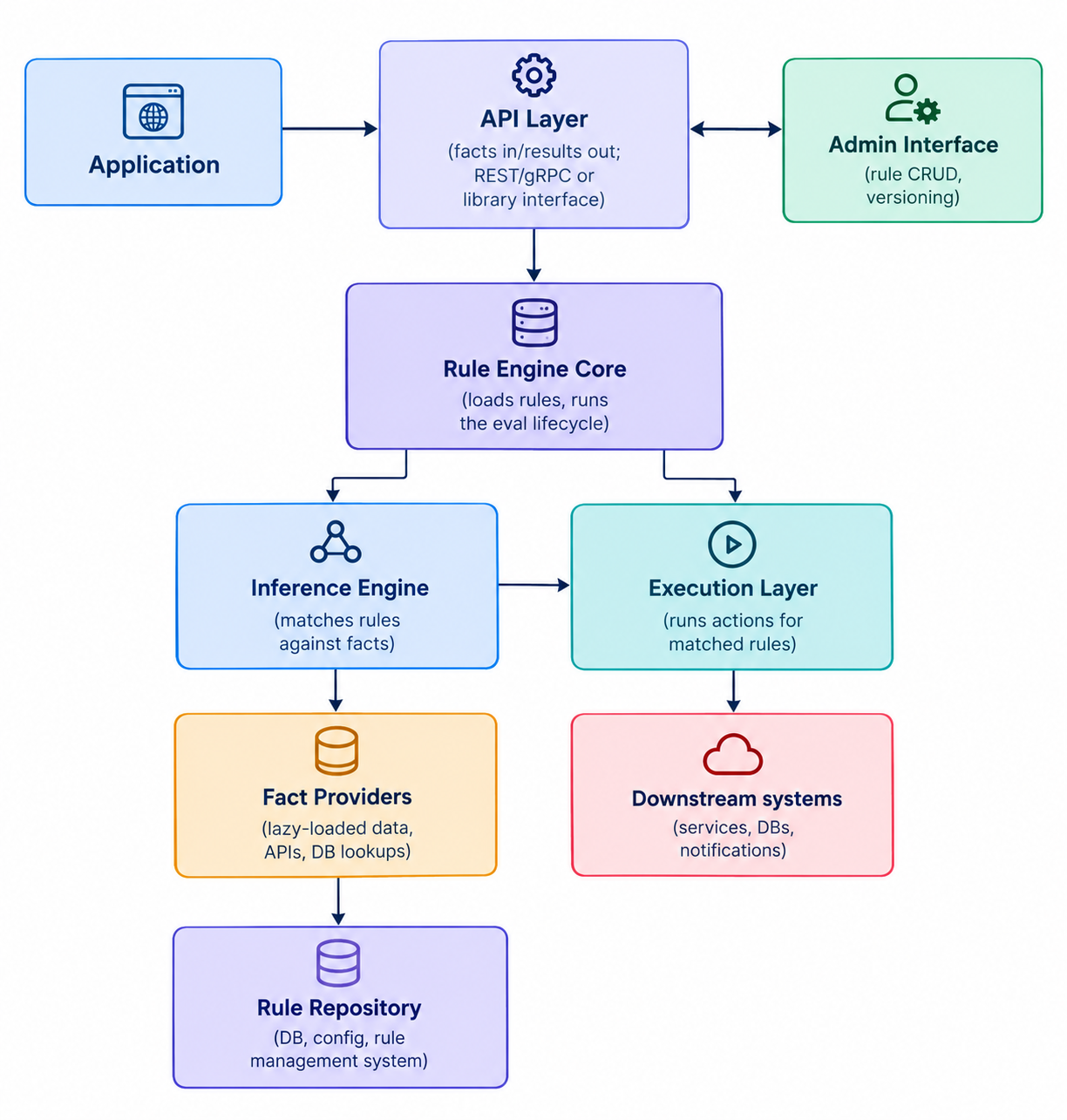
Facts flow in through the API layer. The core hands them to the inference engine, which pulls rule definitions from the repository and pulls additional fact data lazily, only when a rule actually needs it. Whatever matches gets handed to the execution layer, which is the only piece of the diagram that ever touches a downstream system. If you're briefing a designer on the visual version of this, that hand-off point - inference decides, execution acts - is the one relationship worth making visually obvious.
Rule Engine System Design
Rule engine architecture describes the pieces. System design is about the decisions you make with them once volume, latency, and organizational structure enter the picture.
Embedded vs. standalone. An embedded engine runs inside your application process, loading rules on startup or fetching them on demand. Lower latency, simpler to deploy, but it scales and gets monitored as part of the app it's embedded in - you can't reason about it independently. A standalone engine runs as its own service, called over the network. That adds latency per call and another service to operate, but it can scale on its own, version independently, and serve more than one application. If rule logic is shared across products, standalone is usually the right call regardless of the latency cost.
State and persistence. Rule engines are stateless by design: one evaluation, one set of facts, one result, no memory of the last call. If your use case needs to track something across evaluations - how many times a rule has fired for a given user this month, a running total against a threshold - that state has to live outside the engine, in a database or cache the engine reads from as just another fact.
Performance. Individual evaluations are fast. The cost shows up at scale, when a large rule set runs against high-frequency input. Two things actually move the needle: the Rete algorithm (what Drools and similar engines use) builds a network representation of rule conditions so overlapping checks aren't re-evaluated from scratch on every pass, and lazy fact loading defers expensive lookups - external API calls, DB queries - until a rule actually needs that data, instead of front-loading everything for every evaluation whether it's used or not.
Versioning. This has to be designed in from the start, not added after the first bad rollout. Rule versions should be immutable - you don't edit a live version, you publish a new one. Evaluations already in flight should finish against the version they started with, not get switched mid-flight. And rollback needs to be a first-class, one-step operation, not a manual reconstruction of "what the rule looked like before." For anything touching lending, insurance, or fraud decisions, this is also where a compliance review will focus first - a documented, reversible history of exactly what logic ran and when is usually the actual requirement, not a nice-to-have.
How a Rule Engine Works: The Execution Cycle
Facts come in. Rules load from the repository. Conditions get evaluated against the facts. Matching rules fire their actions. Results go back to the caller. Every one of those five steps can fail on its own, and a rule engine that's actually production-ready handles each failure explicitly instead of letting one bad step take down the whole cycle: incomplete or malformed facts, a repository that's temporarily unreachable, a condition erroring on a data type it wasn't expecting, an action that fails after the rule already matched correctly. Lumping all of that into one generic "evaluation failed" error is how a rule engine bug turns into a two-hour debugging session instead of a five-minute one.
Recursive evaluation. Nested conditions - (A AND B) OR (C AND NOT D) - don't evaluate left to right. The engine walks the condition tree depth-first, resolving the innermost sub-expressions first, and each node passes a boolean up to its parent until the whole tree collapses into one match/no-match result.
Rule priority and conflict. When more than one rule matches the same input, something has to decide execution order - usually an explicit priority value (higher fires first) or rule grouping (only the highest-priority match in a group fires at all). Skip this and you get two rules firing on the same conditions with contradictory actions, which is one of the more common production bugs in rule engine systems and one of the harder ones to trace back without solid logging at the inference layer specifically - by the time it surfaces downstream, the actual conflict is two layers removed from where the symptom showed up.
Also read: Rule Engines with Spring Boot
The Pattern in Practice: A Permissions Example
Access control is a clean way to see the pattern working, because the failure mode of the alternative is so familiar: hardcoded permissions mean every policy change is a deployment.
The problem. Four roles - admin, manager, employee, customer - each with different permissions that shift as the product evolves. A manager can approve purchase orders under a dollar threshold; that threshold is exactly the kind of number a finance team will want changed with two days' notice.
The rule-engine approach. Define the check as data, not code:
{
  "id": "rule_manager_approve",
  "conditions": {
    "all": [
      { "fact": "userRole", "operator": "equal", "value": "manager" },
      { "fact": "resourceType", "operator": "equal", "value": "purchase_order" },
      { "fact": "orderValue", "operator": "lessThanInclusive", "value": 50000 }
    ]
  },
  "event": {
    "type": "PERMISSION_GRANTED",
    "params": { "action": "approve" }
  }
}
If the user is a manager, the resource is a purchase order, and the order value is $50,000 or under, approval is granted. Raising that to $75,000 next quarter is a rule update - not a pull request, not a deploy, not a code review cycle.
Building it out:
- Map roles to permissions as a hierarchy - higher roles inherit lower-role permissions - and store that hierarchy as the base of your rule set, not scattered across individual rules.
- Store rules externally, wherever fits your stack, as long as they're loadable at runtime without a restart.
- Wire the engine into the authorization path. On every action attempt, the app assembles the relevant facts and calls the engine; the engine returns which permissions were granted.
- Build a real management interface. This is the step that turns the pattern from an engineering nicety into an actual operational win - authorized non-engineers editing rules directly, without a ticket.
- Version everything. Track changes, keep rollback available, keep an audit history - not as an afterthought, but as part of the initial design.
- Test rule interactions, not just individual rules. Overlapping conditions behave in non-obvious ways once you have more than a handful of rules; isolated unit tests won't catch a conflict that only shows up when two rules both match the same fact set.
Where This Shows Up in Production
Pricing and promotions. E-commerce platforms tie discounts and promotional logic to customer segment, inventory level, and time-based triggers - rules that change often enough that keeping marketing out of the deployment queue is the actual point.
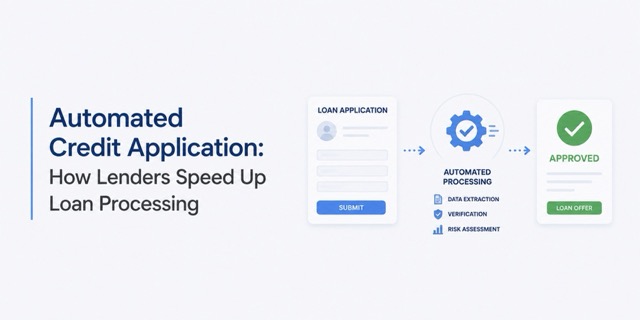
Loan approval. Credit score thresholds, debt-to-income ratios, employment history checks - defined as rules so a regulatory change becomes a rule update, not a code change and a fresh compliance sign-off on the codebase itself.
Insurance claims. Coverage evaluation, deductible math, eligibility checks - logic that shifts with every policy update, externalized so insurers aren't touching the core claims system every time a policy changes.
Content personalization. Recommendation logic driven by viewing history and preference signals, continuously tuned without a redeploy for every adjustment.
Also read: Workflow Rule Engines with PHP
Why Externalize Rules at All
The case for this pattern comes down to three concrete shifts, not five parallel adjectives.
Change becomes a data operation instead of a code operation. A pricing threshold, an eligibility cutoff, a fraud score limit - updating any of these no longer touches the application codebase, which means no code review for a business decision and no deployment window blocking a time-sensitive change.
Non-engineers can own the logic they actually understand. A well-built management interface puts rule changes in front of the people who know the business context - pricing, underwriting, compliance - without routing every change through an engineering queue that has its own priorities.
Auditability comes from centralization, not extra tooling. When every rule lives in one repository with versioning built in, "what changed, when, and who changed it" is a query against that repository instead of a git-blame archaeology project across application code, config files, and whatever spreadsheet someone was tracking changes in on the side.
What this pattern doesn't automatically buy you: performance at scale (that's the Rete/lazy-loading discussion above), or safety from rule conflicts (that's the priority/conflict-resolution discussion above). Externalizing the logic solves a specific problem - where decisions live and how they change - not every problem a growing rule set eventually runs into.
How This Pattern Combines with Others
The rule engine pattern rarely stands alone in a real system:
- Microservices - the engine runs as its own standalone service, scaled and deployed independently of the applications calling it.
- Event-driven architecture - rule evaluation triggers off incoming events, and the results publish back out as new events for downstream consumers.
- Layered architecture - the engine sits as its own explicit layer between application logic and the data layer, rather than being embedded in either.
- Plugin architecture - different rule sets load as swappable plugins, so a configuration change doesn't require touching the engine itself.
Nected's Take on Rule Management
Nected implements this pattern as a platform rather than something you build in-house: rule sets, rule chains, and decision tables cover different ways of modeling the same underlying logic, and the engine connects directly to databases and APIs to pull facts at evaluation time rather than requiring you to pre-assemble them. Custom JavaScript handles the edge cases that don't fit standard condition operators, and output can go out as constants, JSON, or JS formulas depending on what the calling system needs.
Versioning and audit history are built in rather than something you retrofit - which matters given how much of the system design discussion above (immutable versions, first-class rollback, a documented change history) is really an argument for not building that infrastructure yourself unless you have a specific reason to. If you're weighing that build-vs-buy decision, Nected's docs walk through how the rule and decision-table model maps onto the architecture covered here.
FAQ
What is a rule engine design pattern?
A software architecture approach that separates business decision logic from application code. Rules - conditions plus actions - are defined and stored independently, then evaluated at runtime by an engine that takes in facts and fires whatever matches. It's Single Responsibility applied to decision logic: the engine processes, the rules define behavior.
What is rule engine architecture?
The structural breakdown of the components inside a rule engine system: the Rule Repository (storage), the Rule Engine Core (orchestration), the Inference Engine (condition matching), the Execution Layer (running actions), and the API Layer (the interface for facts in, results out). They're deliberately separated so each layer can fail, scale, and change without dragging the others along with it.
What is rule engine design, practically speaking?
It's the set of decisions that turn "we have a rule engine" into "we have a rule engine that survives production" - embedded vs. standalone deployment, how facts get loaded and cached, how rules version and roll back, how conflicts between matching rules resolve, and how the whole thing behaves under load. Skipping these at design time is usually what turns into an incident eighteen months later.
How does the rule engine design pattern differ from plain if-else logic?
If-else logic lives in application code - changing a condition means a code change, a review, and a deployment. Rules in an engine live externally and evaluate dynamically, so changing one is a data write. The pattern also handles a case nested conditionals get ugly fast on: multiple rules matching the same input and multiple actions needing to fire together, without every combination being hand-coded as its own branch.
Can a rule engine handle real-time decisions?
Yes - it's one of the main reasons the pattern exists. Fraud checks, authorization decisions, pricing calculations at request time all run through rule engines synchronously, typically in low milliseconds for a moderate rule set. Very large rule sets or expensive fact lookups are where latency creeps in, and that's exactly what Rete-style matching and lazy fact loading are for.
How does this pattern combine with machine learning?
They solve different problems. Rules encode logic you can write down explicitly; ML models handle patterns that are too complex or implicit to hand-code. In practice, an ML model produces a score - a fraud probability, a risk rating - and the rule engine treats that score as just another fact, firing an action once it crosses a defined threshold. The rules stay auditable; the model handles what rules can't express cleanly.
What should factor into picking a rule engine technology?
Performance under your actual load profile, not a benchmark from someone else's use case. Integration fit with your existing stack. Real rule-management capabilities - versioning, auditing, an interface non-engineers can use - not just an evaluation library. Support model, formal or community. And licensing terms if you're embedding the engine in something you sell - the detail most likely to get skipped early and cause a real problem later.


.svg.webp)
.webp)



.webp)
.webp)











%20(1).webp)