


Business applications rarely make decisions from a single input. A loan application, fraud check, insurance claim, pricing request, or customer eligibility decision can depend on dozens of conditions that change over time.
The engineering problem starts when teams embed those conditions directly into application code. Every policy change then becomes a code change, release, and regression-testing exercise. An inference engine separates the decision logic from the application by evaluating facts against rules and producing a conclusion or action.
An inference engine is the reasoning component of a rule-based system. It takes facts as input, determines which rules match those facts, resolves which matching rules should execute, and fires them to produce decisions or additional facts.
This article explains how that process works, how rule evaluation scales, where forward and backward chaining fit, and how an inference layer can be integrated into a modern application.
What an Inference Engine Actually Does
An inference engine evaluates facts against rules to determine which rules are applicable and what conclusions they produce. It separates decision logic from application code and manages the execution of dependent rules.
The process can be broken down into three steps:
- From Facts to a Decision: The engine evaluates input facts against rule conditions and fires the rules whose conditions are satisfied. A rule can return a decision directly or produce a new fact that becomes input for subsequent rules.
- Rules, Facts, and Derived Facts: Facts represent the current state being evaluated, while rules define conditions and actions. When a rule fires, its output can become a derived fact, which may activate additional rules.
- The Rule-Firing Cycle: The core cycle is match → conflict resolution → fire → update → repeat. The engine identifies matching rules, selects an activation, executes it, updates working memory, and evaluates the resulting state again.
Inside an Inference Engine
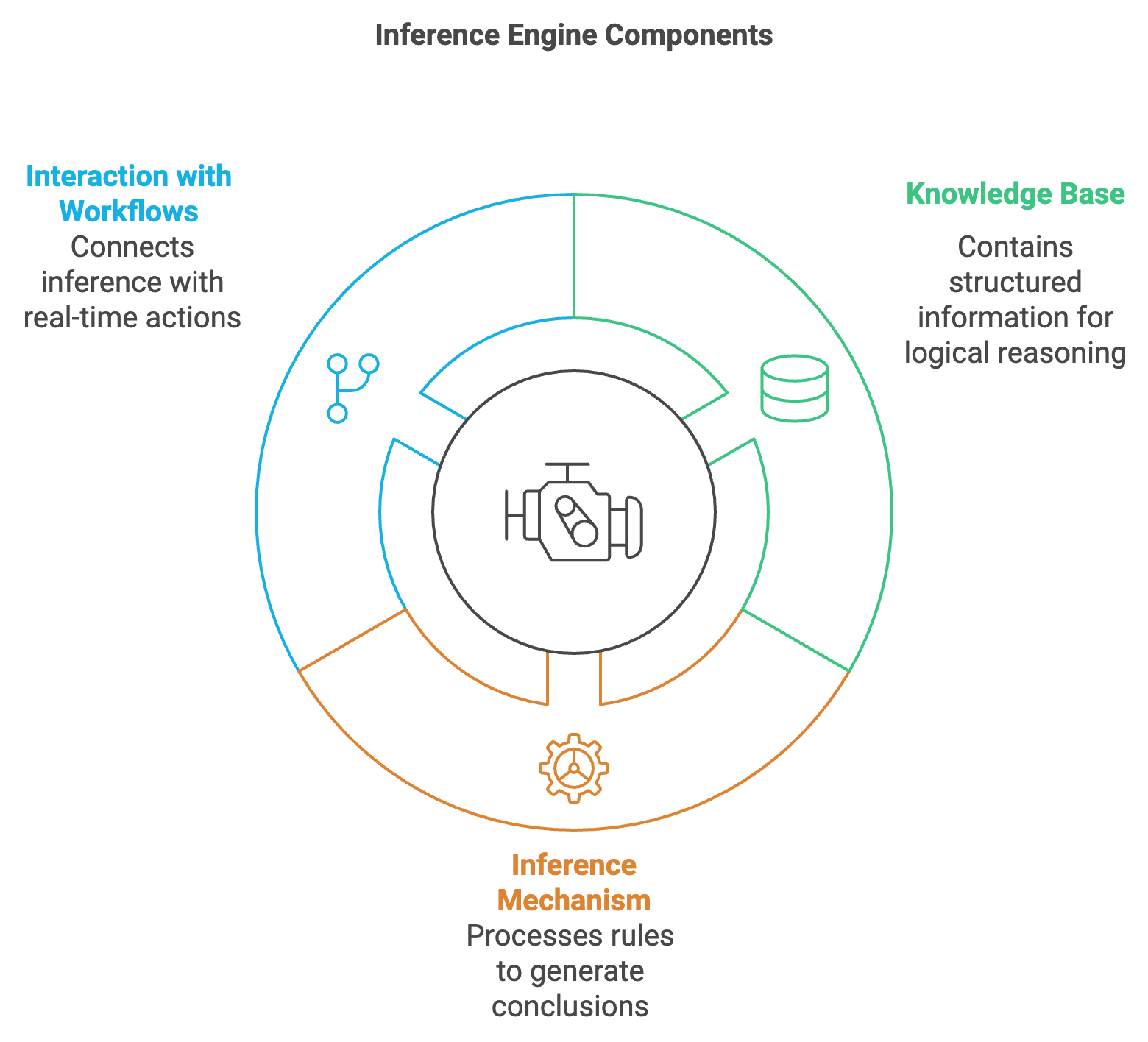
An inference engine separates rule definitions, runtime facts, rule matching, and rule selection. Data moves from the knowledge base and working memory into the inference mechanism, which identifies eligible rules and determines what executes next.
The core components are:
- Knowledge Base: The knowledge base contains the rules and decision logic the engine evaluates. Rules define the conditions, actions, and relationships used to derive decisions from available facts.
- Working Memory: Working memory holds the facts available during an inference session, including application inputs and facts derived by previously fired rules. When a rule changes the state, the updated facts are evaluated against the rule set again.
- Inference Mechanism: The inference mechanism matches working-memory facts against rule conditions to identify which rules are eligible to fire. Depending on the engine, this can use direct evaluation or optimized matching structures such as a Rete network.
- Conflict Set and Rule Selection: When multiple rules match the current working state, they form the conflict set, or agenda, of eligible activations. The engine applies its conflict-resolution strategy, such as rule priority or specificity, to determine which rule fires next.
How Rule Evaluation Scales
As the rule base grows, repeatedly evaluating every rule against working memory can increase execution cost, especially when facts change frequently. A straightforward approach reevaluates rule conditions after each update, which can repeat work unnecessarily.
The Rete algorithm reduces this overhead by organizing conditions into a network and caching partial matches, so changes to working memory can update only the affected parts of the network rather than recomputing every condition from scratch. This works particularly well when rules share conditions and facts change incrementally, but it requires additional memory to maintain those cached matches.
Rete is therefore a workload-dependent optimization, not a universal requirement for scalable rule evaluation; simpler rule sets may perform better with direct or non-Rete evaluation.
Forward Chaining and Backward Chaining
Forward and backward chaining use opposite directions of inference. Forward chaining starts with facts and evaluates rules that those facts activate, while backward chaining starts with a target conclusion and works backward to determine which rules and facts can establish it.
The comparison is:
Choosing the Reasoning Strategy
Use forward chaining when new facts or events should drive the decision process and one rule's output may trigger additional rules. Use backward chaining when the system starts with a specific outcome it needs to establish and should evaluate only the logic relevant to that goal.
The choice is therefore driven by the application's reasoning model: data-driven execution favors forward chaining, while goal-driven evaluation favors backward chaining.
Inference Engine vs Rule Engine
A rule engine manages and executes decision rules. An inference engine evaluates facts against those rules and determines which rules should fire. In many rule-based systems, the inference engine is part of the rule engine.
The distinction comes down to decision logic vs. rule evaluation:
For example, a rule can define:
IF transaction_amount > $10,000
AND customer_risk = "high"
THEN require_manual_review
The rule engine manages and executes this decision logic. The inference engine evaluates the transaction facts, determines that the conditions match, activates the rule, and drives its execution.
Where Inference Engines Fit in a Modern Application
An inference layer sits between application data and the action produced by a decision. The application supplies the facts, the inference layer evaluates them against rules, and the application uses the resulting decision.
The production flow is:
- Application data → Facts: Customer, order, transaction, or account data is passed to the decision layer as facts.
- Facts → Inference: The inference engine evaluates those facts against the applicable rules and determines which rules fire.
- Inference → Decision: The engine returns a decision or derived result, such as eligible = true, discount = 15, or risk = high.
- Decision → Application action: The application uses the result to execute the required action without embedding the decision logic in application code.
- Versioning and traceability: Production systems should record the rule version, inputs, decision, and change history so teams can reproduce decisions, debug failures, and audit changes.
Rule-Based Inference vs AI Model Inference
Rule-based inference and AI model inference both produce decisions from inputs, but they do so differently: rules execute explicit logic, while models generate predictions from learned parameters.
The distinction is clearer across the execution model, source of logic, output, and level of determinism:
Combining Models With Rules
A common production pattern is to use the model for scoring or classification and the rule layer for deterministic policy enforcement.
Transaction
    ↓
Fraud model
    ↓
risk_score = 0.91
    ↓
Rule evaluation
    ↓
manual_review
The rule evaluates the model output like any other input:
IF risk_score > 0.8
THEN require_manual_review
This separates model inference from business policy: the model generates the signal, and the rule determines the resulting action.
Implementing an Inference Layer With Nected
Nected provides an API-driven rule and workflow layer for executing decision logic outside application code. Its current documentation supports Simple Rules, Decision Tables, and RuleSets, with rules able to consume inputs, retrieve data through datasets, and expose decisions through APIs.
The implementation can be structured around four concerns:
- Define decision logic as rules: Use Simple Rules for individual conditions, Decision Tables for condition-to-outcome mappings, and RuleSets for grouped rule logic. For example, loan eligibility can evaluate credit_score >= 700, annual_income >= 80000, and debt_to_income < 0.40 without embedding those conditions in the application.
- Evaluate rules through APIs: A production application sends the required inputs to the published rule and consumes the returned decision. This creates a service boundary between application logic and decision logic, so changing a rule does not require changing the calling application.
- Version and govern decision logic: Once rules control production decisions, changes need traceability. Nected provides staging and production environments, publishing controls, and audit capabilities for changes to rules, RuleSets, datasets, connectors, and related configuration.
- Connect decisions to downstream actions: Rule results can feed Nected workflows that combine rules with database operations, REST APIs, data sources, and other workflow nodes. The resulting architecture is application → rule → decision → workflow → downstream service, allowing the inference layer to participate directly in the application's execution path.
Bottom Line
Inference engines turn changing business rules into executable decisions without embedding that logic in application code. By combining rule evaluation, efficient matching, and traceable decision execution, they provide a practical foundation for production decision systems.
Nected extends this model with API-driven rules and workflows, allowing teams to manage and integrate decision logic independently of application releases.
FAQs
What is an inference engine?
An inference engine is the reasoning component of a rule-based system. It evaluates available facts against rules, identifies applicable rules, executes them, and can derive new facts or decisions.
How does an inference engine work?
It typically loads facts into working memory, matches those facts against rules, selects applicable rules, fires them, updates the working state, and repeats the process until the inference cycle reaches a stopping condition.
What are the main components of an inference engine?
A typical rule-based inference system includes a knowledge base containing rules, working memory containing facts, a matching mechanism, and a rule-selection or conflict-resolution mechanism.
What is the Rete algorithm?
Rete is a rule-matching algorithm that stores partial matches in a network so an engine can avoid repeatedly evaluating unchanged conditions. It can improve performance for workloads with many overlapping rules and incremental fact changes, but it also introduces memory and implementation overhead.
What is the difference between forward and backward chaining?
Forward chaining starts with known facts and derives consequences. Backward chaining starts with a target conclusion and works backward to determine which conditions must be satisfied.
What is the difference between a rule engine and an inference engine?
A rule engine is the broader system used to define and execute rules. The inference engine is the reasoning mechanism within that system that determines which rules match the available facts and how they are executed.
Is AI model inference the same as rule-based inference?
No. Rule-based inference evaluates explicit logic, while ML inference applies a trained model, and LLM inference generates outputs from model parameters and input context. They solve different problems, although they can be combined in the same decision architecture.
Can an inference engine work with machine learning models?
Yes. A model can produce a score, prediction, or classification that becomes an input to deterministic rules. The rules can then apply business constraints to that model output.
Where are inference engines used?
They are commonly used for eligibility, approvals, fraud and risk decisions, pricing, personalization, routing, claims processing, and other applications where decisions depend on changing business rules.