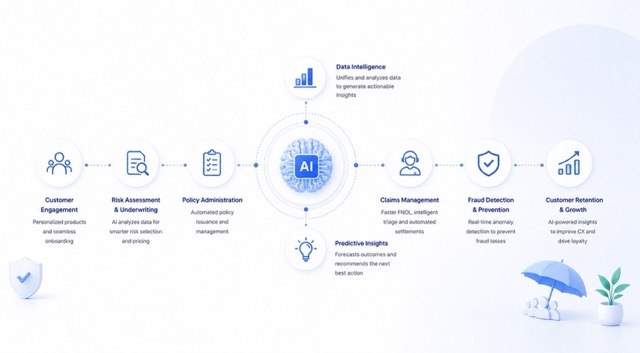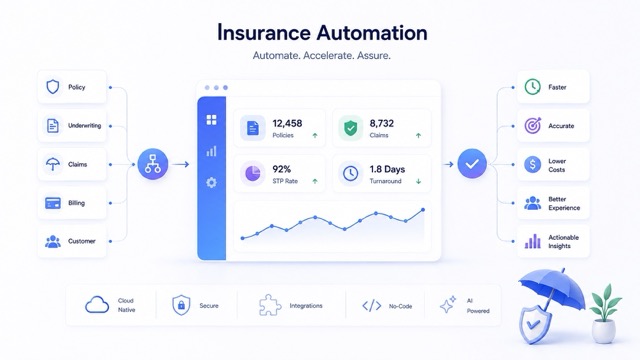


Insurance automation software helps carriers automate decisions and processes across underwriting, claims, policy servicing, billing, document handling, and customer operations.
But insurance automation does not always mean replacing the insurance core. A carrier may need a new policy administration platform, or it may simply need to automate a claims workflow that currently moves between a core system, email, documents, databases, and human reviewers.
That architectural distinction matters when evaluating insurance automation software. Guidewire and Duck Creek operate at the insurance-core layer. Appian focuses on process orchestration across systems. Pega combines workflow, case management, and decisioning. Nected provides a backend rules and workflow layer that can sit alongside an existing insurance stack.
This guide compares five platforms based on their automation scope, insurance functionality, decisioning capabilities, workflow orchestration, integrations, deployment options, and fit for modern U.S. insurance operations.
How We Evaluated These Insurance Automation Platforms
The evaluation considers:
- Automation scope: Whether the platform automates core insurance functions, cross-system processes, business decisions, or operational workflows.
- Insurance functionality: Coverage of policy administration, claims, billing, rating, underwriting, and servicing.
- Decisioning: Support for business rules, eligibility, risk decisions, routing, pricing, and other deterministic decisions.
- Workflow orchestration: Ability to coordinate systems, data, AI, employees, and automated actions.
- Integration model: APIs, databases, core-system integrations, external data, documents, and third-party applications.
- Configurability: How insurers can change products, rules, workflows, and process logic.
- Governance: Versioning, testing, auditability, human review, and control over automated decisions.
- Deployment: SaaS, cloud, self-managed, or hybrid deployment options.
- Architectural role: Whether the platform replaces the insurance core or extends an existing environment.
Insurance Automation Software at a Glance
Guidewire
Guidewire is primarily an insurance core platform. Its InsuranceSuite brings together PolicyCenter, ClaimCenter, and BillingCenter, with PricingCenter and UnderwritingCenter extending the platform into pricing and risk assessment.
That makes Guidewire fundamentally different from a standalone workflow or rules platform. It is designed to become part of the carrier's core operating architecture, managing insurance transactions rather than simply automating tasks around an existing core.
Key Features:
- PolicyCenter: Manages the policy lifecycle from quote through renewal and provides configurable product-design capabilities for P&C insurers.
- ClaimCenter: Handles claims from first notice of loss through settlement, with automation around areas such as assignment, fraud detection, and adjudication.
- BillingCenter: Supports direct, agency, installment, and other billing processes with configurable billing workflows and payment operations.
Pros:
- Complete P&C core coverage: Policy, claims, and billing operate as connected applications instead of requiring the carrier to stitch those core functions together.
- Insurance-specific product configuration: PolicyCenter is designed around insurance product modeling, allowing insurers to configure and launch P&C products without treating them as generic application objects.
- Integrated pricing and underwriting: PricingCenter and UnderwritingCenter extend the core beyond policy administration into pricing and risk assessment.
Cons:
- Core-transformation scope: Guidewire is a poor fit if the carrier only wants to externalize a few business rules or automate a narrow workflow around an existing core.
- P&C orientation: Its core InsuranceSuite positioning is specifically centered on P&C insurance, so carriers outside that domain need to evaluate product coverage separately.
- Implementation complexity: Replacing core policy, claims, and billing infrastructure involves substantially more migration, integration, configuration, and testing than adding a standalone automation layer.
Best for: Mid-size and large P&C insurers undertaking core-system modernization.
Nected
Nected takes a different architectural position. It is not an insurance core platform. It provides a backend rules, decisioning, and workflow layer that can be integrated with applications already running policy, claims, underwriting, or customer operations.
Nected supports Simple Rules, Decision Tables, and RuleSets. Rules can consume custom inputs or data retrieved through datasets, while workflows can connect rules with backend actions such as REST APIs and database operations. Rules can also be exposed through APIs for real-time execution from an existing application.
This makes Nected most relevant when the insurer's core system already exists but business logic is embedded in application code or scattered across backend services.
Key Features:
- Decision Tables: Model multiple combinations of conditions and outcomes in a table-based structure, useful for underwriting eligibility, claim routing, approval thresholds, or other multi-variable decisions.
- RuleSets: Combine Simple Rules and Decision Tables into a reusable ruleset, including parallel execution where independent rules need to run together.
- API-triggered workflows: Rules and workflows can be invoked through APIs, while workflows can connect decision logic with REST APIs and database actions.
Pros:
- Business logic can sit outside application code: An insurer can change a Decision Table or RuleSet without turning every underwriting or eligibility change into an application-code deployment.
- Fits existing insurance architecture: Nected can act as a decision layer alongside an existing policy administration, claims, CRM, or internal application rather than requiring a core replacement.
- Self-hosting is available: Production deployments can run on Kubernetes using Helm, with Docker Compose positioned for development and evaluation.
Cons:
- Not an insurance system of record: Nected does not provide the policy administration, claims administration, or billing core that Guidewire and Duck Creek provide.
- Insurance domain logic must be modeled: Unlike an insurance core with prebuilt insurance entities and processes, the carrier needs to define its own decision logic, inputs, outputs, and workflow behavior.
- Backend/API-oriented: Nected is designed for backend rules and workflows; it is not the right choice when the primary requirement is automating user interfaces in legacy desktop applications.
Best for: Insurers that already have core systems and need configurable business rules, real-time decisions, and backend workflow automation around them.
Duck Creek
Duck Creek is another P&C insurance-core platform, covering policy, rating, billing, and claims. Its current product direction also extends into insurance-native AI and agentic workflows.
The distinction from Nected is important: Duck Creek is designed to operate deeply inside the carrier's insurance transaction architecture. Its current platform combines core insurance capabilities with agentic applications that automate work across areas such as underwriting, claims, billing, and policy operations.
Key Features:
- P&C Core: Policy, rating, billing, and claims capabilities operate as connected parts of the insurance platform.
- Preconfigured claims automation: Duck Creek provides preconfigured workflows, coverage types, tasks, and business rules supporting processes such as coverage verification, reserving, payments, and straight-through processing.
- Agentic AI Platform: Provides an insurance-native layer for building, deploying, and governing AI agents across underwriting, claims, billing, and policy workflows.
Pros:
- Core and automation in one insurance platform: Duck Creek combines P&C core functions with automation instead of requiring a separate orchestration layer for every core process.
- Preconfigured insurance process logic: Claims includes preconfigured business rules, tasks, and workflows that are specific to insurance operations rather than generic workflow components.
- Insurance-native agent orchestration: Its agentic platform is explicitly grounded in policy, claims, underwriting, and carrier business rules, with governance and human oversight built into the platform positioning.
Cons:
- Core-platform commitment: Duck Creek is excessive when the requirement is only to introduce a decision engine or automate a small number of backend processes.
- P&C focus: Its core product architecture is centered on P&C insurance, which narrows its direct fit for carriers evaluating other insurance domains.
- Newer agentic capabilities require careful evaluation: The agentic layer is a newer part of the platform and should be evaluated based on the specific application and availability required rather than treating every announced capability as an established core function. Duck Creek's 26.09 release, for example, introduced additional automation and governance capabilities across its core products.
Best for: P&C carriers modernizing their core while adding insurance-specific AI and agentic automation.
Appian
Appian approaches insurance automation primarily as a process orchestration problem. Instead of replacing the carrier's core system, Appian connects existing systems, data, documents, AI agents, and employees into coordinated processes. Its insurance portfolio covers underwriting, claims, FNOL, policy servicing, and other operational workflows.
This architecture is particularly relevant when a process crosses several systems. For example, Appian's P&C underwriting offering can connect policy administration systems, claims systems, CRMs, risk models, third-party data, and documents into a unified underwriting workflow.
Key Features:
- Connected Underwriting: Provides an underwriting workbench that unifies policyholder data, risk models, third-party systems, documents, and workflow for P&C underwriting.
- Connected Claims: Uses data fabric, AI agents, document processing, and process automation to coordinate claims processes across systems.
- Digital FNOL: Supports omnichannel claims intake and uses intelligent document processing and AI to extract information from claims documents and emails.
Pros:
- Strong cross-system orchestration: Appian is designed to connect systems such as Guidewire rather than forcing the carrier to replace the core to automate the surrounding process.
- Document-heavy insurance workflows: Its underwriting and claims products specifically address documents such as ACORD forms, loss runs, emails, and other unstructured inputs.
- Human + AI process coordination: Appian's process engine can route work between AI agents and employees, which fits insurance processes where exceptions still require underwriter or claims-handler intervention.
Cons:
- Not a replacement for the insurance core: Appian orchestrates around systems such as Guidewire rather than serving the same policy/claims/billing system-of-record role.
- More platform than a simple rules requirement: A carrier that only needs an external decision table or API-based rule evaluation may not need Appian's broader process platform.
- Implementation depends on process integration: Its value is highest when the process genuinely crosses systems, data sources, documents, and users; a self-contained workflow may not justify that architecture.
Best for: Carriers that need to connect fragmented systems and automate complex underwriting, claims, FNOL, and operational processes.
Pega
Pega combines workflow, case management, decisioning, and AI for insurance operations. Unlike Guidewire and Duck Creek, Pega is not primarily positioned as a replacement for the insurance core. Its insurance capabilities focus on processes such as underwriting, claims, service, distribution, and decision-driven work.
Its underwriting automation, for example, can automate intake and triage, apply appetite and work-assignment rules, and use process AI to distribute work according to complexity, capacity, specialization, and other factors.
Key Features:
- Underwriting automation: Automates intake, triage, appetite evaluation, work assignment, and escalation across underwriting processes.
- Claims case management: Combines claims workflows, business rules, AI, analytics, and straight-through processing across the claims lifecycle.
- Process AI and decisioning: Can use predictions to identify complex versus routine cases and route work accordingly, including insurance claims.
Pros:
- Strong fit for exception-heavy processes: Pega's case-management model is useful when an insurance process has multiple stages, exceptions, approvals, and participants rather than a simple linear workflow.
- Decisioning directly influences work: Rules and AI predictions can affect claim assignment, underwriting triage, prioritization, and routing instead of operating as a separate decision service.
- Claims-specific automation depth: Pega's insurance claims capabilities include rules-based segmentation, automated assignment, coverage verification, reserves, fraud scoring, and adjudication-related decisioning.
Cons:
- Not a core-system replacement: Carriers looking specifically for policy administration, billing, or a P&C claims core should compare Pega with the core capabilities of Guidewire or Duck Creek rather than treating it as an equivalent.
- Better suited to complex cases than simple rules: Using a full case-management and decisioning platform for one isolated eligibility rule can be unnecessarily broad.
- Configuration requires process modeling: Pega's advantage comes from modeling complex cases and decisions; teams need to define the underlying process, decision logic, integrations, and exception paths rather than expecting automation from a simple trigger-action setup.
Best for: Large insurers with complex underwriting, claims, service, and case-management processes that require embedded decisioning.
Insurance Automation Software vs. Core Insurance Platforms
DimensionInsurance Core PlatformDecisioning & Workflow LayerWhat it replaces or extendsReplaces or modernizes the insurer's core policy, claims, and billing applicationsExtends existing core systems without becoming the policy or claims system of recordPrimary transaction boundaryOwns the transaction from creation through persistence and lifecycle managementExecutes a decision, workflow, or action and passes the result back to the calling systemBusiness logic locationInsurance product and transaction logic is configured inside the core platformBusiness rules can be externalized from applications and maintained as independently deployable logicDecision executionDecisions are generally part of the core insurance transaction flowDedicated decision services can evaluate inputs and return outcomes to existing applicationsWorkflow orchestrationPrimarily coordinates processes within the core insurance domainCan coordinate APIs, applications, humans, documents, and external services across system boundariesSystem-of-record responsibilityYes, maintains authoritative insurance transaction recordsNo, relies on existing systems for authoritative policy, claim, customer, or billing dataCross-system automationUsually requires integration with surrounding enterprise systemsDesigned to operate across multiple systems and coordinate actions between themChange ownershipCore product teams typically manage changes to insurance products and transaction behaviorBusiness/operations and engineering teams can manage selected rules and workflows independently of core releasesModernization strategyReplace / consolidate legacy insurance coresAugment / decouple capabilities from legacy or existing coresTypical architecture decision“We need to modernize our policy, claims, or billing platform.”“Our core works, but this process or decision needs to change faster than the core can.”Representative platforms in this articleGuidewire, Duck CreekNected, Appian, Pega
Insurance Automation Software Pricing and Total Cost of Ownership
Insurance automation TCO depends heavily on where the platform sits in the insurance architecture. A core platform such as Guidewire or Duck Creek can introduce migration and core-system implementation costs, while a decisioning or workflow layer such as Nected, Appian, or Pega typically shifts the cost toward integrations, workflow configuration, and ongoing process changes.
Key cost drivers include:
- Core replacement vs. augmentation: Replacing policy, claims, or billing systems requires substantially more implementation and migration work than adding an automation layer around existing systems.
- Integration volume: Costs increase with the number of connections to policy administration, claims, billing, CRM, document management, payment, data, and third-party services.
- Workflow and rule complexity: Highly customized underwriting, claims, eligibility, pricing, or exception-handling logic requires more configuration, testing, and maintenance.
- Data migration: Core modernization projects may require migration and validation of policy, claim, customer, billing, and historical transaction data.
- Automation scale: For workflow and decisioning platforms, transaction volume, API calls, users, environments, or automation runs can affect licensing and infrastructure costs.
- Operational governance: Production rule changes, audit trails, access controls, regression testing, and compliance reviews add recurring operational costs.
How to Choose the Right Insurance Automation Software
Choose based on what you are automating and where it belongs in the insurance architecture. Use these checks before selecting a platform:
- Decide Whether You Are Replacing or Extending the Core: If policy, claims, billing, or rating systems need replacement, evaluate a core platform. If they stay, look at decisioning and workflow layers.
- Identify Where the Decision Logic Lives: Map underwriting, pricing, eligibility, and claims rules. If rules are embedded in application code, a decisioning layer can separate them from core applications.
- Map the Process Across Systems: Trace every API, document, data source, and human handoff. Cross-system processes with document and human orchestration require more than a standalone rules engine.
- Separate Core Functions From Automation: Determine whether you need policy administration, claims, billing, rating, or product configuration. If yes, evaluate a core platform rather than using workflow automation as a substitute.
- Test Exceptions, Not Just the Happy Path: Test failed APIs, missing data, duplicate claims, manual referrals, rule changes, overrides, retries, and audit records. Production automation must handle exceptions without creating new manual bottlenecks.
Bottom Line
The right insurance automation software depends on the layer you need to change. Guidewire and Duck Creek fit carriers replacing or modernizing core P&C systems, while Appian fits cross-system process orchestration and Pega fits complex case management with embedded decisioning.
Nected fits insurers that want to externalize business rules and automate backend decisions and workflows without replacing the existing insurance core. The best choice is therefore determined by the system boundary, decision logic, integration requirements, and exception handling the insurer needs to automate.
FAQs
What is insurance automation software?
Insurance automation software automates insurance decisions and processes such as underwriting, claims, policy servicing, billing, document processing, and workflow routing. The scope varies by platform, from core insurance transactions to backend decisioning and cross-system orchestration.
Does insurance automation require replacing the core system?
No. Insurers can retain their policy or claims core and add a decisioning or workflow layer around it. This approach is useful when the requirement is limited to specific processes, decisions, or operational bottlenecks.
What is the difference between insurance automation and an insurance core platform?
An insurance core platform owns core insurance transactions; an automation platform typically operates around them. Core platforms manage functions such as policy administration, claims, billing, and rating, while automation platforms handle rules, workflows, integrations, documents, and human handoffs.
Can underwriting decisions be automated?
Yes. Rule-based underwriting decisions can be automated using eligibility criteria, decision tables, risk rules, and routing logic. AI can also support document extraction, risk analysis, and triage, while complex cases can remain with underwriters.
Can claims processing be automated?
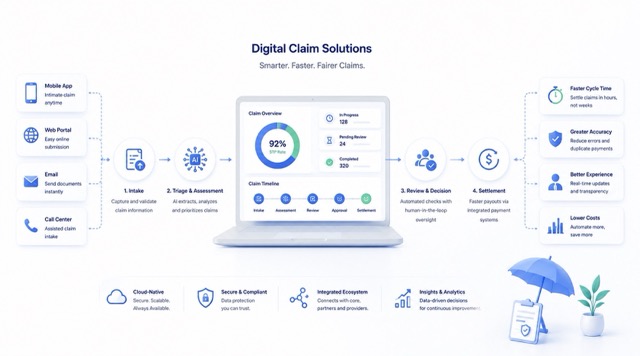
Yes. Claims automation can cover FNOL, document intake, classification, assignment, coverage verification, fraud scoring, payment workflows, and straight-through processing for eligible claims.
What is the difference between Nected and Guidewire?
Guidewire is an insurance core platform; Nected is a backend decisioning and workflow layer. Guidewire manages policy, claims, billing, pricing, and underwriting capabilities, while Nected can execute configurable rules and workflows alongside existing insurance applications without becoming the system of record.
What is the difference between Appian and Pega?
Appian focuses on cross-system process orchestration, while Pega combines workflow, case management, and decisioning. Appian is suited to processes connecting systems, documents, data, AI, and people; Pega is stronger when complex cases, decisions, work assignment, and exceptions must operate together.
Is Nected an insurance core platform?
No. Nected provides backend rules, decisioning, and workflow capabilities. It can expose rules through APIs and connect workflows to REST APIs and databases, but it does not replace policy administration, claims administration, or insurance billing systems.
What should insurers test before selecting an automation platform?
Test production exceptions, not only the happy path. Evaluate failed APIs, missing data, duplicate records, document errors, rule changes, human overrides, exception routing, retries, audit trails, and high-volume processing before selecting the platform.