

A credit application rarely reaches an underwriter as one complete piece of information. Income may come from a payroll or bank-data provider, credit history from a bureau, liabilities from another system, and supporting documents from the applicant. The underwriter then has to bring these inputs together before applying the lender's credit policy.
That process becomes difficult to scale when the same checks are repeated across thousands of applications. An underwriter may spend time verifying income, checking debt obligations, calculating DTI, reviewing credit data, and confirming eligibility before reaching the part of the application that actually requires judgment.
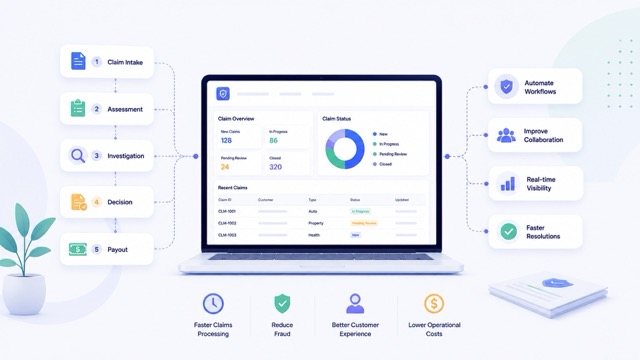
Risk tools for credit facilitate automation of such processes. They can gather and verify data on borrowers, obtain data on risks, conduct necessary analyses, and prepare applications for credit decision-making.
The important distinction is that automating underwriting does not mean automating every credit decision. The most useful approach is to automate decisions that follow clearly defined conditions and route exceptions to a credit professional.
Top 3 Credit Risk Decision Engines to Consider
The three platforms below address credit decisioning from different angles. Taktile focuses heavily on decision strategy development and experimentation, Provenir provides broader risk decisioning and data orchestration, while Nected provides a configurable decision layer for lenders that need to manage credit rules and workflows.
At a Glance:
This decision, however, would depend on whether the lender’s underwriting bottleneck lies in the strategy experiment side or the risk requirements side. If strategy experiments are to be done, then the Taktile software is preferred; however, if risk requirements are also to be considered, the Provenir software would suffice.
Regardless of which platform a lender chooses, the underlying value comes down to what parts of the underwriting process it can automate. Here are the detailed overview of all the top 3 credit risk decision engines that we’ve curated for you:
Taktile
Best for: Digital lenders and risk teams that need to build, test, and optimize credit decision strategies.
Taktile is designed around decision strategy management. Risk teams can create, evaluate, modify, and deploy underwriting strategies without treating every policy change as an application-development project.
This makes it particularly relevant for lenders that frequently test or adjust their underwriting strategies and want to understand how those changes affect credit decisions.
Key features:
- Credit decision strategy management
- Strategy testing and experimentation
- Decision workflow configuration
- Risk strategy deployment
- Support for changing underwriting policies
Pros:
- Strong focus on credit decision strategy development
- Useful for testing and optimizing underwriting strategies
- Suitable for teams that frequently change risk policies
Cons:
- May be more than smaller lenders need if their primary requirement is straightforward rule-based decisioning
- Its strategy-focused approach may not cover every broader risk-management requirement on its own
Provenir
Best for: Enterprise lenders and financial institutions that need broader risk decisioning and data orchestration.
Provenir takes a broader approach to risk decisioning by bringing together data, risk evaluation, fraud, and decisioning processes.
This can make it relevant for larger financial institutions where credit underwriting is only one component of a wider risk architecture.
Key features:
- Risk decisioning
- Data orchestration
- Credit risk assessment
- Fraud decisioning
- Integration of multiple risk data sources
Pros:
- Broad risk decisioning capabilities
- Useful when credit is part of a larger risk-management architecture
- Strong fit for complex enterprise environments
Cons:
- Broader functionality can be unnecessary for lenders looking specifically for a lightweight credit rules layer
- Enterprise-oriented implementations may involve greater complexity
Nected
Best for: Fintechs, NBFCs, and mid-market lenders that need configurable credit decision logic and workflows.
Nected provides a low-code decisioning engine that lenders can leverage to create and govern their underwriting policies. Information about the borrowers and other risk-related data can be linked with decision-making conditions based on criteria like income level, debt-to-income ratio, credit score, and the amount of the loan.
For example, a lender could define a policy such as:
Verified income ≥ ₹50,000 + DTI ≤ 40% + credit score ≥ 700 → Continue processing
A different result can trigger a different workflow:
DTI > 40% → Credit review
This approach allows lenders to separate their credit policy from the core lending application and update decision rules as policies change.
Key features:
- Configurable credit rules
- Low-code decisioning
- Workflow automation
- Conditional routing
- Integration with existing data and risk systems
- Exception and manual-review paths
Pros:
- Flexible for changing credit policies
- Helps separate decision logic from core application code
- Supports automated routing as well as human review
- Relevant for fintechs, NBFCs, and mid-market lending teams
Cons:
- It is primarily a decisioning and workflow layer rather than a replacement for every credit bureau, risk model, or lending system
- Lenders still need appropriate data sources and risk infrastructure for the inputs used by their rules
How Nected Fits Into Credit Underwriting?
How Nected Solves Credit Underwriting?
Credit risk models create borrower information, verification results, calculations, and risk information. Nected can then take this data and apply the lender’s pre-defined underwriting rules and define the next action for the workflow process.
For example:
This makes Nected a decisioning and workflow layer that can sit alongside existing lending and credit-risk systems. If a lender changes a policy, such as reducing the maximum DTI from 40% to 35%, the relevant rule can be updated without rebuilding the entire lending application.
Why Manual Underwriting Becomes a Bottleneck as Lending Scales
Manual underwriting becomes a bottleneck when credit teams have to perform the same verification and policy checks repeatedly for applications that follow similar patterns.
Consider a personal-loan application. Before deciding whether the borrower qualifies, an underwriter may need to verify:
- Declared monthly income
- Existing monthly liabilities
- Credit bureau information
- Loan amount requested
- Debt-to-income ratio
- Employment or income stability
- Product-specific eligibility criteria
If the lender processes 5,000 applications a month, manually repeating these checks creates a significant operational workload.
The problem becomes more pronounced when the information sits in different systems. An underwriter may have to retrieve bureau data, check income information, review documents, calculate affordability, and then compare the results against the lender's policy.
This also creates a sequencing problem. A missing document should stop the application from moving to the next stage. A failed income verification should trigger another verification step. An application that exceeds an approval limit should go to the appropriate credit authority. When these decisions depend on manual follow-up, applications can sit between stages even when the underlying credit policy is straightforward.
Credit risk tools address this specific bottleneck by automating the checks and routing decisions that can be defined in advance.
What Credit Risk Tools Automate in Underwriting?
Credit risk tools can automate many of the repetitive checks that happen before an underwriter needs to make a judgment call.
Five common areas include:
- Credit bureau analysis: Retrieve and evaluate credit scores, payment history, existing liabilities, credit utilization, and other bureau data against predefined criteria.
- Income and employment verification: Validate declared income and employment information using connected data sources and identify missing or inconsistent information.
- DTI and affordability calculation: Automatically calculate debt-to-income ratios, loan affordability, exposure, and other financial metrics used in credit assessment.
- Credit eligibility checks: Apply product-specific conditions such as minimum credit score, minimum income, maximum DTI, loan amount limits, operating history, or required documentation.
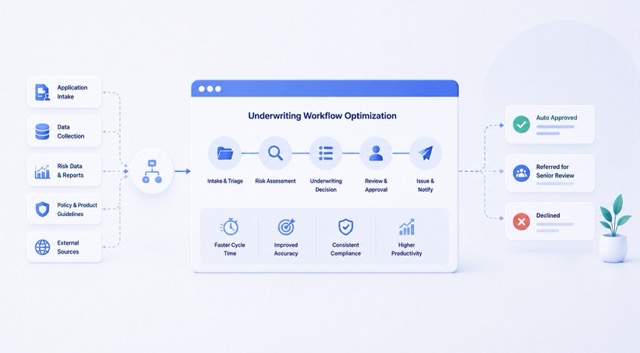
- Application routing and exception handling: Send applications that meet standard conditions forward while routing incomplete applications, policy exceptions, conflicting information, or cases above approval limits for additional review.
The important distinction is that these automated checks do not necessarily mean every credit decision is fully automated. They provide the inputs and policy outcomes that determine whether an application can continue automatically or requires human intervention.
How Automated Underwriting Decisions Are Made?
The automated underwriting decision typically is made using a combination of borrower information, risk factors, computations, and credit policy, and not a single factor alone.
A simplified flow looks like this:
Borrower data → verification → credit risk inputs → policy rules → underwriting outcome
Consider a borrower with:
- Verified income: ₹80,000/month
- Existing debt: ₹20,000/month
- DTI: 25%
- Credit score: 760
- Requested loan: ₹4 lakh
Suppose the lender's policy requires:
- Verified income of at least ₹50,000
- DTI of 40% or below
- Credit score of at least 700
- Loan amount within the applicable approval authority
The borrower meets each condition. If there are no other exceptions, the application can continue through the standard underwriting path.
Now change only one input:
Existing debt: ₹36,000 → DTI: 45%
Credit score is still 760 but the application does not comply with the DTI policy of the lender. This does not mean at all that the applicant must be automatically turned down. The policy of the lender may be such that applications above 40% DTI go for manual credit review.
So the workflow becomes:
DTI = 45% → policy threshold exceeded → credit review
This highlights the fact that whereas the credit risk tool calculates or extracts the risk factors, it is the underwriting policy of the lender that dictates the impact of the factors on the application.
Similarly, when there is a credit risk model in place, the model will generate the probability of default or risk score, but the lender requires a certain policy to interpret it.
For example:
Risk score within approved range → Continue
Risk score above referral threshold → Credit review
Risk model unavailable → Manual assessment or defined fallback
The underwriting process therefore has two connected layers:
- Risk analysis: What does the available borrower data indicate?
- Decision logic: Given that information, what should the lender do next?
That distinction becomes particularly important when an application does not fit the standard path.
Where Credit Risk Tools Still Need Human Review
Not every underwriting condition can be reduced to a simple pass-or-fail rule. A salaried borrower with stable income and complete verification may fit a standard automated path. A self-employed borrower with irregular income, multiple business accounts, or recently changed sources of income may require an underwriter to interpret the information.
The same applies when the data itself conflicts. For instance:
- The declared income is ₹1 lakh, but the verifiable regular income is ₹70,000.
- The credit report has liabilities not disclosed in the application.
- There is an incomplete set of documents required.
- The loan exceeds the approval limit.
- A risk model produces an unexpected result.
These situations require the workflow to recognize why the application cannot continue normally. A useful automated process therefore does not simply produce: Pass / Fail
It produces a defined path:
This keeps automation focused on predictable decisions while giving underwriters the context needed for exceptions. At this point, another requirement becomes clear: the lender needs a way to maintain these rules and connect them to the underwriting workflow as policies change.
Conclusion
Credit risk tools can automate much of the repetitive work surrounding underwriting: collecting borrower information, retrieving credit data, verifying financial inputs, performing calculations, applying defined conditions, and routing applications based on the results.
The goal is not to make every underwriting decision automatic. Standard applications can move through predefined rules, while incomplete, conflicting, or policy-exception cases can be routed to underwriters with the relevant information already assembled.
Nected can complement this process by connecting credit-risk inputs and borrower data to configurable underwriting rules and workflow actions.
The practical approach is to automate what can be defined, surface what needs attention, and keep human judgment where the credit decision genuinely requires it.
FAQs
What are credit risk tools used for in underwriting?
Credit risk management tools assist in gathering and analyzing information of the borrower that is necessary during the underwriting process. They can be applied in different processes of the lending procedure such as credit scoring, income verification, calculations, risk assessment, qualification, and loan routing.
How do credit risk tools automate underwriting?
Automating processes include the following: credit check, validation of the borrower’s data, determination of debt-to-income ratio (DTI), eligibility criteria checking, and application routing according to predefined results.
Can credit risk tools automatically approve loans?
They can support automated approval for applications that meet predefined underwriting conditions. Applications that fall outside those conditions can instead be routed for additional verification or human review.
What happens when an application fails an automated underwriting rule?
The result is determined by the lender’s policy. Violation of one of the conditions could mean further verification, analysis of creditworthiness, senior management approval, or other procedures besides automatic rejection.
Do credit risk tools replace underwriters?
Not at all. The automated system will take care of repetitive processes and generate the application forms for decision-making, whereas the underwriter can take care of the exceptional scenarios.
What is the difference between a credit risk model and underwriting rules?
A credit risk model analyzes borrower data and produces a risk output, such as a risk score or probability. Underwriting rules determine how that output, together with other borrower information, should affect the lending workflow.
How does Nected fit into credit underwriting?
Nected can apply configurable credit rules and workflows to borrower data, verification results, and risk-model outputs. This can be used to decide if the application proceeds automatically or needs to go through another step such as credit analysis.