.svg)

.svg)


.png)

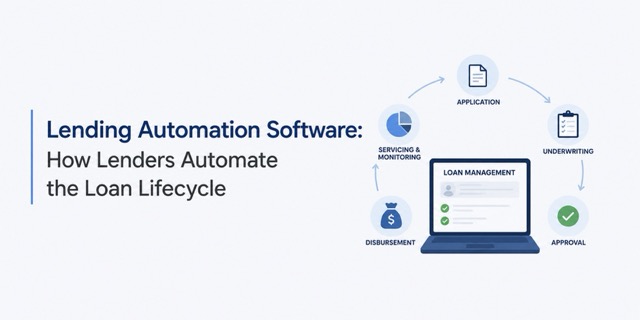
Loan underwriting becomes difficult to scale when every application requires an underwriter to collect data, verify it, apply credit policy, calculate exposure, and decide whether the case can be approved or needs review.
In the case of standard personal loans, this evaluation will often hinge on predetermined criteria. Proof of income, investigation of outstanding debts, assessment of credit criteria, and evaluation of the loan amount will be required. Making an underwriter perform each of these checks manually adds little value when defined rules already determine the outcome.
Loan underwriting automation moves those repeatable checks into a decision workflow. Automated approval will occur for applications that conform to the lender's guidelines of the lender, and those that do not fall under such criteria may be referred to an underwriter.
Why Manual Loan Underwriting Struggles with High Application Volumes and Complex Credit Policies
Manual underwriting becomes a bottleneck when underwriters spend more time assembling and checking application data than evaluating exceptions.
A typical application may require:
- Credit bureau data
- Verified income
- Existing debt and exposure
- Employment information
- Bank transaction data
- Product eligibility
- Affordability calculations
- Fraud or identity results
- Internal credit policy
The difficulty increases when these inputs come from different systems. A lender may have one system for applications, another for bureau data, another for income verification, and separate tools for fraud and banking data. An underwriter then has to bring those results together before applying the credit policy.
Complex policies add another layer. A lender might have different income requirements for salaried and self-employed borrowers, different limits by product, and separate referral thresholds for high-value applications.
The result is not necessarily bad underwriting. It is too much manual work around underwriting.
Also Read: Leading Providers of Underwriting Workflow Optimization Solutions
What Parts of the Loan Underwriting Process Can Actually Be Automated?
The best candidates are activities where the lender already knows what information to check and what condition should trigger the next step.
Commonly automated activities include:
- Data retrieval: Pull credit, income, banking, employment, and existing-customer information from connected sources.
- Data validation: Check whether required information is available and whether key values are consistent.
- Eligibility checks: Apply conditions such as minimum income, geography, age, employment type, loan amount, or product eligibility.
- Affordability calculations: Calculate debt-to-income, repayment capacity, exposure, or other product-specific measures.
- Credit assessment: Run scorecards or risk models against verified borrower data.
- Policy checks: Compare the application against credit policy, exposure limits, and approval thresholds.
- Referral routing: Route all loan applications beyond the limits of the automated decision into the correct credit reviewer.
- Decision execution: Approve, decline, or refer an application based on the combined results.
Automation should not mean that every underwriting activity becomes machine-controlled. Judgment-heavy cases still need an underwriter. The point is to keep those cases separate from applications that can be assessed consistently through predefined criteria.
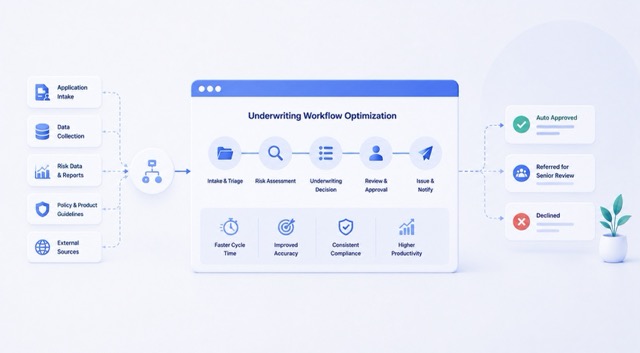
How Loan Underwriting Automation Moves an Application from Data Verification to Credit Decision
A lender's underwriting process can be reduced to a sequence of data checks and decisions:
Application → verified data → credit assessment → policy evaluation → decision → referral where required
- Verify the inputs
The system collects the information required for the specific lending product. For a consumer loan, this could include income, employment, bureau data, existing liabilities, and requested loan details. SME lending may require bank transactions, financial statements, business information, and existing business debt.
- Apply the credit policy
The verification of data will then be based on the lender’s requirements. The following are examples:
Verified income ≥ required minimum
Debt-to-income ≤ permitted threshold
Loan amount ≤ product limit
An application not meeting any of the compulsory conditions will either be rejected or referred by the lender.
- Evaluate risk
A scorecard, credit model, or other risk model can assess the application using the verified data. This produces a risk assessment. It does not automatically determine the final lending action.
- Determine the outcome
The underwriting logic combines model results with policy conditions. The application can then be:
- Approved if all required conditions are satisfied.
- Declined if it fails a defined mandatory condition.
- Referred if the case falls outside the automated decision boundary.
This distinction is important because a model score alone cannot capture every product rule or approval condition.
When Loan Underwriting Automation Works Best, and Where Manual Review Still Matters
Automated underwriting works best when the lender has a repeatable credit policy and enough application volume for manual assessment to become operationally expensive.
It is especially useful where:
- There are specific eligibility requirements for the product.
- Most applications use the same core data inputs.
- Credit policy can be expressed as measurable conditions.
- A large proportion of applications are routine.
- The lender needs consistent approval and referral decisions.
Manual review remains important for applications where the available data does not support a straightforward decision.
Cash flow can be high for an entrepreneur borrower while income can be erratic. A business borrower may have healthy revenue but unusual recent debt exposure. A borrower may also provide conflicting information that requires additional verification. These cases should not be forced through an automated approval path simply because the lender has an automated underwriting system.
A better model is:
Automate standard cases → identify exceptions → give underwriters the relevant evidence.
Loan Underwriting Automation vs. Automated Credit Scoring: What's the Difference?
For example, a credit model may assign an application a low-risk score. The lender may still decline it if the requested amount exceeds the product limit. Conversely, an application with a weaker score may be referred to a senior underwriter rather than automatically declined if the lender's policy permits additional review.
Credit scoring estimates risk. Underwriting automation applies the lender's policy to that risk. That distinction becomes important when lenders use several models, external data sources, or different policies across products.
How Nected Helps Manage Automated Underwriting Decisions?
Automated underwriting works well for applications that meet predefined criteria, but some cases will still fall outside the automated decision boundary. This could include income not verified, discrepancies within the application form, an amount that is higher than the automatic approval threshold, or an exception to the policy.
Nected can help enhance lending and underwriting applications with this decisioning layer for these conditions. Lenders can create rules to decide if the application is to be auto-approved or otherwise treated.
For example:
Application data → Credit and policy inputs → Nected rules → Approve / Decline / Refer
A lender could configure a rule such as:
Requested amount > automated approval limit → Senior credit review
Or:
Income verification fails → Additional verification
The workflow can also retain the reason for referral, so the underwriter receives the relevant evidence instead of having to reconstruct the application.
This allows the core lending application to handle the broader underwriting process while Nected manages configurable decision logic that may change as lending policies and approval conditions evolve.
Conclusion
Loan underwriting automation is not about removing underwriters from the lending process. It is about automating repeatable checks and routing cases that require judgment to the right reviewer.
Data verification, eligibility checks, affordability calculations, policy evaluation, risk assessment, and standard decision routing can be automated when the criteria are clearly defined. Applications that fall outside those criteria can then be referred with the relevant evidence and reason for review.
Nected could facilitate this approach by supplying a customizable decision engine layer that enables management of dynamic decision criteria without having each policy hard-coded within the application itself.
Frequently Asked Questions
What is loan underwriting automation?
Automated loan underwriting employs technology to automate underwriting tasks that can be repeated, such as verification, eligibility, credit, policy assessment, and decision routing.
What can lenders automate during underwriting?
Data extraction, validation, affordability testing, policy testing, model calculations, and referrals may be automated for lenders whenever these tasks are performed based on clear criteria.
Does underwriting automation replace human underwriters?
Not at all. The system takes care of standard applications and refers any exceptions to humans. Underwriting will still be needed where there is conflicting information or other special situations.
Is automated underwriting the same as credit scoring?
No. Credit scoring estimates borrower risk. The underwriting automation takes into account that risk assessment along with the credit policy of the bank itself, among others, for deciding on acceptance, rejection, or referral of the application.
What happens when an application fails an automated underwriting rule?
The outcome depends on the lender's policy. It may be declined, sent for additional verification, or referred to a credit underwriter for review.
Can underwriting rules be changed without changing the lending application?
Yes, when the lender separates business decision logic from the core application. With a configurable decisioning layer, thresholds, eligibility conditions, and referral rules can be updated without rebuilding the entire underwriting workflow.


.svg.webp)




.webp)



.webp)
.webp)
.webp)


%20(1).webp)