.svg)

.svg)




.png)

Daily, banks deal with numerous similar tasks such as document verification, account information updates, loan application processing, and compliance reporting. Though these tasks have standard processes, most of them are manual, hence being costly and time-consuming.
Robotic Process Automation (RPA) is used by banks to automate all these repetitive and rule-based tasks without changing current banking systems. Through the use of software bots, banks can complete these processes at a faster pace than when done manually, thus giving employees an opportunity to concentrate on analyzing work.
As more and more banks continue digitizing their operations, RPA becomes increasingly practical.
Why Manual Banking Operations Are No Longer Sustainable
The vast majority of the processes within a bank involve some level of repetition. Customer onboarding, loan processing, KYC, account servicing, reconciliations, and other types of regulatory reporting will always demand from an employee to input data into various systems, validate documents, and perform some other predefined actions.
The manual process raises several operational challenges:
- Increased duration of the process: Each verification and approval done manually adds up to the process duration.
- Higher operational costs: When the number of transactions goes up, the bank needs to employ more people to deal with the operations.
- Human errors: The manual data input, incorrect validation, or policy implementation might slow down the transactions or result in compliance issues.
- Separate systems: All the customer information is usually spread across multiple software solutions, requiring an employee to use different applications for a single task.
Increased load but no increased efficiency when the number of clients rises. These challenges only become more pronounced within the digital banking environment, where the customers expect services like account opening, personal loans, and card issuance to be executed in minutes, not days.
In order to automate repetitive tasks and integrate it with the existing technology stack, banks need RPA.
Also Read: What is BRE in Banking and How it Works?
What RPA Actually Automates Inside a Bank
RPA automates repetitive tasks which have a predictable pattern. Rather than replacing the banking applications, software bots work with the existing systems to perform the routine processes without any human intervention.
Some of the commonest use cases in the banking industry include:
- Customer Onboarding
Bots gather the customer data, check if all the mandatory fields are present, obtain documents, conduct KYC verification, update CRM systems, and create customer accounts in several banking applications.
- Processing Loans
The robots collect the documents of the customers, extract relevant information, validate the application information, verify credit bureau information, update the loan management systems and pass on the application to underwriting.
- Account Maintenance
Regular tasks like updating the customer information, updating contact information, issuing new debit card or updating account preferences can be automated.
- Processing Payments
The bots reconcile transactions, process payment instructions, validate settlement information and update accounting systems without any manual intervention.
- Regulation Reporting
Regular reports for regulation purposes are provided by the banks. The robots gather the required information from multiple systems, validate information and generate reports.
- Reconciliation
In place of matching the transactions manually, the bots match payment transactions from multiple banking systems, find out discrepancies and report exceptions.
- Customer Service Operations
The robots gather customer information, update the service request, create support tickets and perform background activities while customer service staff works on solving customer problems. RPA does not modify the business decisions but automates repetitive operations.
Why RPA Alone Can't Automate Every Banking Process?
RPA is most efficient in scenarios that involve following predefined rules. Nevertheless, many bank processes are based on decisions, not actions.
To illustrate, an RPA bot can prepare documentation for a business loan, yet it cannot decide whether this person fulfills all requirements of the bank’s lending policy unless separate rules are set up for that.
In a similar manner, RPA can start KYC verification, yet a decision about whether a client is eligible for simplified, enhanced, or manual due diligence is made according to the company's rules and policies.
All processes that are related to risk analysis, fraud detection, pricing, eligibility, and regulatory analysis require a layer of decisions in addition to automation of actions.
This is why RPA is often used together with decision engines and workflow automation systems by many banks.
Also Read: 10 Best Robotic Process Automation Softwares List
From Customer Onboarding to Compliance: Where Banks Are Using RPA Today
Banks use RPA across multiple operational functions where high transaction volumes and repetitive work create bottlenecks.
- Customer Onboarding: Due to RPA, the entire process of document capture, customer identification, opening accounts for them, and communication with prospective customers becomes automated, thus becoming time-efficient.
- KYC/AML Operations: Robots are applied in collecting data about the customers, validating the documents uploaded by customers, conducting sanctions checks on the customers, and preparing the case for compliance review.
- Loan Operations: With the help of RPA technologies, all steps of the loan management process are simplified from collecting documents to updating the system of lending.
- Account Servicing: Routine requests related to address change, closing accounts, nominee change, issuance of statements and card requests may be automated.
- Payment Operations: Payments' validation, processing, reconciliation, handling exceptions and monitoring transactions are performed by banks through software robots.
- Regulatory Compliance: RPA technology simplifies repetitive processes of regulatory compliance that include gathering of necessary data, report preparation, keeping audit logs, etc.
- Back Office Finance: With the help of robots invoice processing, internal reconciliation, journal entries, vendor payments and reporting may be automated.
What Changes After Banks Automate Routine Operations?
Apart from reducing the workload on banking operations, automation also brings about a change in the process of application processing, time allocation of personnel, and implementation of bank policies.
- Faster Processing Throughout Banking Operations: Processes like KYC Verification, Account Creation, Loan Document Validation, Payment Reconciliation, and Reporting are automated and therefore done in minutes instead of hours.
- Consistency of Process Execution: All applications go through the same process with no room for inconsistencies in case of manual processes execution.
- Reduced Human Errors: RPA makes redundant any data input and data changes, resulting in fewer human errors such as inaccurate customer data, duplicate entries, skipped verifications, and reconciliation problems.
- More Time for Value Adding Activities: The people working in operations department will not be required to take care of documentation work and updating multiple systems but can spend their time on exception management, customer service, underwriting and so forth.
- Better Regulatory Compliance and Auditability: Automated processes perform consistently KYC/AML checks and compliance procedures while logging everything that is being done thus simplifying audit and reporting to regulators.
- Greater Operations Scalability: It becomes possible for banks to work with more customers and perform higher number of loan application processing, requests and transactions without increasing size of operations department accordingly.
- Consistency in Customer Experience: Customers get faster onboarding, loan decisioning, customer service due to the elimination of routine work from backend process.
Bringing Together RPA, Decision Rules, and Workflows for End-to-End Banking Automation
RPA can automate repetitive tasks, but banking processes rarely consist of tasks alone. RPA technology may automate routine actions; however, banking processes often go beyond such actions and include business decision making, policy checking, approval, and exception handling that cannot be done by automation only.
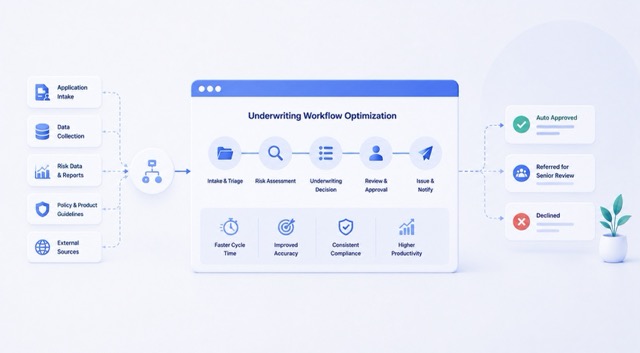
As an illustration, a loan application submitted by the business must first be processed and prepared by an RPA bot that retrieves financial reports, verifies KYC documentation, pulls up the report from the credit bureau, and loads it into the loan management system. When all the necessary information is ready, the bank needs to decide on whether the loan should be granted to the applicant.
Such decision may depend on many aspects, among which are creditworthiness, business turnover, debt-to-income ratio, collateral requirements, exposures, fraud check, and many others. The decision is made according to the set of rules, and it is made by the decision engine.
Further action will depend on the result of the decision made: workflow automation assigns the case to an underwriter, requests some documentation, informs the applicant, performs compliance check, or sends the loan for disbursement.
Together, these technologies automate different parts of the same process:
- RPA executes repetitive operational tasks, such as collecting data, updating systems, and processing documents.
- Credit decisioning engines assess the various policies and rules in order to arrive at consistent credit decisions.
- The process automation engine will manage the entire end-to-end workflow process, handling all approvals, escalations, and notifications.
As opposed to simply automating tasks, banks are able to automate their lending workflow process, all the way from loan application submission to making the credit decision.
How Nected Supports End-to-End Banking Automation
Nected enables banks to unite decision-making rules, workflows, and automation solutions under one orchestration layer.
With Nected, banks will be able to:
- Unify business rules around lending, onboarding, fraud detection, and compliance.
- Create flexible workflows for approvals without having to code anything into the software.
- Connect with core banking, CRM, API, database, and RPA systems.
- Manage exceptions manually while automating regular decisions.
- Get full audit trail records for compliance purposes.
- Change business rules without changing the software’s source code.
Nected does not replace RPA solutions; rather, it works in tandem with them, making decisions about how the bank’s processes need to flow.
Conclusion
RPA has become an essential technology for modern banking because it eliminates repetitive manual work without requiring banks to replace their existing systems. Through automation of repetitive tasks, banks will be able to increase efficiency in their operations by speeding up their processes, reducing the occurrence of mistakes, cutting down on costs, and improving customer experience.
This is not possible through task automation alone because some banking operations require making business decisions based on policy and regulatory guidelines. The combination of RPA technology and decision engine makes the process possible.
Frequently Asked Questions
What is RPA in banking?
RPA is the Robotic Process Automation, which automates various repetitive and rules-based banking activities such as customer onboarding, document verification, payments, reconciliation, and reporting.
How does RPA differ from AI?
RPA implements automation of predetermined tasks according to fixed rules, while AI analyses data and recognizes patterns supporting decision making. Both RPA and AI are used by many banks together to implement automation of the whole business process.
What banking processes can be automated using RPA?
The applications of RPA include customer onboarding, KYC process, loan processing, payment process, reconciliation process, servicing of accounts, compliance report, and back-office financial processes.
Can RPA substitute banking employees?
No, RPA only implements automation of repetitive operational processes leaving time for other tasks such as customer support, risk management, exceptions handling, etc.
Why do banks use RPA combined with decision engines?
RPA implements task automation but cannot analyze complex business policies. Decision engines implement lending policies, compliance rules, fraud policies, and other rules, which allows for the full process automation.
How Nected helps to automate banking?
Nected helps to create configurable decision workflows, centralized business rules storage, system integration, automation of approvals, and traceable audit trails.


.svg.webp)






.webp)




.webp)
.webp)
.webp)


%20(1).webp)