

A Golang rule engine evaluates business rules against application data and returns a decision based on the conditions that match. Instead of embedding every pricing, eligibility, approval, or routing condition directly in Go code, teams can represent these decisions as a separate rule layer.
The key architectural choice is where that rule layer should live. You can implement the evaluation directly in Go, use a dedicated Go rule engine, or move decision logic outside the application so it can be managed and changed independently.
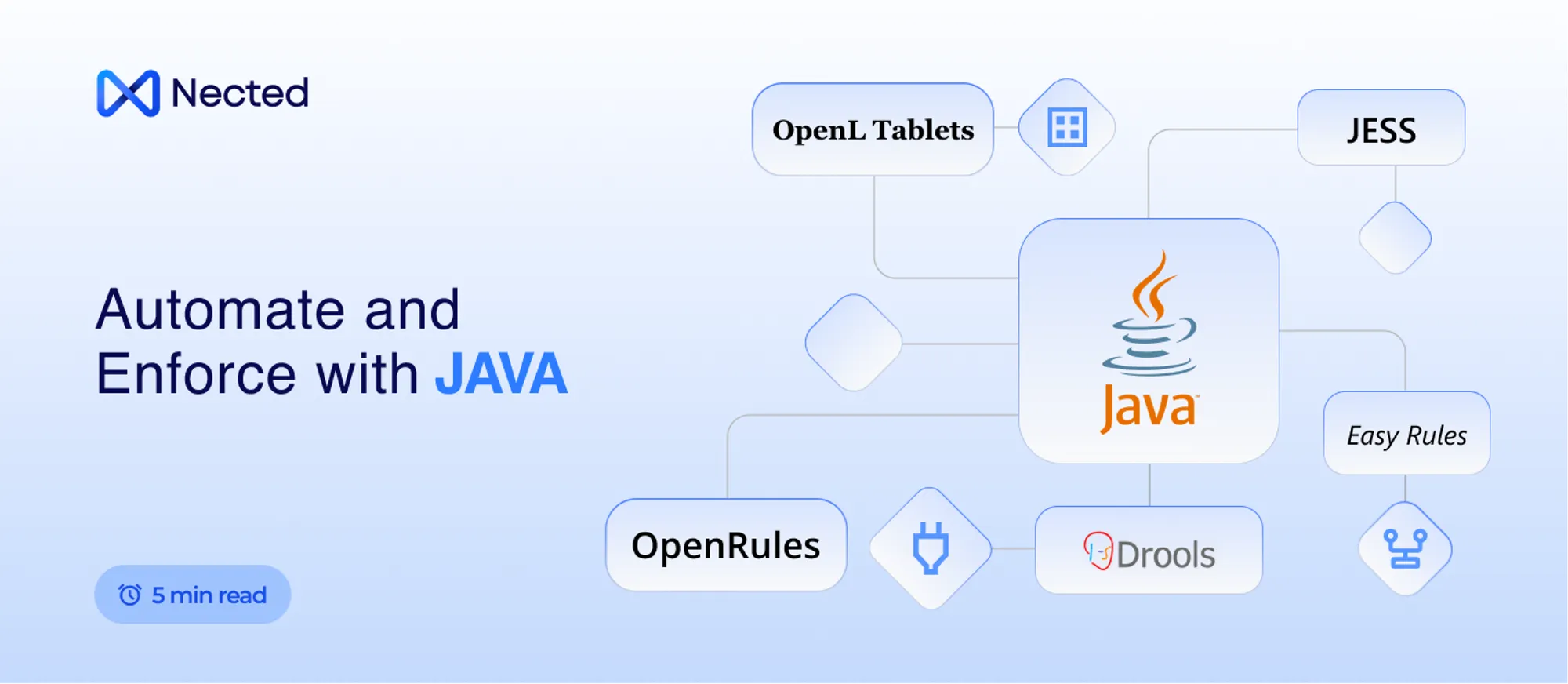
This guide covers how to implement a rule engine in Golang, when a rules engine makes sense, how GoRules and Grule compare, and where Nected fits when business rules need an independent lifecycle.
What Is a Golang Rule Engine?
A Golang rule engine evaluates business conditions against application data and produces a decision or result when those conditions match. The basic model is still an if-then decision, but the rules are represented and evaluated through a dedicated engine instead of being scattered across application services.
That separation becomes useful when the same business logic appears in multiple places or changes more frequently than the surrounding application code.
When to use a Golang rule engine
Consider a Golang rule engine when:
- Rules involve multiple conditions or priorities. Complex combinations, exceptions, and overlapping conditions can be easier to represent and evaluate through a dedicated rule model.
- The same rules are used across services or execution paths. A shared rule definition avoids duplicating eligibility, pricing, fraud, or routing logic across API handlers, background jobs, and event consumers.
- Rules change independently of application code. If business conditions change without changes to the underlying transaction or API logic, separating evaluation from the Go service can reduce unnecessary code releases.
- Rules need independent testing. You can test rule combinations, boundary conditions, priorities, and expected outcomes without testing the entire application flow.
- Rules need to be loaded or updated dynamically. Engines can evaluate rules stored in configuration, decision models, databases, or other runtime sources instead of requiring every change to be compiled into the Go binary.
- The rule set has outgrown scattered conditionals. When related decisions are distributed across multiple handlers or services, a dedicated evaluation layer can make the rule set easier to trace and manage.
When not to use a Golang rule engine
A rule engine is usually unnecessary when:
- The decision is small and stable. A few straightforward conditions are usually clearer as native Go.
- The logic is tightly coupled to application state. If evaluation depends heavily on internal methods, transaction state, database operations, or Go-specific implementation details, moving it into a rule engine can add unnecessary indirection.
- Rules do not need independent deployment or management. If rule changes already follow the same release cycle as the application and that workflow works well, a separate engine may not add much value.
- The decision path is highly latency-sensitive. An embedded engine adds evaluation overhead, while an external rules service also introduces network latency.
- Preparing rule inputs is more complex than the rules themselves. If the application must perform substantial data transformation just to construct the facts or context required by the engine, the added abstraction may not be worthwhile.
How to Implement a Rule Engine in Golang
A basic rule engine in Go can be implemented in a few steps: define the input, represent the rules, evaluate them, and return the resulting decision.
- Define the Rule Input
Create a struct containing the data the rules need to evaluate.
type Order struct {
CustomerTier string
Total float64
}
- Define the Rule Structure
Represent each rule with a condition, priority, and result.
type Rule struct {
Name string
Priority int
Evaluate func(Order) bool
Result string
}
- Create the Rules
Define the conditions that determine when each rule should match.
premiumRule := Rule{
Name: "premium-order",
Priority: 10,
Evaluate: func(o Order) bool {
return o.CustomerTier == "enterprise" && o.Total > 500
},
Result: "premium",
}
- Evaluate the Rules
Pass the input to the rule engine and return the result of the first matching rule.
func Evaluate(order Order, rules []Rule) string {
for _, rule := range rules {
if rule.Evaluate(order) {
return rule.Result
}
}
return "standard"
}
- Handle Rule Priority
When multiple rules can match the same input, define an explicit priority or conflict-resolution strategy. This prevents the result from depending only on the order in which rules are stored or evaluated.
- Test the Rules
Test normal cases, boundary values, and overlapping conditions separately from the rest of the application. Go's table-driven tests are useful for testing multiple rule inputs.
- Externalize Rules When Needed
For larger rule sets, rules can be represented through a DSL, JSON configuration, or decision model instead of compiled Go functions. This allows the rule definitions to evolve independently from the application code.
This approach works well for a small, developer-owned rule set. As rules require dynamic updates, versioning, complex relationships, or independent management, using an existing rule engine can be more practical than maintaining a custom implementation.
Top 3 Golang Rule Engines
Once rule logic starts moving beyond a few conditions, the choice of implementation matters. Some teams keep rule evaluation inside the Go application for lower-latency, in-process decisions, while others separate decision logic from application code so rules can be managed and changed independently.
The options below represent both approaches. GoRules and Grule provide rule evaluation that can be integrated with Go applications, while Nected provides an external decisioning layer that Go services can access through API
1. GoRules (ZEN Engine)
GoRules ZEN Engine is an open-source business rules engine written in Rust with native Go bindings. It uses portable JSON-based decision models and supports decision tables, expressions, switches, functions, and reusable decisions. The engine can be embedded directly into a Go application, with the application responsible for providing the decision model and input data.
Key features
- JSON-based decision models
- Decision tables, switches, and expressions
- Native Go bindings
- In-process evaluation
- Batch evaluation
- Reusable decision models
- Cross-runtime support
Pros
- Keeps decision evaluation inside the application without requiring a network call.
- JSON decision models make rules portable across supported runtimes.
- Supports structured decision models rather than limiting logic to individual expressions.
- Provides reusable decision components for larger decision flows.
Cons
- The underlying engine is written in Rust, so it is not a pure Go implementation.
- Teams need to learn the ZEN decision model and expression language in addition to Go.
- Rule management capabilities depend on whether you use the embedded engine alone or the broader GoRules platform.
2. Grule
Grule is a rule engine library built specifically for Go and inspired by the Drools rule-engine model. It provides its own Grule Rule Language (GRL) for defining conditions and actions and evaluates those rules against application facts. Grule also supports rule priority through salience, which is used when multiple rules match.
Key features
- Go-native rule engine
- GRL domain-specific language
- Fact-based evaluation
- Rule priorities through salience
- JSON rule representation
- Knowledge-base model
- Rule execution listeners
Pros
- Designed specifically for Go applications.
- Provides a dedicated rule language instead of embedding every condition in Go code.
- Supports explicit rule priorities when multiple rules match.
- JSON representation allows rules to be loaded from external sources.
Cons
- Developers need to learn GRL alongside Go.
- Rules remain closely tied to the application's facts and execution model.
- Rule versioning, approval workflows, and broader rule management require additional tooling.
- A full rule engine can be unnecessary when the application only has a small number of stable conditions.
3. Nected
Nected is different from an embedded Go rule engine. Instead of running the decision engine inside the Go process, it provides an external decisioning layer that the Go application can call through an API.
The Go service remains responsible for application execution, while Nected handles the configured business decision. This approach is useful when rules need an independent lifecycle for testing, versioning, management, and deployment, or when the same decision needs to be consumed by multiple applications.
Key features
- API-based decision execution
- Visual rule and decision-table configuration
- Versioned rule management
- Testing and controlled rule releases
- Reusable decisions across applications
- Rule management outside the Go codebase
Pros
- Rule changes can be made independently of the Go application's source code and deployment cycle.
- The same decision logic can be consumed by multiple applications or services.
- Provides a management layer around rules instead of requiring developers to maintain a rule DSL directly.
- Separates application execution from business decision management.
Cons
- Introduces a network call between the Go application and the decision layer.
- Adds an external dependency that needs to be considered for availability and latency.
- Requires an API contract between the Go service and the decisioning layer.
- May be unnecessary when rules are small, stable, and intended to remain developer-owned.
The distinction is therefore straightforward: GoRules and Grule are options for embedding rule evaluation into a Go application, while Nected is an option when the requirement extends to managing business decisions independently from the Go codebase.
GoRules vs. Grule vs. Nected: At a Glance
How to Integrate Nected with a Go Application
If your Go application needs business rules that can change independently of the application code, Nected can be used as an external decision layer. The Go service sends the required inputs to a Nected rule or decision endpoint and uses the returned result in its application logic.
- Create the rule in Nected
Define the conditions and outcomes in Nected. For example, an order service could evaluate:
customer_tier = enterprise
order_total > 500
↓
decision = premium
The rule can be tested and versioned in Nected without changing the Go service.
- Send inputs from Go
The Go service sends the values required by the rule to the Nected API:
payload := map[string]interface{}{
"customer_tier": "enterprise",
"order_total": 750,
}
body, _ := json.Marshal(payload)
req, _ := http.NewRequest(
"POST",
decisionURL,
bytes.NewBuffer(body),
)
req.Header.Set("Content-Type", "application/json")
- Use the returned decision
Nected evaluates the rule and returns the configured result. The Go application can then use that result in its existing workflow:
Go service
↓
Nected API
↓
"premium"
↓
Go service applies the corresponding action
The Go code therefore handles the application flow, while the decision conditions remain outside the codebase.
- Manage rule changes separately
This is the main difference from an embedded Go rule engine. Changes to the rule can be tested, versioned, and promoted through Nected without modifying the Go implementation that calls the decision. This approach is useful when the same business decision is consumed by multiple services or when the rule lifecycle needs to be independent of the Go application's release cycle.
Bottom Line
A Golang rule engine makes sense when business decisions need more structure than scattered if-else statements can provide. For rules that should run inside the Go application, GoRules and Grule provide different approaches to in-process evaluation.
If rules also need independent versioning, testing, approval, and deployment, Nected takes a different approach by managing the decision logic outside the Go codebase and exposing it through an API.
The choice ultimately comes down to where you want the rule evaluation and rule lifecycle to live: inside the Go application or as an independently managed decision layer.
FAQs
What is a Golang rule engine?
A Golang rule engine evaluates business rules against application data and returns a decision or action when the rule conditions match. It separates decision logic from the application's core execution flow.
When should I use a rule engine in Go?
Use one when rules have multiple conditions, priorities, frequent changes, or need to be reused across services. For a small set of stable conditions, native Go code is usually simpler.
How do I implement a rule engine in Golang?
A basic implementation involves defining the rule inputs, creating a rule structure, evaluating conditions, handling matching or priority logic, and testing the resulting decisions. Larger systems can use a dedicated engine or externalize rule definitions.
What are the best Golang rule engines?
GoRules (ZEN Engine) and Grule are options for integrating rule evaluation with Go applications. Nected takes a different approach by providing an external decisioning layer that Go services can access through an API.
What is the difference between a Go rule engine and an external decision engine?
A Go rule engine can evaluate rules inside the application's process, while an external decision engine evaluates them outside the application and returns the result through an API. The latter can provide an independent lifecycle for rule management, testing, and deployment.
Can I change rules without redeploying a Go application?
Yes, if the rules are externalized from the compiled Go application. Depending on the architecture, they can be loaded from configuration, a decision model, or an external decisioning platform such as Nected.
Are rule engines slower than if-else statements in Go?
A rule engine introduces some evaluation overhead compared with a simple conditional. An external decision engine also adds network latency. The actual impact depends on rule complexity, evaluation frequency, and whether the engine runs in-process or remotely.
Can a Go rule engine handle multiple matching rules?
Yes. The engine can use different matching strategies, such as first-match, unique-match, or multiple-match evaluation. When multiple rules can match, the implementation should also define how priority or conflicts are handled.