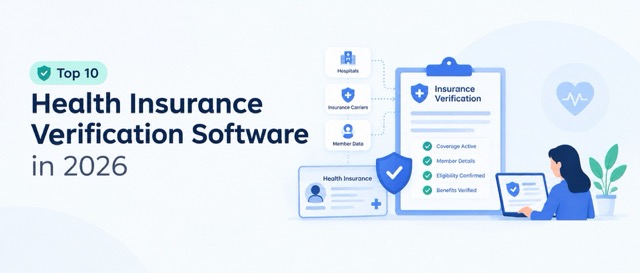



Health insurance verification software helps healthcare organizations determine whether a patient's coverage is active, identify applicable benefits, and surface eligibility information before services are delivered. The technical challenge is not simply performing an eligibility check; it is integrating payer connectivity, 270/271 transactions, response normalization, EHR or PMS workflows, and downstream decisioning into a reliable production system.
For U.S. providers, ineffective verification can result in inaccurate patient-responsibility estimates, manual payer lookups, registration rework, and eligibility-related claim issues. The right platform therefore depends on payer coverage, transaction volume, integration architecture, specialty requirements, and how much of the verification workflow needs to be automated.
Eligibility verification is also different from claim processing. Eligibility verification determines coverage and benefits before or around the point of service, while claim processing evaluates and adjudicates a claim after healthcare services have been provided.
Because eligibility workflows handle protected health information (PHI), technical evaluation should also cover authentication, authorization, encryption, audit logging, data retention, access controls, integration security, and the vendor's contractual obligations. A vendor's HIPAA-related claims should be evaluated alongside the healthcare organization's own HIPAA compliance requirements rather than treated as compliance by themselves.
How We Picked These Tools
The comparison focuses on the technical characteristics that determine how an eligibility platform operates within a U.S. healthcare architecture.
Real-time vs. batch verification: Real-time verification is relevant when eligibility must be checked during scheduling, registration, or check-in. Batch verification is useful for pre-visit worklists and larger patient populations.
PHI handling and compliance posture: Because eligibility workflows process protected health information (PHI), we considered factors such as authentication, authorization, encryption, audit logging, access controls, data retention, and the vendor's stated compliance posture.
Integration model: We evaluated how each platform connects with existing healthcare systems, including APIs, EHR/PMS integrations, HL7/FHIR interfaces, and other integration methods.
Payer network and specialty coverage: Payer connectivity and support for medical, dental, and vision eligibility can vary by vendor and transaction type. Coverage should be validated against the organization's actual payer mix and specialty requirements.
Pricing model/transparency: Enterprise healthcare platforms may use quote-based pricing based on transaction volume, payer connectivity, integrations, or broader RCM services. Where public pricing is unavailable, the vendor's commercial model should be evaluated directly.
The List, at a Glance
Waystar
Waystar is a healthcare revenue-cycle platform with eligibility verification as part of its financial-clearance capabilities. Its eligibility workflow is designed to retrieve and normalize payer data, identify coverage gaps, match plan information, and surface actionable alerts inside provider workflows. Waystar also supports batch eligibility initiated from an EMR, alongside real-time verification capabilities.
Technically, the platform sits between the provider's EHR/RCM environment and payer connectivity. The application submits patient and coverage information, the eligibility transaction is processed through the payer network, and the resulting coverage and benefit data is normalized before being returned to the workflow.
Key Features:
- Eligibility and benefit verification: Retrieves coverage and benefit information and presents it in a more actionable format.
- Payer-data normalization: Normalizes payer responses so staff does not have to interpret every payer's response structure independently.
- Automated coverage workflows: Supports plan-code matching, coverage detection, alerts, and batch eligibility workflows.
Pros:
- Integrated financial clearance: Eligibility verification is connected to Waystar's broader patient-access and revenue-cycle workflows rather than functioning as an isolated eligibility check.
- Normalized eligibility results: Waystar converts payer responses into a more consistent format, helping staff work with coverage and benefit information without interpreting each payer's response structure separately.
- Real-time and batch workflows: Supports eligibility verification both at the point of service and through batch workflows initiated from an EMR.
Cons:
- Not an eligibility-only product: Its broader RCM scope may add capabilities that an organization does not need if the requirement is limited to eligibility verification.
- Dependent on payer responses: Normalization can standardize the returned information, but it cannot provide benefit details that the underlying payer does not return.
- Workflow integration is part of the value proposition: Organizations that do not plan to use Waystar within their wider financial-clearance workflow may capture less value from the platform.
Experian Health
Experian Health provides insurance eligibility and patient-access technology for healthcare organizations. Its architecture is focused on connecting provider systems to payer data while improving the quality and usability of eligibility information before services are delivered.
For a provider engineering team, the important component is the connectivity and normalization layer. Instead of implementing separate payer integrations and response parsers inside the EHR or patient-access application, the organization can consume eligibility information through the Experian Health environment.
Key Features:
- Eligibility connectivity: Supports electronic eligibility transactions across participating payer networks.
- Coverage discovery: Can help identify coverage information that is missing or incorrect during registration.
- Patient-access integration: Designed to operate within broader front-end revenue-cycle workflows.
Pros:
- Enterprise connectivity: Suitable for organizations processing eligibility across large payer populations.
- Patient-access focus: Eligibility is connected to registration and financial-clearance processes.
- Data normalization: Reduces the need for application teams to interpret every payer response independently.
Cons:
- Enterprise complexity: Smaller practices may not require the broader platform capabilities.
- Payer-specific limitations: Connectivity does not guarantee identical benefit information across all plans.
- Integration effort: Organizations with heavily customized EHR environments may require additional implementation work.
Availity
Availity is a healthcare information exchange and payer-provider connectivity platform rather than simply a front-desk eligibility application. Its infrastructure supports eligibility and benefits transactions alongside other healthcare administrative transactions. Health plans such as Aetna list Availity as an electronic transaction vendor for eligibility, claim submission, claim status, and related transactions.
From an engineering perspective, Availity can serve as the connectivity layer while the provider's own application controls what happens after the eligibility response is received.
Key Features:
- Multi-payer connectivity: Provides a common network for provider-to-payer transactions.
- Eligibility and benefits: Supports electronic eligibility inquiries and responses.
- Broader transaction infrastructure: Eligibility can operate alongside claims, claim-status, authorization, and remittance workflows.
Pros:
- Broad network model: Useful when an organization works with many health plans.
- Standards-based transactions: Works around established healthcare transaction standards.
- Extensible architecture: Eligibility can become one component of a larger provider-payer integration.
Cons:
- Not primarily a decision engine: Application-specific eligibility rules remain outside the connectivity layer.
- Response variability: Different payers can return different levels of benefit detail.
- Integration complexity: Custom applications still need error handling, transaction tracking, and workflow logic.
pVerify
pVerify is positioned specifically around healthcare eligibility and benefits verification, with an API-oriented architecture for applications that need to integrate eligibility into their own workflows.
For engineering teams, the distinction is important: instead of forcing staff to perform verification through a separate interface, an application can call an eligibility service and use the returned data inside its own registration, scheduling, or revenue-cycle workflow.
A production implementation might conceptually look like:
POST /eligibility
Content-Type: application/json

{
  "patient": {
    "firstName": "John",
    "lastName": "Smith",
    "dateOfBirth": "1988-05-14"
  },
  "subscriber": {
    "memberId": "ABC123456"
  },
  "payer": {
    "payerId": "12345"
  },
  "serviceDate": "2026-09-20"
}
The application should then treat the response as external payer data, not as an unquestionable authorization to provide a service. Benefit information returned by eligibility transactions can be incomplete or payer-dependent.
Key Features:
- API-first eligibility: Designed for programmatic integration into healthcare applications.
- Eligibility data access: Provides eligibility information that can be incorporated into custom workflows.
- Developer-oriented integration: Appropriate when eligibility needs to become part of an application's own processing pipeline.
Pros:
- API-centric architecture: Fits teams building custom healthcare applications.
- Less manual verification: Eligibility can be embedded into registration and scheduling workflows.
- Flexible integration: Can operate as a service underneath an organization's own UI and business logic.
Cons:
- Engineering required: API-based integration requires development, monitoring, and error handling.
- Payer dependency: The API cannot return benefit information that the connected payer does not provide.
- Business logic remains external: Organizations still need their own rules for routing, exceptions, and follow-up.
Nected
Nected serves a different role from traditional eligibility clearinghouses and verification platforms. It is a decisioning and workflow layer that can consume eligibility data from an existing payer API, clearinghouse, EHR, database, or other connected source and apply configurable business rules to that data.
That distinction matters technically. Nected does not replace the 270/271 connectivity layer. Instead, it can sit after eligibility data has been retrieved and determine what the organization should do with the result.
Nected's healthcare materials describe automated patient-eligibility rules and API-based assessment, while its rules platform supports decision tables, rule sets, and workflow-based automation.
Key Features:
- Configurable decisioning: Eligibility conditions can be represented through rules and decision tables rather than hard-coded application conditions.
- API and workflow integration: Eligibility data can be consumed and used to trigger downstream actions.
- Rule lifecycle management: Decision logic can be tested, versioned, and governed independently from the core application.
Pros:
- Separates rules from application code: Eligibility policies can change without rewriting the entire backend.
- Flexible routing: Different eligibility outcomes can trigger different workflows, queues, or API actions.
- Useful as a decision layer: Works alongside an existing payer or clearinghouse rather than requiring replacement of the existing connectivity stack.
Cons:
- Not a clearinghouse: It does not replace the payer connectivity required to obtain eligibility data.
- Requires an upstream data source: Rules depend on accurate eligibility information from the connected system.
- Additional architecture: A simple eligibility lookup may not justify introducing a separate decisioning layer.
FinThrive Insurance Verifier
FinThrive Insurance Verifier focuses on patient-access workflows, combining eligibility and benefit verification with coverage discovery and EHR integration. FinThrive states that its platform supports more than 940 payer connections and more than 20 million insurance-verification transactions per business day.
Its architecture is particularly focused on putting eligibility results where registration teams already work. FinThrive documents integration with EHR environments including Epic, Oracle Cerner, and MEDITECH, with results returned to EHR worklists.
Key Features:
- Normalized 271 responses: Converts payer responses into easier-to-consume eligibility and benefit information.
- Coverage discovery: Can identify missing, expired, or unknown coverage in addition to verifying known insurance.
- EHR integration: Supports embedded eligibility workflows and return of results to EHR work queues.
Pros:
- Strong patient-access workflow: Designed around front-end registration and financial clearance.
- Coverage discovery: Goes beyond checking a single known policy.
- Automation: Uses automation and connected data to reduce repetitive verification work.
Cons:
- Broader RCM scope: Organizations seeking only an eligibility API may not need the larger platform.
- Enterprise orientation: Implementation can be more involved than a simple API integration.
- Payer dependency: Benefit detail remains dependent on the information returned by the payer.
Inovalon Eligibility Verification
Inovalon's eligibility capabilities are designed for organizations that need eligibility verification as part of broader healthcare data and revenue-cycle workflows. The platform is particularly relevant when verification needs to operate at scale rather than as an isolated lookup.
A batch-oriented architecture can process scheduled patient populations before appointments:
Patient Schedule
↓
Eligibility Batch
↓
Payer Queries
↓
Eligibility Responses
↓
Response Processing
↓
Exceptions
↓
Staff Work Queue
The technical advantage of this model is that eligibility does not have to wait until registration staff are interacting with the patient. Verification can be moved earlier in the workflow, allowing exceptions to be handled before the appointment.
Key Features:
- Batch eligibility: Supports verification across larger patient populations rather than only individual lookups.
- Recurring workflows: Useful for organizations that need eligibility checked repeatedly as appointments approach.
- Operational tracking: Verification results can feed exception management and follow-up workflows.
Pros:
- High-volume processing: Suitable for organizations with large patient populations.
- Pre-service workflow: Moves verification earlier in the patient-access process.
- Operational visibility: Supports tracking of verification activity and exceptions.
Cons:
- Less focused on custom APIs: Teams building their own eligibility application may prefer an API-first platform.
- Workflow complexity: Broader functionality can be unnecessary for simple eligibility checks.
- Payer response limitations: Batch processing does not eliminate payer-specific response limitations.
DentalXChange
DentalXChange is specifically focused on dental transactions, making it technically different from general medical eligibility platforms. Its Enhanced Eligibility API can retrieve service types, coverage levels, insurance type, effective dates, limitations, deductibles, and maximums from participating payers.
This makes it relevant for dental PMS applications where eligibility needs to expose benefit-specific data rather than only return a generic active/inactive coverage result.
Dental PMS
↓
DentalXChange API
↓
270 Eligibility Request
↓
Dental Payer
↓
271 Response
↓
Benefit Data
↓
PMS / Verification Workflow
A response can contain structured information that the dental application can use to populate benefit displays:
{
"coverageLevel": "Individual",
"insuranceType": "Dental",
"effectiveDate": "2026-01-01",
"deductible": 50,
"annualMaximum": 1500
}
The exact fields available depend on the payer response.
Key Features:
- Dental eligibility: Designed specifically around dental coverage and benefits.
- Structured benefit information: Supports service types, coverage levels, deductibles, maximums, and limitations.
- API integration: Allows dental applications and PMS platforms to integrate eligibility into their own workflows.
Pros:
- Dental specialization: Benefit structures are aligned with dental workflows.
- Detailed benefit data: More useful than a basic active/inactive eligibility response.
- Developer integration: APIs allow eligibility to be embedded into dental software.
Cons:
- Narrow scope: It is not a general medical eligibility platform.
- Payer participation: Results depend on the connected dental payer.
- Benefit variability: Not every payer returns the same level of benefit detail.
Optum Eligibility API
Optum's Eligibility API is particularly relevant to engineering teams because its API abstracts healthcare eligibility transactions behind a JSON interface. The documented endpoint accepts a JSON representation of a 270 transaction and produces a JSON representation of the 271 response. Optum also provides raw-X12 support for applications that need to work directly with the EDI format.
This gives developers two integration approaches:
Application
↓
JSON Eligibility API
↓
Optum
↓
270 → Payer → 271
↓
JSON Response
Or, where native EDI handling is required:
Application
↓
Raw X12 270
↓
Optum
↓
Raw X12 271
A simplified request structure is:
{
"controlNumber": "123456789",
"tradingPartnerServiceId": "SERVICE_ID",
"subscriber": {
"memberId": "MEMBER123",
"firstName": "John",
"lastName": "Smith",
"dateOfBirth": "1988-05-14"
}
}
Optum documents that eligibility responses can vary by trading partner and health plan and that the API returns information received from the trading partner.
Key Features:
- JSON-based eligibility API: Developers can integrate eligibility without constructing every X12 segment directly.
- Native X12 support: Applications can use raw 270/271 transactions where required.
- Service-specific eligibility: Requests can specify service types when supported by the payer.
Pros:
- Developer-friendly integration: JSON reduces the implementation burden around raw EDI.
- Standards-based: Maintains the underlying 270/271 transaction model.
- Integration flexibility: Teams can use JSON or native X12 depending on system requirements.
Cons:
- Engineering required: The API is infrastructure, not a complete patient-access application.
- Payer limitations: Optum explicitly notes that responses vary by trading partner and health plan.
- Application-owned business logic: Your system still needs to decide how eligibility results affect registration, routing, or escalation.
TriZetto
TriZetto operates across the broader healthcare transaction ecosystem, so its relevance depends on which TriZetto product and workflow an organization is evaluating. TriZetto Provider Solutions is listed by health plans as an electronic transaction vendor supporting eligibility alongside claims, remittance, and claim-status transactions.
For enterprise environments, the architectural advantage is the ability to place eligibility within a larger transaction-processing environment rather than maintaining an isolated eligibility integration.
Key Features:
- Healthcare transaction connectivity: Supports eligibility alongside other administrative healthcare transactions.
- Enterprise integration: Can participate in larger payer/provider integration architectures.
- Multiple transaction workflows: Eligibility can coexist with claims, remittance, and claim-status processing.
Pros:
- Enterprise scale: Suitable for organizations managing multiple healthcare transaction types.
- Broader transaction ecosystem: Eligibility does not have to operate as a standalone system.
- Established connectivity model: Useful for organizations already operating around enterprise healthcare EDI.
Cons:
- Product-specific capabilities: TriZetto is a broader portfolio, so the exact eligibility functionality depends on the product being evaluated.
- Implementation complexity: Enterprise integrations require more architecture and operational management than a simple eligibility API.
- Not primarily a decision engine: Organizations requiring configurable eligibility decisioning may need an additional rules layer.
Bottom Line
The right health insurance verification software depends on the part of the eligibility workflow your organization needs to improve. Waystar, Experian Health, FinThrive, and Inovalon are broader patient-access and revenue-cycle platforms; Availity, pVerify, and Optum are more relevant for payer connectivity and API-driven eligibility workflows; and DentalXChange is focused specifically on dental eligibility.
Nected addresses a different requirement: configurable decisioning and workflow automation. It can consume eligibility information from an existing payer, clearinghouse, API, EHR, or database and apply business rules to determine whether a verification result should be accepted, flagged, routed, or escalated. This makes it relevant when the technical problem is not obtaining eligibility data but managing the business logic applied to that data.
For engineering teams, the key consideration is therefore whether they need payer connectivity, eligibility verification, response normalization, EHR/PMS integration, or an independent decisioning layer.
FAQs
What is health insurance verification software?
Health insurance verification software helps healthcare organizations verify a patient's insurance coverage and benefits before or around the time healthcare services are provided. Depending on the platform, it can handle payer connectivity, eligibility transactions, response processing, coverage discovery, and integration with EHR or practice-management systems.
What is the difference between eligibility verification software and a clearinghouse?
A clearinghouse primarily provides connectivity between healthcare providers and payers for standardized transactions such as eligibility inquiries and responses. Eligibility verification software can extend beyond connectivity by adding response normalization, patient-access workflows, coverage discovery, automation, and other operational capabilities.
What is a 270/271 transaction?
The 270 is the ASC X12 healthcare eligibility and benefit inquiry, while the 271 is the corresponding eligibility and benefit response. These transactions allow provider systems and payers to exchange standardized eligibility information electronically.
Does real-time eligibility verification work for every payer?
No. Real-time availability depends on the payer, supported transaction types, connectivity arrangements, enrollment requirements, and the information returned by the payer. A platform may support real-time verification while individual payers still provide limited or delayed responses.
Can eligibility verification software verify benefits as well as coverage?
Yes, depending on the platform and payer. Eligibility responses can include information such as coverage status, effective dates, deductibles, copayments, coinsurance, and service-specific benefits. The exact information available varies by payer.
Is health insurance eligibility verification the same as claim processing?
No. Eligibility verification establishes coverage and benefit information before or around the point of service. Claim processing occurs after services are delivered and involves processing the submitted claim and determining payment responsibility.
What should engineers look for when evaluating eligibility software?
Engineering teams should evaluate the API and integration model, 270/271 support, payer coverage, real-time and batch capabilities, EHR/PMS integration, response normalization, authentication, authorization, encryption, audit logging, scalability, and error-handling capabilities.
Where does Nected fit in insurance verification?
Nected fits primarily at the decisioning and workflow layer. It can consume eligibility data produced by an existing payer or connectivity platform and apply configurable rules to determine the next action, such as accepting the verification result, flagging an exception, routing it for manual review, or triggering another workflow.
Is Nected a health insurance clearinghouse?
No. Nected should not be positioned as a replacement for a payer network or eligibility clearinghouse. Its role is to apply configurable decision logic and automate workflows using eligibility and other healthcare data supplied by connected systems.