

Income verification sits directly between a borrower's application and the lender's affordability and credit decision. The lender needs to know whether the income reported in the application is genuine, current, and sufficient to support the requested credit.
In a manual process, this can involve reviewing payslips, bank statements, employment records, tax documents, or payroll information and comparing them with the borrower's application.
That creates a problem when lending volumes increase. The lender is not simply checking whether a document exists; it needs to determine whether the income can actually be relied on for underwriting. It is determining which income can actually be relied on for underwriting and whether different sources tell the same story.
Automated income verification connects these checks to the lending workflow so verified information can feed directly into affordability and credit decisions, while inconsistent cases can be sent for further review.
Why Manual Income Verification Slows Down Lending Decisions
Manual income verification becomes slow when the lender has to collect evidence from different sources and reconcile it before underwriting can proceed.
Take a salaried applicant applying for a personal loan. The application declares income of ₹80,000 per month. It may be necessary for the lender to verify a payslip, confirm employment, and analyze bank statements to verify if the declared income is actually received.
It may be necessary for an analyst to view the uploaded document, identify the salary and its pay period, compare the same with the application, match the figures with the bank statement, and decide which one to take for assessing affordability. The problem gets tougher if there is disagreement between the sources.
The payslip could declare an income of ₹80,000, whereas the bank account regularly receives only ₹68,000. The borrower may have switched jobs. A large portion of the stated income may come from commission or bonuses rather than fixed salary.
These cases cannot be resolved by simply extracting a number from a document. The lender needs to determine whether the income is verifiable, recurring, and eligible under its credit policy.
Manual processing also means the same judgment may be repeated for thousands of applications. This is where delays accumulate: not because every application is difficult, but because every application requires someone to perform the same verification steps.
What Automated Income Verification Actually Checks
Automated income verification is not limited to reading a payslip. It establishes whether the income information supplied by the borrower is supported by available evidence and whether it meets the lender's definition of qualifying income.
The first check will be on the income level. This test involves comparing the declared income with the information available from payroll, banking records, employment agencies, or documents.
The second is income frequency and consistency. A monthly salary received consistently over several months provides different evidence from a single large credit into a bank account.
The third is employment status. A lender may have different underwriting treatment for salaried employees, contractors, self-employed borrowers, and applicants who have recently changed employment.
The fourth is income composition. Not all components can be processed similarly. For example, a bank can take into account base salary entirely but will apply a different approach to variable pay.
The final step is detecting the discrepancies. For instance, let us imagine that the borrower claims ₹90,000 monthly income, and the recurring salary payments come to ₹65,000 on average. It is inaccurate to state that "income verified" simply because there is an existing document that was utilized. The difference needs to be determined by the policy of the lender.
How Automated Income Verification Works Across Payslips, Payroll, and Bank Data
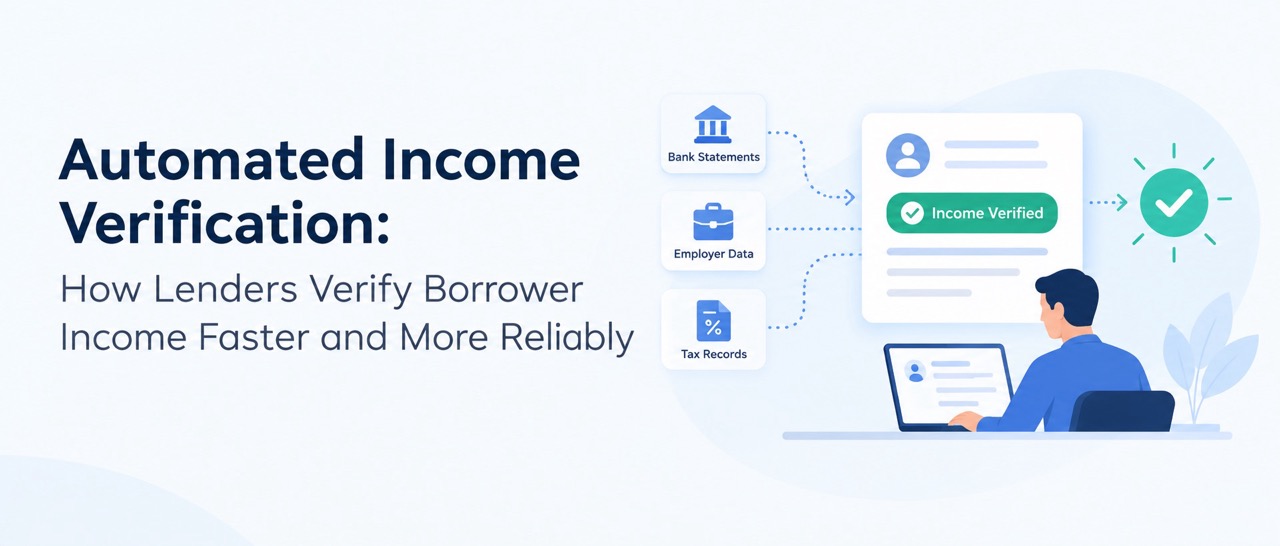
Value lies in making comparisons of income streams in the same verification process rather than examining each source separately. Normally, the process begins with the loan applicant sending in an application form with information on income and employment. Depending on the type of loan product being offered, the verification process identifies the sources to be verified.
When dealing with a salary earner for a personal loan product, the lender will verify the income from payroll or financial transactions while the payslip serves as proof.
The payslip offers information about the employer’s name, pay period, gross salary, deductions, and net salary. Document-processing technology can extract these fields automatically. But the document still represents information supplied by the borrower or employer; it does not necessarily prove that the stated amount was actually received.
Bank data provides a different form of evidence. Recurring salary credits can show what entered the borrower's account and how consistently it was received.
Payroll or employment data can provide another layer by confirming current employment and reported earnings where that data is available.
The lender can then compare the sources:
Application income → payslip → payroll data → bank credits
If both figures are within the allowed tolerance level by the lender, the process can continue. However, if there is a considerable discrepancy, the process flow may indicate how to proceed further.
Take, for instance, when there is a slight variation between claimed ₹75,000 salary and confirmed ₹73,500 salary. A much larger difference may require another verification or manual assessment.
This is an important distinction: automated verification does not mean automatically accepting whatever the first data source returns. It means applying a consistent process to the evidence available.
When Automated Income Verification Makes Sense, and When Manual Review Still Matters
Automated income verification is most useful when lenders process a large number of applications where income assessment follows a reasonably defined policy.
Consumer lending is a strong example. A lender may receive thousands of applications where the relevant questions are largely consistent: Is the borrower employed? What income is being received? Is it recurring? Does it meet the product's minimum requirement? Does it support the requested repayment?
Automating those checks allows the credit team to spend less time validating routine applications. It becomes less straightforward with income that does not fit a standard pattern.
A self-employed borrower may receive business income across several accounts. A contractor may have irregular payments. A salesperson may receive a low base salary with substantial commission. A recently employed borrower may have only one or two salary credits. These cases do not necessarily indicate a problem. They simply require a different assessment.
Automation should therefore handle standard verification and identify cases where the available evidence does not fit the lender's normal criteria. Manual review remains important where the lender needs to interpret unusual income rather than simply verify a predefined condition.
Automated Income Verification vs. Document-Based Income Verification
DBV involves information from the documents provided by the borrower himself; this might include pay slips, bank statements, tax papers, or letters from their employer.
But then, there is an issue for the lender to decide whether the information provided in those documents reflects the current situation of the borrower's income. The automated process involves these documents and can link to the payroll, bank, employment, or any other information sources.
For instance, we may consider the case where the borrower provides a payslip with a sum of ₹85,000. The DBV process will only involve checking whether the required information is present in the provided document.
In the automated income verification process, the information can be compared against the regular deposits to the bank account and/or payroll information, and if the two match, the credibility of the information will increase.
Documents remain useful when direct data is unavailable or when additional evidence is required. The difference is that documents become one input into the verification process rather than the entire verification process.
How Nected Helps Connect Verified Income to Credit Decisions
Automated income verification produces a verified income result, but that result still needs to be used within the broader credit workflow. The lender may need to calculate qualifying income, compare it with affordability requirements, or determine whether a discrepancy requires additional verification or manual review.
Nected can complement existing income-verification and lending systems by providing a configurable decisioning and workflow layer for these rules.
For example:
Verified income → qualifying-income rules → affordability check → next lending action
Income verified + qualifying income meets requirement → Continue processing
Income discrepancy → Additional verification
Qualifying income below product threshold → Credit review
Income source requires manual assessment → Underwriter review
It enables lenders to use their income/affordability criteria on actual data without incorporating all policy criteria in the core loan system.
As income policies change, for example, how variable compensation is treated or which income sources qualify, the decision logic can be updated independently of the broader lending workflow.
The verification systems remain responsible for establishing the income evidence, while Nected can help determine what should happen next based on the lender's configured rules.
Conclusion
Automated income verification is most useful when lenders need to establish which income can be relied on for a credit decision, rather than simply confirm that a borrower submitted supporting documents.
Payslips, payroll records, bank transactions, and employment data provide different forms of evidence. The combination allows lenders to compare declared income with validated income, determine qualified income, and identify any discrepancies, as well as direct exceptions appropriately.
Combining Nected into this process enables lenders to leverage a decisioning and workflow layer to connect validated income with affordability, eligibility, referral, and approval criteria.
The goal is not to remove human judgment from income assessment. It is to make routine verification consistent and reserve manual review for cases that genuinely require interpretation.
Frequently Asked Questions
What is automated income verification?
AI-enabled income verification involves using interconnected data sources and predetermined criteria for establishing whether or not the stated income level of the borrower is credible.
What sources can lenders use to verify income?
It depends on the lending instrument and market on how lenders make use of the Payslip, Payroll, Bank Transactions, Employment Information, Tax Data, and more.
Is a payslip enough to verify borrower income?
Not always. While a payslip may prove that the income was reported for the specific period, it does not necessarily confirm receipt by the borrower of such income and its continuous nature. This could be further verified from the banks or payroll records.
What happens when declared income differs from verified income?
The lender can apply a defined policy. The application may require additional verification, use a different qualifying-income figure, or be referred for manual review.
Can automated income verification handle self-employed borrowers?
It can, where reliable financial or transaction data is available. On the other hand, earnings from self-employment tend to be more inconsistent and may need further analysis of income from business activities.
Does automated income verification replace underwriters?
No. It handles defined verification checks and identifies discrepancies. Underwriters remain important for cases involving irregular, complex, or insufficiently verified income.
How does income verification affect credit decisions?
Verified income can feed affordability calculations, debt-to-income ratios, loan eligibility, and approval limits. This allows the lender to use verified rather than simply declared income when assessing the application.
Why should income verification be connected to the lending workflow?
Because verification is only one stage of the credit process. Connecting the result directly to affordability and decision rules prevents manual data transfer and allows the application to move immediately to the appropriate next step.
How can Nected support automated income verification?
Nected can apply configurable rules to verified income and related lending data to determine the next action, such as continuing processing, requesting additional verification, or routing the application for credit review.