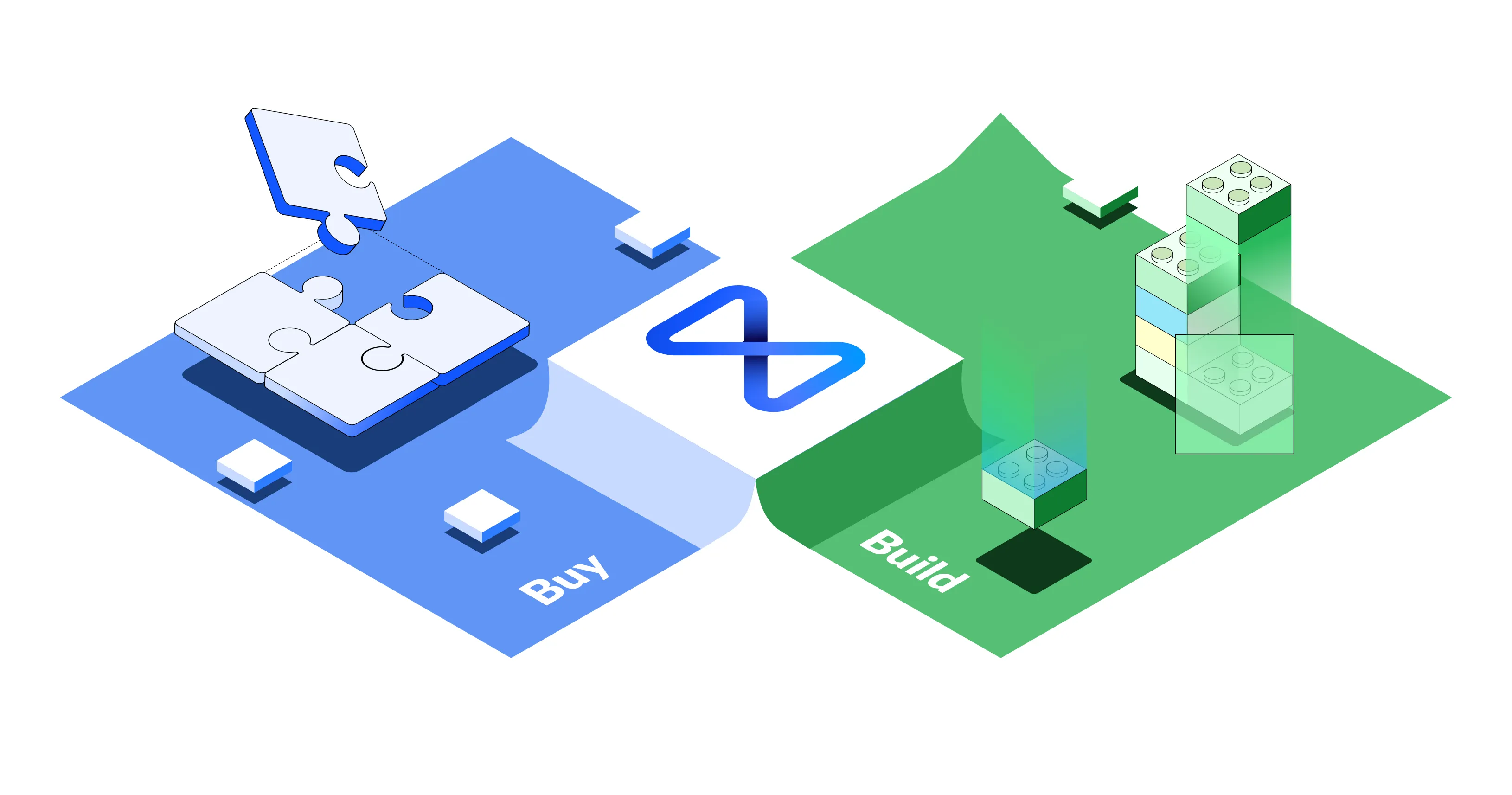
Build or Buy? Why In-House Solutions Often Fail

Product teams often start with YAML or Drools, but they then encounter scaling issues, rising costs, and poor business adoption. Nected is a faster alternative: a flexible, production-ready decision engine that you can use from day one.

Launch in Days Not Months, 10x Cheaper Dev in 12 Months, No Infra Maintenance or Monitoring, Business Teams Control Logic, Versioning Audit Trails More, Enterprise Security Minus Cost
  • Real-Time Assessment using API Connector
  • Customize Scoring Rules in No-code/low-code
  • Automated Decision-making via CRON
  • Built Complex Scoring Models in Minutes
  • Integration with Third Party Systems
  • Iterate Conditions Instantly
Used by teams across 500+ companies globally

Why Most Internal Rule Engines Can’t Keep Up

Building in-house might seem cost-efficient—until it isn’t. Internal tools often look flexible at first, but fail to keep pace with real-world business needs.

Build Never Stops Icon
'Build' never stops
What starts as a simple rule engine turns into a full-blown system: pipelines, infra, data handling, deployments, test orchestration. You're not building a tool—you’re building a product you'll have to maintain forever.
Engineering vs Business Velocity Icon
Engineering ≠ Business Velocity
Only a fraction of the work is logic. The rest is scaffolding. Business teams still depend on dev bandwidth for every update, so agility suffers, and backlog grows.
Cost Over Time Icon
It’s Not Cheaper in the Long Run
Open source isn’t free once you add infrastructure, developer hours, and scaling challenges. By year two, the “savings” vanish, replaced by ongoing overhead and firefighting.
No Interface for Business Icon
No Interface for Business Teams
Homegrown tools lack access controls, audit logs, or a usable UI. So, business users wait on Jira tickets, and engineers become bottlenecks for every small rule change.

Schedule a Call for Your POC

They Built Internally. Then Moved to Nected.

Real teams tried building internal solutions. Here’s what happened next.

Profile image
Greg R.

Tech Lead, Sidecar Health (Healthcare · 500+ Employees)

"Our internal system was flexible—but painfully slow to update."
"We built a basic rule engine in-house to manage pricing rules. It gave us control, but every rule update required dev coordination and full QA cycles. Over time, changes slowed down ops. Once we moved those flows to Nected, we instantly saw results. Pricing logic became business-owned. Today, we're expanding it across routing, too—without touching infra."
Profile image
Kartik Raina

Engineering Manager, Tata 1mg (HealthTech · 1,000+ Employees)

"We spent months building flows that Nected gave us in days."
"At 1mg, we built custom logic to handle pricing and customer workflows. The architecture worked—until we needed speed. Rollouts were blocked on sprints, and business teams couldn't touch logic. Nected changed that. What used to take us three months of dev work, we shipped in three weeks—with zero regression. Ops and support overhead dropped too."
Profile image
Souradeep Paul

Director of Product, Brightchamps (EdTech · 500+ Employees)

"Every product change needed backend support. It didn't scale."
"Our in-house rule logic was hardcoded into our backend—every small logic tweak went through engineering. We knew it wasn't scalable. Once we moved our logic to Nected, we could iterate without dev involvement. It reduced our development time by 50% and gave us modularity we didn't have before. We're shipping faster—and without creating tech debt."
Profile image
Head of Strategy

Wealthright (FinTech · 200+ Employees)

"We couldn't iterate on incentives fast enough—until we left our scripts behind."
"We initially handled incentive logic with code and Excel-based systems. Updates were slow, testing was manual, and business teams couldn't experiment. With Nected, we moved that entire process into dynamic workflows. Now our ops team updates rules themselves. Development is 80% faster, and we've eliminated rollout delays entirely."

COMPARE

Capabilities Nected Delivers That Hard-Coded Solutions Don’t

Feature
Rule Ownership
Change Velocity
Implementation Time
AI-Native Decisioning
Workflow & Automation
TCO (Annual)
Performance
Security & Governance
Cloud-Native Language-Agnostic
Migration
Hard Coded/Open Source
Owned by engineers
Instant deployment
Days to weeks
Manual integration
Built-in workflow and automation
$135K-$303K/year (80%+ savings)
Optimized for rule evaluation (3x faster P95 latency)
Built-in security and governance
Significant infrastructure work
Automated DRL conversion + parallel run support
Nected
Owned by engineers
3-5 hours per change
3-6 months
No / Manual / Limited
Custom instrumentation required
$653K-$2M/year
Depends on code complexity
Custom instrumentation required
No / Manual / Limited
N/A

Not Just Inefficient—In-House Rule Engines Are Costly Too

Before you commit engineering hours and budget to building a decision engine—or wiring Drools into production—pause and run the numbers.

Year 1 Year 2 Year 3 Year 4 Year 5

ROI Comparison

Total Cost of Ownership

Hard Coded
(In-House)
$137,500
cumulative
$75K–$200K initial
Open Source
(like Drools)
$85,000
cumulative
$50K–$120K initial
$6,500
cumulative
$4K–$9K (Startup)
Time to First Value 6–9 months 3–6 months Days to weeks
Developer Headcount 3–5 FTEs 2–4 FTEs 0–1 FTE
Iteration Speed 2–4 weeks per change 1–2 weeks per change Minutes (live updates)
Business User Access No (engineering only) No (custom UI required) Yes (visual, no-code)
Audit, Versioning, SLA Custom-built, high effort Partial, requires extensions Built-in, enterprise-grade
Infra & Ops Overhead High (dedicated infra & ops) High (infra, tuning, support) Minimal (managed)
Upgrade & Tech Debt Risk High (manual rewrites) High (framework upgrades) None (platform-managed)
Total Cost per Year (1000 TPS) $670K–$1.31M $653K–$2.07M $135K–$303K
Total 3-Year Cost (1000 TPS) $2.01M–$3.94M $2.09M–$5.84M $405K–$909K

Success Stories Across Industries

Drools slowed them down with code-heavy logic and zero workflow support. Nected helped them move faster, scale smarter, and hand control back to the teams that need it. Here’s what they have to say after making the switch:

Souradeep P.

Director of Product Management (Ed-Tech)

★★★★★
“Best Business-Friendly Decision Engine”
“We cut development time by 50% and launched region-specific promotions in hours instead of weeks.”
Verified User

Financial Services

★★★★
“Adaptable, Flexible & Faster for Lending Decisions”
“Policy changes that once took weeks were implemented in under 24 hours, shifting technical effort away from engineering teams.”
Verified User

Apparel & Fashion

★★★★★
“Rules Engine & Logic Module”
“We centralized previously undocumented workflows, enabling consistent, error-free decisions while reducing manual effort.”
Julian F.

Administrator

★★★★★
“It Allows Me to Process My Ideas Better”
“We consolidated multiple tools into a single platform, eliminated context switching, and improved overall productivity.”

Like Building It Yourself—Only Faster, Cheaper, and Scalable

Full Control & Flexibility
Nected provides developer-level control through a low-code/no-code interface—allowing both technical and non-technical teams to define and manage rules easily.
Cost Savings with Open-Source Tools
Open-source tools seem affordable but increase long-term maintenance effort. Nected delivers predictable pricing and reduced overhead.
Rapid Deployment
Pre-built integrations and a clean UI allow Nected to go live in days, not months—avoiding delays common with in-house builds.
Business-Friendly Interface
In-house UIs can slow down business teams. Nected’s intuitive, no-code dashboard puts rule control directly in their hands.
Built-In Experimentation & Testing
A/B testing in custom builds is difficult to implement. Nected has native experimentation tools—enabling logic testing without added effort.
Comprehensive Governance & Compliance
Audit trails, version control, rollback, and certifications are built in—ensuring governance and compliance from day one.

See Nected vs In-House Build in 15 Minutes

Watch how fast you can deliver decision automation with Nected—what would normally take months of internal development and ongoing maintenance.

In this demo, you’ll see:

  • Rules and workflows built visually, without custom code
  • Instant testing and one-click deployment (no CI/CD setup required)
  • Seamless integrations without writing custom connectors
  • Business teams updating logic directly, without developer bottlenecks
  • Monitoring, versioning, and rollback built-in from day one

Perfect for: Engineering leaders evaluating build vs buy, product managers pushing for faster delivery, and executives seeking predictable costs and rapid ROI.

Stop babysitting brittle logic. Start scaling with Nected
Switch Now
Built for Innovators, Trusted by Experts

At Nected, we don’t just offer another automation tool—we provide a frustration-free alternative to rigid, outdated decision engines.

Joe Shoop
Director Of Engineering
We spent months struggling with a rigid rule engine that needed constant developer involvement. Switched to Nected, and now our pricing rules update in real-time—without engineering bottlenecks.
James W.
director of product
Our previous tool lacked proper audit logs, making compliance a nightmare. With Nected, we track every change, rollback when needed, and stay fully compliant.
Michael T.
Director Of Engineering
Scaling with our old system was impossible. Every time we tried to expand our pricing models across new regions, we ran into performance issues, API rate limits, and frustrating downtime. Nected handled multi-region deployments effortlessly, allowing us to launch in new markets without a hitch. It’s the kind of flexibility we always needed but never had—until now.
Olivia B.
Senior Product Manager
Performance issues used to plague our old system—delays, downtime, and inconsistent results. Nected handles high-volume decisions instantly, without breaking a sweat.
William S.
Business Head
We used to lose deals because our decision engine couldn’t handle complex client-specific pricing structures. Our competitors had more flexible offerings, and we were falling behind. Switching to Nected changed that overnight. We can now implement dynamic, real-time pricing models tailored to each client, giving our sales team the edge they always wanted.
Ava K.
Director Of Engineering
Nected doesn’t box us in—it seamlessly connects with our existing tools, integrates with any system through APIs, and scales as our business evolves.
Ethan D.
Business Head
We used a decision tool that felt like it was built in the early 2000s—clunky, unintuitive, and slow. Nected is modern, smooth, and designed for how businesses operate today.
Sophia L.
Senior Product Manager
I didn’t realize how inefficient our decision automation was until we switched. What used to take days of manual adjustments and back-and-forth approvals now happens in minutes with Nected’s automated workflows. We’ve slashed operational costs, reduced human errors, and finally have a system that moves as fast as we do.

FAQs

What is Nected’s Decision Engine?

It’s a low-code decision automation system that lets you define and evaluate business logic through visual rule chains, APIs, and structured conditions—without modifying backend code.

Who is it for?

Product, finance, risk, and ops teams who want control over decision logic without relying on developers.

What kind of decisions can I automate?

You can handle credit approvals, pricing decisions, payout rules, fraud flags, user onboarding paths—any conditional, data-driven business logic.

How is it different from IBM ODM or other rule engines?

Nected gives you a faster, more visual interface with no-code deployment, built-in rule chaining, live variant testing, and data source integration—without deep setup or vendor lock-in.

Can it connect to external data sources?

Yes. You can fetch input from APIs, databases, spreadsheets, or CRM tools in real time.

Can I audit and version logic changes?

Yes. Nected tracks every version and execution with detailed logs, making it easy to maintain transparency and compliance.

What do you mean by invocations? And how is it better than other products?

Invocations refer to the number of times your workflows/rule is triggered via API, cron or other trigger. It will count the parent rule/workflow and can have as many rules, nodes within it. This metric is often used for billing purposes. Compared to other products, invocations as a billing metric can be more cost-effective and transparent, aligning closely with your actual usage and needs. It ensures you pay for the value you receive, rather than flat rates or less relevant metrics.

What if I exceed my plan quota?

If you exceed, you'll be charged based on additional usage and will be added in your monthly charge. In case of payment failure after grace period, your plan will be reverted to free trial limiting your monthly execution and # of rules/flows as per free plan, however all your existing rules/workflow data would be kept intact.

What if I decide to cancel? Can I cancel anytime?

Firstly, we do not have a vendor lock-in, so you can cancel anytime you want. However, if you decide to cancel once your subscription for a given period has started then you would be able to cancel at the time of the next billing cycle only.

Can I upgrade my plan in between?

Yes, you can typically upgrade your Nected plan at any point during your billing cycle. The upgrade process is usually straightforward, often involving just a few clicks in your account settings. Upgrading mid-cycle may involve prorated charges for the higher-tier service.

Which plan should I go for?

The best plan depends on your specific needs, such as the expected number of invocations, the complexity of your workflows, and the level of support you require. It’s a good idea to start with a basic plan and upgrade as your needs evolve, especially if you're new to Nected. Moreover, you can also write to us at assist@nected.ai and we will help you figure out the best plan for your brand.

Would I be getting assistance in setting up Nected or building my POC?

Yes, Nected usually offers assistance in setting up and creating a Proof of Concept (POC), especially under certain plans. This assistance can include access to customer support, documentation, and possibly dedicated account management.

What level of support does the Startup and Growth plan have?

The Startup and Growth plans typically provide basic to enhanced support, including access to customer service through email or chat, a knowledge base, and possibly community forums. Response times and the extent of personalized assistance may vary between these plans.

What level of support does on-premise plan have?

The on-premise plan generally offers the most comprehensive support, including dedicated account managers, 24/7 support, and tailored assistance for deployment, maintenance, and troubleshooting. This plan is best suited for businesses with extensive, mission-critical use of Nected.

Check How Nected Performs compared to Others

Learn how TATA 1mg delivered 3 months of sprint in 3 weeks using Nected's Rule-Engine and Workflow.
Learn how Brightchamps reduced repetitive tech tasks by 80% with Nected.
Learn how Vidyakul optimized it's revenue and leads funnel in just 20 days with Nected.
Learn how Torch streamlined it's logistics and policies with Nected.
Learn how a global aviation giant supercharged their operations and marketing with Nected.
Learn how a client based B2B SaaS tool leveraged Nected to build seamless functions for many.
Learn how this Fintech company streamlined it's credit and lending policies with Nected.
Learn how Sidecar Health partnered with Nected to optimize health services, improve operational workflows, and deliver superior patient experiences through advanced automation.
No items found.

Q

Why shouldn't we just build our own decision engine in-house?

+

Many teams try, but in-house builds take 6–12 months to reach basic functionality, require a dedicated dev team, and pile on ongoing maintenance. Nected ships production-ready in days, with workflows, rule versioning, analytics, and integrations already built-in.

Can Nected handle complex, custom logic like an in-house system would?

+

Yes. Nected supports nested rules, decision trees, scoring models, and enterprise-scale workloads. Developers can extend it via APIs and SDKs, while business teams configure logic visually — so you get both flexibility and speed.

How does the long-term cost compare to building in-house?

+

In-house builds carry hidden costs — developer salaries, infra, upgrades, compliance, and support. Over 3–5 years, Nected typically costs 60–80% less, since you avoid re-inventing what's already solved.

What about integrations? Our systems are unique.

+

Nected provides pre-built connectors for databases, APIs, CRMs, ERPs, and payment systems. Anything custom can connect via our REST API. In practice, integrations are usually faster and more reliable than in-house connectors.

How scalable is Nected? Can it match what we'd build ourselves?

+

Absolutely. Nected is cloud-native and handles millions of calls per minute with sub-200ms response times. Auto-scaling ensures performance under peak loads, without the ops burden your team would shoulder in-house.

What deployment options are available?

+

Unlike a one-off in-house build, Nected offers SaaS (fully managed), Private Cloud, and On-Premise deployments. You choose the model that fits your compliance and data residency requirements.

Is Nected as customizable as a system we'd build ourselves?

+

Nected combines configurability (extendable via APIs and scripts) with usability (drag-and-drop builder for non-technical teams). You get the control of an in-house build without the complexity tax of maintaining it.

How secure is Nected?

+

Security is built in from day one: SOC 2, ISO, GDPR readiness, RBAC, SSO, audit logs, versioning, and encryption. With in-house builds, you'd have to implement and maintain these controls yourself.

What about compliance and auditability?

+

Nected provides decision logs, rollback protection, audit trails, and governance out of the box. These are features most in-house teams underestimate and end up bolting on later at great cost.

Users Share Issues with Camunda and
Look for Alternatives

Adam J.

Project Manager

★★★★
“Limited Collaboration for Non-Technical Teams”
“Camunda’s complexity makes it difficult for non-technical team members to participate in rule management, limiting overall project efficiency.”
Leo M.

Business Analyst

★★★★
“Slow Iterations”
“Adapting to rapidly changing business requirements is challenging with Camunda. The need for technical intervention at every step slows down the process."
William R.

IT Consultant

★★★★
Scalability Issues”
“As our project scaled, we faced significant performance issues with Camunda. Optimizing for scalability required considerable effort and resources.”
Lucy C.

Investment Banker

★★★★
“Learning Curve”
“It requires a lot of effort to learn how to use it. I don't see good integration with cloud solution. It looks not enough resource/doc on how to run on distributed systems”
Adam J.

Project Manager

★★★★
“Limited Collaboration for Non-Technical Teams”
“Camunda’s complexity makes it difficult for non-technical team members to participate in rule management, limiting overall project efficiency.”
Leo M.

Business Analyst

★★★★
“Slow Iterations”
“Adapting to rapidly changing business requirements is challenging with Camunda. The need for technical intervention at every step slows down the process."
William R.

IT Consultant

★★★★
“Scalability Issues”
“As our project scaled, we faced significant performance issues with Camunda. Optimizing for scalability required considerable effort and resources.”
Lucy C.

Investment Banker

★★★★
“Learning Curve”
“It requires a lot of effort to learn how to use it. I don't see good integration with cloud solution. It looks not enough resource/doc on how to run on distributed systems”