.svg)

.svg)
.webp)


.png)

To a regulator, risk management is a massive binder of policies and compliance checklists. To an engineer building banking infrastructure, risk management is a set of absolute constraints on your system design.
You aren't just building CRUD apps. You are building highly concurrent systems designed to detect, track, and mitigate financial disaster in real-time—often before a database transaction is even allowed to commit. If your risk pipelines are weak, your architecture will inevitably fail at the exact moment the market gets volatile.
For banks, this isn’t just a compliance box to tick. It’s part of how the business stays stable and keeps trust intact. If the process is weak, things usually break in the same places first: credit exposure, operations, and reporting. Banks that handle risk well tend to react faster and avoid expensive surprises.
What Is Risk Management in Banking
Risk management in banking is the process banks use to identify, assess, control, and monitor the risks tied to lending, transactions, operations, and regulation. The goal is pretty simple. Keep losses under control and make sure the bank can keep functioning when conditions get messy.
Importance of Effective Risk Management in Banking (Financial Institutions)
The importance of effective risk management in financial institutions cannot be overstated. Banks operate in an environment full of uncertainty, where risks can come from economic shifts, geopolitical tensions, technology changes, and shifting regulations. Without a solid framework, banks can face major losses, reputation damage, or worse.
Effective risk management helps banks:
Ensure Financial Stability: By spotting and reducing risks early, banks can avoid large losses and protect their balance sheet.
Build Trust and Reputation: Banks that handle risk well look more reliable to customers, investors, and regulators. That matters more than it sounds.
Optimize Returns: When risks are understood, banks can make better decisions and take the kind of calculated bets that actually fit the business.
Sign up with Nected and streamline risk management in banking today!
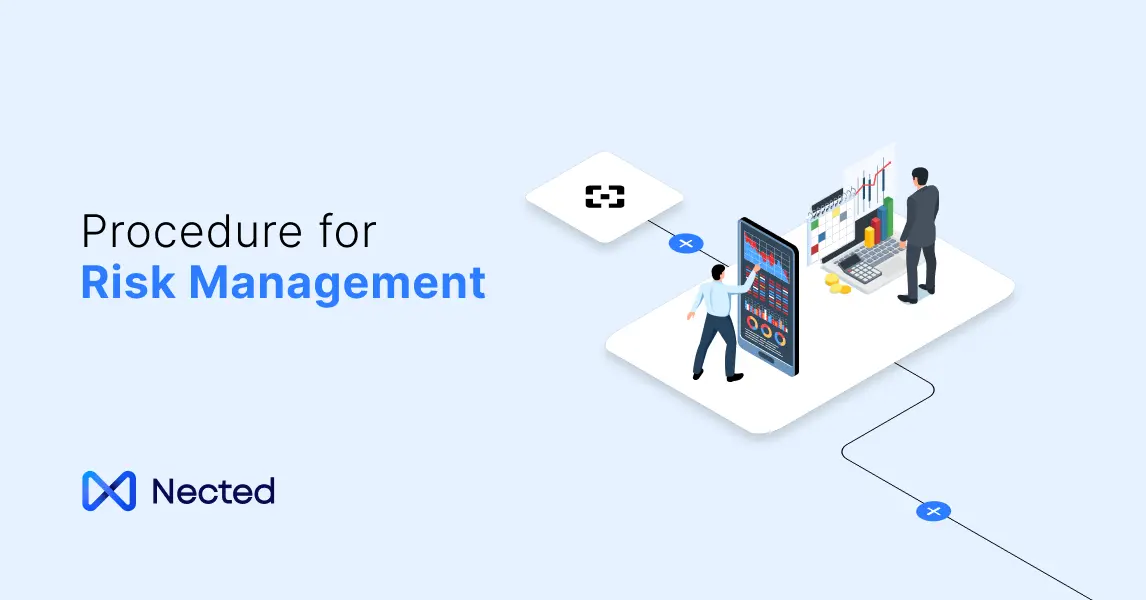
Risk Management Process in Banking
The process is usually pretty direct, though each bank handles it a little differently.
Risk Identification comes first. Banks look for exposures across lending, trading, operations, and compliance. This part often gets ignored until something goes wrong.
Risk Assessment follows. The bank measures how likely the risk is and how much damage it could do. Stress tests, scoring models, and exposure analysis usually show up here.
Risk Mitigation is where banks act. They may tighten lending rules, hedge positions, improve controls, or limit exposure.
Monitoring & Reporting keeps the whole thing alive. Risks change, and the reporting has to keep up or the process becomes useless fast.
Risk Management in the Banking Sector
Risk management in the banking sector is shaped by regulation as much as by internal policy. Banks don’t just build strategies on their own. They work inside frameworks set by regulators, and Basel guidelines are a big part of that.
In practice, banks implement risk strategies through policy limits, review cycles, model checks, and controls around high-risk activity. The stronger banks are usually the ones that keep this tied to day-to-day decisions instead of treating it like a separate department problem.
Goals of Risk Management in Banking Sector
The primary goals of risk management in banking sector include:
Capital Preservation: Protect the bank’s capital from avoidable losses.
Regulatory Compliance: Stay aligned with rules so penalties and sanctions don’t pile up.
Operational Continuity: Keep services running even when something goes wrong.
Strategic Risk-Taking: Let the bank take informed risks instead of random ones.
Enhancing Stakeholder Value: Keep the risk-return balance healthy for shareholders, customers, and everyone else involved.
Risk Management Tools in Banking
Banks use a mix of risk management tools, and the stack usually gets messy in real life.
Risk assessment tools help score credit exposure, measure market movements, and test different scenarios. These are the tools teams lean on before approving loans or pushing capital into a new area.
Monitoring systems track transactions, exposures, and unusual activity in real time. That’s where fraud flags and threshold alerts usually come from.
Compliance tools keep policies mapped to regulatory requirements. They help with audit trails, reviews, and reporting. Banks need this stuff more than they like admitting.
Automation platforms connect the whole process. They reduce manual work, keep decisions consistent, and make it easier to update rules when regulations change.
The Four Core Risk Pipelines
Risk management isn't a single microservice; it is embedded across four distinct execution paths in the banking stack:
- Loan Approvals (Synchronous Orchestration): You aren't just checking a local database column for a credit score. You are orchestrating synchronous API calls to external bureaus, parsing unstructured financial histories, and evaluating them against strict compliance thresholds—all before the user’s browser session times out.
- Fraud Detection (Real-Time Event Streaming): This is pure, low-latency stream processing. You have to evaluate malicious payloads, check IP velocity, and block the action before the database transaction actually commits.
- Transaction Monitoring (Asynchronous Aggregation): Flagging unusual payment patterns by running continuous, asynchronous queries over massive, incredibly noisy historical datasets.
- Portfolio Management (Distributed State): Aggregating exposure metrics across millions of distributed accounts to ensure the institution isn't over-leveraged in a single sector.
Systematic Approach Employed by Banks to Manage Risks
Banks don't just guess at these thresholds. They enforce risk using a rigid, six-step architectural pipeline. If you are building a fintech app, this is the blueprint you are trying to replicate:
- Risk Identification (Data Ingestion): You can't evaluate what you can't see. This step requires building the pipes to pull in raw telemetry, third-party market feeds, and historical transaction logs into a centralized data lake or message broker.
- Assessment & Measurement (Algorithmic Evaluation): Once the data is ingested, the system runs heavy quantitative models. Instead of basic if/else checks, the engine calculates complex metrics like Value at Risk (VaR) and runs automated stress tests against the payloads.
- Risk Mitigation (Automated Execution): Based on the assessment, the backend triggers programmatic responses. This is the code that instantly freezes a compromised account, dynamically adjusts a credit limit, or routes a transaction to a manual review queue.
- Monitoring (Continuous Streaming): Risk isn't evaluated just once at onboarding. The architecture requires continuous, real-time analytics to ensure the aggregate risk profile of the entire bank stays within acceptable mathematical limits.
- Reporting (Immutable Auditability): When regulators knock on the door, you cannot hand them an application log full of stack traces. The system must generate perfectly formatted, tamper-proof execution traces proving exactly why a decision was made.
- Review and Adaptation (Iterative Deployment): Market conditions and federal regulations shift constantly. The system must be designed so that underlying risk models can be updated immediately without breaking the core application.
Incorporating these systematic steps allows banks to manage risk better and react faster when conditions shift.
Nected's low-code/no-code rules engine and workflow automation tools help banks handle risk more efficiently. The rules engine makes it easier to adjust to changing regulations without heavy coding, while workflow automation keeps the process consistent. Together, they reduce manual work and help teams stay on top of control checks.
Types of Risks in Banking
Banks deal with a mix of risks, and each one hits differently. Understanding them is the starting point for any workable framework.
1. Credit Risk:
Credit risk is the risk of loss when a borrower fails to repay a loan or meet contractual obligations. It’s one of the biggest risks banks carry because lending sits at the center of the business.
Impact: Defaults hit principal, interest income, and asset quality all at once.
Management: Banks handle this with credit scoring, collateral, underwriting standards, and sometimes credit derivatives.
2. Market Risk:
Market risk comes from movements in interest rates, equity prices, exchange rates, and commodity prices.
Impact: These shifts can cut into the value of trading and investment portfolios pretty quickly.
Management: Diversification, hedging, derivatives, and constant monitoring are the usual defense.
3. Operational Risk:
Operational risk comes from broken internal processes, failed systems, weak controls, or external events. Fraud, legal issues, and system outages all fit here.
Impact: The result is usually losses, penalties, and a hit to reputation.
Management: Controls, audits, and cybersecurity are the basics. Banks that skip them pay for it later.
4. Liquidity Risk:
Liquidity risk is the chance that a bank can’t meet short-term obligations because cash isn’t available when needed.
Impact: A liquidity crunch can shake confidence fast and push the bank into a much worse position.
Management: Banks use reserves, liquidity stress tests, and funding diversification.
5. Interest Rate Risk:
Interest rate risk comes from changes in rates that affect net interest income and asset values.
Impact: Even small changes can squeeze profitability.
Management: Asset-liability management, gap analysis, swaps, and scenario analysis are common responses.
6. Compliance Risk:
Compliance risk is the chance of legal trouble, financial loss, or reputational damage from breaking laws, rules, or standards.
Impact: Non-compliance can lead to fines, legal action, and trust issues that linger.
Management: Banks rely on training, monitoring, reporting, and compliance programs that actually get used.
Each risk needs a different response, but they still have to fit into one framework. That part is where a lot of teams struggle.
Benefits of Risk Management in Banking
Effective risk management in banking gives institutions a few very real advantages:
Financial Stability: Less exposure means fewer major losses, which helps the bank stay steady even when the market turns rough.
Regulatory Compliance: Strong controls make it easier to stay within regulatory requirements and avoid penalties.
Enhanced Decision-Making: With clearer risk data, banks can make better calls on investments, lending, and expansion.
Reputation and Trust: Customers and regulators notice when a bank handles risk properly. It builds confidence over time.
Operational Resilience: Good risk management helps banks keep moving when internal or external disruptions hit.
Long-Term Growth: Once the basics are under control, banks can grow with a little more confidence instead of guessing.
Read Also: Incentive Compensation Management: Nected's Simple Solutions
Best Practices in Banking Risk Management
A few habits make the whole system less fragile.
Strong banks usually start with a clear risk framework that brings credit, market, operational, and compliance risks into one place.
They also keep monitoring active instead of treating it like a quarterly exercise. That part gets ignored more often than it should.
Stress testing matters too. So does scenario analysis. If the model only works in calm conditions, it isn’t much of a model.
Regulatory alignment has to be built in from the start. Risk culture matters as well. People need to know what the controls are and why they exist.
Technology helps a lot here. Tools like Nected can automate repetitive checks, keep workflows consistent, and cut down on manual errors.
Conclusion
Risk management in banking is what keeps financial institutions stable, compliant, and able to grow without stumbling over preventable losses. Banks that treat it seriously usually have a better shot at handling uncertainty when it shows up. The tools change, the rules change, and the pressure never really stops. The banks that stay sharp are the ones that keep adapting.
FAQs
Q1. What is Risk Management in Banking?
Risk management in banking is the process banks use to identify, assess, and reduce risks tied to lending, operations, markets, and compliance. It keeps the institution steadier and protects depositors, investors, and the bank itself.
Q2. Why Is Risk Management Important for Banks?
Risk management matters because it helps banks protect assets, stay compliant, and avoid avoidable losses. It also makes decisions less reactive, which is usually a good thing in banking.
Q3. How Does Nected Enhance Banking Risk Management?
Nected helps banks automate risk workflows, connect rule-based decisions, and keep processes consistent. That makes it easier to update controls when regulations or market conditions change.
Q4. What Key Risks Do Banks Need to Manage?
Banks need to manage credit risk, market risk, operational risk, liquidity risk, interest rate risk, and compliance risk. Each one needs a different response, but they all need attention.
Q5. How Can Nected Help Banks Optimize Their Risk Management Processes?
Nected gives banks a low-code/no-code way to build and adjust risk workflows faster. That cuts down on manual work and makes it easier to respond when something changes.


.webp)
.svg.webp)







.webp)





%20(1).webp)