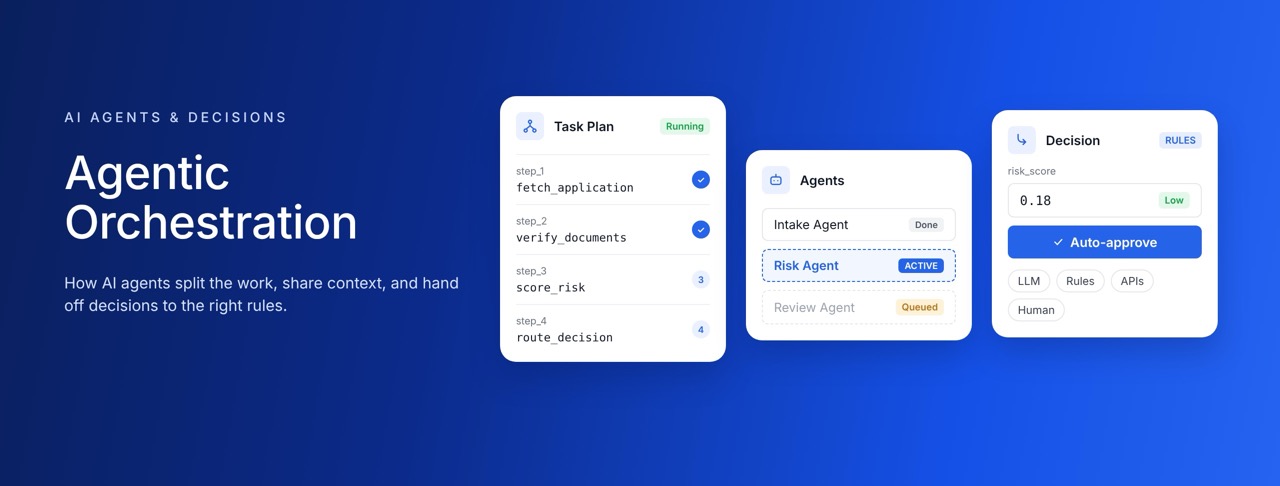


Moving from a single AI agent to a production multi-agent system introduces a coordination problem. Multiple agents may need to share state, call tools and APIs, hand off work, recover from failures, and operate under different permission boundaries.
An agentic orchestration layer manages these interactions. It controls task execution, context propagation, tool access, state transitions, and routing while providing the observability and governance required to operate agent workflows in production.
This article covers the architecture, orchestration patterns, security and reliability considerations, and best practices for building production-grade agentic systems.
What Is Agentic Orchestration?
Agentic orchestration is the runtime layer that coordinates AI agents, models, tools, APIs, and application services across a multi-step workflow. It manages how work is delegated, how execution state is maintained, and how components hand off results to one another.
In a production system, an agent may need to retrieve data, call an API, invoke another specialized agent, evaluate a result, or trigger an application action. The orchestration layer manages these dependencies and determines what should execute next based on workflow state and intermediate results.
It can also enforce execution policies such as timeouts, retries, permissions, validation, and human-approval gates. This becomes especially important when agents have access to databases, internal APIs, cloud services, or systems that can perform real-world actions.
The distinction is straightforward: an agent performs a task; an orchestrator manages how multiple agents, tools, and services work together to complete the workflow.
Also Read: What is Orchestration and How It is Different from Automation?
Agentic Orchestration vs. Traditional Workflow Automation
Traditional workflow automation follows predefined steps, conditions, and branches. Agentic orchestration introduces model-driven execution, allowing workflows to adapt based on runtime context and intermediate results. Here’s the comparison:
AspectTraditional Workflow AutomationAgentic OrchestrationExecution modelFollows predefined steps and branchesCan dynamically determine execution based on context and resultsDecision logicDeterministic rules, conditions, and expressionsModel-driven decisions combined with rules and workflow logicTask routingRoutes to paths defined at design timeCan select agents, tools, or tasks at runtimeWorkflow adaptabilityHandles scenarios explicitly defined in the workflowCan respond to intermediate results and previously unknown inputsState managementWorkflow state is explicitly defined and persistedCombines workflow state with task-specific agent context and outputsExternal actionsApplication services and integrations execute predefined actionsAgents can select and invoke permitted tools and APIs during executionFailure handlingPrimarily handles known workflow and integration failuresMust account for tool failures, model errors, invalid outputs, and agent coordination failuresHuman interventionAdded at predefined workflow checkpointsCan be triggered dynamically based on risk, uncertainty, or policyPredictabilityHigh when workflow paths and inputs are knownLess deterministic unless constrained by workflow logic, validation, and business rulesTestingFocuses on workflow paths, conditions, and integrationsRequires testing agents, tool calls, prompts, routing, state transitions, and end-to-end behaviorBest fitStable, rule-driven business processesDynamic workflows requiring reasoning, tool use, and runtime adaptation
How Agentic Orchestration Works
Agentic orchestration starts with a goal, event, or application request and manages the execution required to complete it. The orchestrator determines what work is required, selects the appropriate agent, model, tool, or service, and provides the context needed for that step.
Task planning can be implemented through predefined workflow logic, model-based planning, or a combination of both. For example, a software-engineering workflow might route an issue through code analysis, test generation, test execution, and review. Each step can be handled by a specialized agent or a deterministic application service.
After a component executes, the orchestrator evaluates the returned result and updates the workflow state. The result may trigger the next task, a different execution path, a retry, an escalation, or a human approval step. This allows the workflow to adapt to intermediate results instead of following a fixed sequence for every request.
State management is critical when multiple agents participate in the same execution. The workflow can maintain task status, previous results, tool responses, identifiers, decisions, retry information, and errors. Agents should receive only the context required for their current task rather than the complete execution history.
For example, an extraction agent may return structured customer data that is passed to a validation agent. The validation result can then determine whether the workflow calls an external API, routes the case for review, or continues to the next agent. The orchestrator maintains the execution state across these handoffs.
This makes the orchestrator responsible for coordination, state transitions, routing, and execution control, while individual agents remain responsible for their assigned reasoning or task.
Also Read: Workflow Engine vs Orchestration Engine: Key Differences & Use Cases
Agentic Orchestration Architecture
A production agentic system typically connects the orchestration layer with agents, models, tools, state, data, business rules, and application services. The orchestrator sits between these components and controls how work moves through the system.
A typical architecture looks like:
Application or Event → Orchestrator → Agents/Models → Tools/APIs → Data & Services → Result → Orchestrator
The main components are:
- Orchestrator: Manages workflow execution, task routing, agent selection, state transitions, context propagation, retries, timeouts, approvals, and execution tracing. It coordinates the workflow rather than performing the specialized reasoning itself.
- AI Agents and Models: Perform specialized tasks such as classification, extraction, analysis, research, code generation, or decision support. Different agents can use different models based on capability, latency, cost, or modality requirements.
- Tools and APIs: Give agents access to external capabilities such as databases, search systems, CRM platforms, ticketing systems, internal APIs, cloud infrastructure, and code repositories. Access should be explicitly scoped to each agent rather than exposing every available tool.
- Shared State: Maintains the authoritative state of an execution, including task status, intermediate results, tool responses, identifiers, decisions, retries, and errors. This is separate from the context passed to an individual model.
- Data Sources: Provide the information agents need to perform their tasks. These can include operational databases, data warehouses, document stores, knowledge bases, search indexes, and external APIs. Access should follow the application's existing authentication and authorization controls.
- Business Rules: Apply deterministic constraints to agent-driven workflows. Eligibility checks, approval thresholds, compliance requirements, and routing policies can be evaluated independently of model output before an action is allowed to proceed.
- Events and Message Systems: Support asynchronous execution through queues, event buses, and webhooks. These systems can trigger or resume workflows when application events, system alerts, completed jobs, or external updates occur.
- Application Services: Execute actions outside the AI layer, such as updating records, creating tickets, sending notifications, executing transactions, or triggering downstream services. The orchestrator determines when these actions should occur and under what conditions.
Agentic Orchestration Patterns
Orchestration patterns define how agents execute tasks, share results, and handle dependencies. The right pattern depends on whether tasks must run in sequence, can execute concurrently, require dynamic delegation, or depend on an external event or human decision.
Here are the main agentic orchestration patterns used in production systems:
- Sequential orchestration: Tasks execute in a defined order, with the output of one step becoming an input to the next. This works when downstream tasks depend on earlier results. For example, a document-processing workflow can extract fields, validate the extracted data, and then run a compliance check. If validation fails, the workflow can stop or route the case for review. The trade-off is latency: every dependent step must wait for the previous one to complete.
- Parallel orchestration: Independent tasks execute concurrently, with their results combined before the workflow continues. A customer-support workflow could retrieve account information, search a knowledge base, and analyze the customer request concurrently. The orchestrator then combines those results for the next step. Parallel execution can reduce latency, but requires handling partial failures, result aggregation, rate limits, and increased concurrent resource usage.
- Hierarchical orchestration: A supervisor agent coordinates specialized agents instead of handling every task itself. It can assign work, collect results, determine whether additional tasks are required, and consolidate the outputs. This pattern is useful when the required work is dynamic. A research workflow, for example, could delegate retrieval, source verification, and analysis to specialized agents and request additional work when the returned evidence is insufficient.
- Event-driven orchestration: The workflow starts or resumes when an external event occurs. Events can originate from webhooks, message queues, application services, monitoring systems, or database changes. For example, a payment failure can trigger an investigation workflow that retrieves transaction details, evaluates the account, and routes the case based on the result. This pattern is useful for asynchronous and long-running workflows where the next action depends on an external system.
- Human-in-the-loop orchestration: Human approval is introduced at a defined point when an automated action requires additional authorization or review. An agent can prepare a recommendation while the orchestration layer pauses execution until an authorized user approves the action. This is useful for financial transactions, production changes, access modifications, and regulated decisions. Approval should be represented as an explicit workflow state rather than relying on an instruction in the agent's prompt. This allows the workflow to resume reliably and provides a clear audit trail.
Also Read: What is AI Decision Engine: The Complete Guide to Smarter, Faster Automated Decisions
Security in Agentic Orchestration
Agentic workflows expand the attack surface because agents can access APIs, databases, internal services, and external systems. Security must therefore control both agent access and the actions agents can perform.
Here are the key security controls:
- Authentication and authorization: Authenticate and authorize every tool and service invocation. An agent should not inherit unrestricted access simply because the orchestrator has access.
- Least-privilege permissions: Define which tools and operations each agent can use. For example, a support agent may read order data and create tickets without permission to modify billing records.
- Sensitive data protection: Restrict access to PII, financial data, credentials, and other sensitive information. Pass sensitive data to models only when required.
- Prompt injection and tool validation: Treat model output as untrusted when it can trigger external actions. Validate tool calls against permissions, schemas, destinations, and business policies.
- Secrets management: Keep API keys, tokens, and database credentials outside prompts and model context. Store and manage them through the application's infrastructure.
- Human approval for high-risk actions: Require explicit approval for actions such as financial transactions, production changes, or access modifications. The agent can recommend the action, but deterministic controls should authorize execution.
Reliability and Observability in Agentic Workflows
Agentic workflows can fail at multiple layers: models can produce invalid outputs, tools can timeout, APIs can fail, and intermediate results can be insufficient for downstream tasks. Production systems need bounded failure handling and end-to-end execution visibility.
Here are the key reliability and observability controls:
- Retries and timeouts: Use bounded retries for transient failures and define timeouts for model, tool, and API calls. Different failure types should use appropriate retry policies.
- Fallbacks: Where appropriate, fall back to another model, service, cached result, or human review instead of allowing execution to stall.
- Idempotency: Prevent retries from duplicating side effects. Actions such as payments, record creation, and notifications should use idempotency controls where required.
- Structured logging and tracing: Record the execution path, including workflow ID, agent/model, tool calls, state transitions, latency, retries, errors, and final outcome. Sensitive data should be protected or excluded from logs.
- Explicit error handling: Define whether a failed task should stop the workflow, trigger a retry, or allow execution to continue. Required checks should fail closed rather than silently proceeding.
- Workflow-level monitoring: Track end-to-end latency, failure rate, retry rate, token usage, cost, completion rate, and tool errors, not just model latency.
Also Read: Top 10 Workflow Orchestration Tools (2026 Guide)
Challenges of Scaling Agentic Orchestration
As agentic workflows grow, the main scaling challenges are:
- Workflow complexity: More agents and tools create more execution paths, making workflows harder to test, maintain, and debug.
- State and coordination: Multiple agents may depend on shared or intermediate state. Stale data, conflicting updates, or incompatible outputs can cause downstream failures.
- Latency and cost: Multiple model and API calls increase execution time and compute cost. Parallel execution, appropriate model selection, and controlled context size can reduce this overhead.
- Model unpredictability: Model outputs can vary between executions. Structured outputs, validation, and deterministic controls are necessary for workflows with critical decisions.
- Observability: Failures can originate from any agent, model, tool, or state transition. End-to-end tracing is required to identify where execution failed.
Building Agentic Workflows with Nected
Agentic workflows can handle interpretation and reasoning, but deterministic business policies should remain outside the model. This is where Nected fits into the orchestration layer. For example, an agent can extract application data and classify a financial case, while Nected evaluates the deterministic rules that decide whether the case is eligible, requires approval, or should be rejected.
The workflow can be structured as:
Application → Agent → Nected → Orchestrator → Action
- Agent extracts and interprets data: The agent processes the request and produces structured inputs required for the decision.
- Nected evaluates business rules: The orchestration layer sends those inputs to Nected. Nected evaluates configured conditions such as eligibility, thresholds, risk criteria, or approval requirements.
- Nected returns a decision: The decision is returned as structured output that the workflow can use for routing.
- Orchestrator executes the result: The workflow can continue to an API call, another agent, human approval, or termination based on the decision.
This keeps model reasoning separate from deterministic decisioning. The agent does not need to encode business policies in prompts, while the rules can be updated and tested independently of the model. Nected can expose the decision logic through APIs, allowing the same rules to be consumed by agentic workflows and existing backend services without duplicating policy logic across the application.
Agentic Orchestration Best Practices
Production agentic workflows need clear boundaries between agents, deterministic controls, and execution state. The following practices help keep workflows predictable, secure, and maintainable as they scale:
- Keep agent responsibilities narrow: Give each agent one clearly defined responsibility. This makes agents easier to test, monitor, and replace.
- Separate reasoning from business logic: Use models for interpretation and reasoning. Keep eligibility, routing, thresholds, permissions, and approvals in deterministic systems.
- Use least-privilege access: Give each agent only the tools, data, and operations required for its task.
- Keep workflow state explicit: Store authoritative execution state outside the model context. Pass agents only the context required for their current task.
- Design for failure: Define timeouts, retries, fallbacks, and termination conditions for external dependencies and agent failures.
- Test agent-tool interactions: Test agents, tool interfaces, routing logic, validation, and failure scenarios independently before relying on end-to-end tests.
Bottom Line
Agentic orchestration provides the control layer required when AI workflows move beyond a single agent and begin coordinating multiple models, tools, APIs, data sources, and application services.
Production systems need more than agent reasoning. They need explicit state, controlled tool access, deterministic business rules, failure handling, observability, and human oversight where required.
Using a decisioning layer such as Nected alongside agentic orchestration keeps deterministic business policies separate from probabilistic model behavior. Agents can handle reasoning and interpretation, while explicit rules control decisions that need to remain predictable, testable, and auditable.
FAQs
What is agentic orchestration?
Agentic orchestration is the coordination of AI agents, models, tools, APIs, state, and application services across a multi-step workflow. The orchestration layer controls task routing, context propagation, execution, state transitions, error handling, and next-step decisions.
How does agentic orchestration work?
An orchestration system receives a goal, decomposes it into tasks, selects agents or tools, provides relevant context, executes the tasks, evaluates results, updates workflow state, and determines what should happen next.
What is the difference between an AI agent and an orchestrator?
An AI agent performs a specific reasoning or execution task, typically using a model and potentially external tools. An orchestrator coordinates the overall workflow by deciding which component runs, managing dependencies and state, and controlling what happens after each result.
What are the main agentic orchestration patterns?
The primary patterns include sequential, parallel, hierarchical, event-driven, and human-in-the-loop orchestration. Sequential workflows handle dependent tasks, parallel workflows handle independent work, hierarchical workflows use supervisory coordination, event-driven workflows react to external events, and human-in-the-loop workflows introduce approval checkpoints.
How do you secure agentic workflows?
Use authentication and authorization at tool and service boundaries, enforce least-privilege permissions, protect sensitive data, isolate secrets from model contexts, validate tool calls, defend against prompt injection, and require human approval for high-risk operations where appropriate.
How do you monitor and debug agentic systems?
Use distributed tracing and structured logging to capture workflow execution, agent calls, model and tool interactions, state transitions, retries, errors, latency, and cost. End-to-end traces are particularly important because failures can originate from any component in a multi-agent workflow.
Can business rules be used with AI agents?
Yes. Business rules can provide deterministic constraints around model-driven decisions. An agent can interpret inputs or make recommendations, while a decisioning layer evaluates eligibility, thresholds, routing, compliance, or approval requirements before the workflow executes the resulting action.