

AI agents can reason over inputs, use tools, and take actions. But when a workflow involves multiple agents, APIs, data sources, and business systems, the challenge shifts from what one agent can do to how the entire workflow is coordinated.
Agentic orchestration provides that coordination layer. It determines which task runs when, which agent or tool handles it, what context is passed between steps, and what should happen based on each result.
This article explains what agentic orchestration is, how it works, how it differs from traditional workflow automation, the main orchestration patterns, and the challenges involved in running multi-agent workflows in production.
What Is Agentic Orchestration?
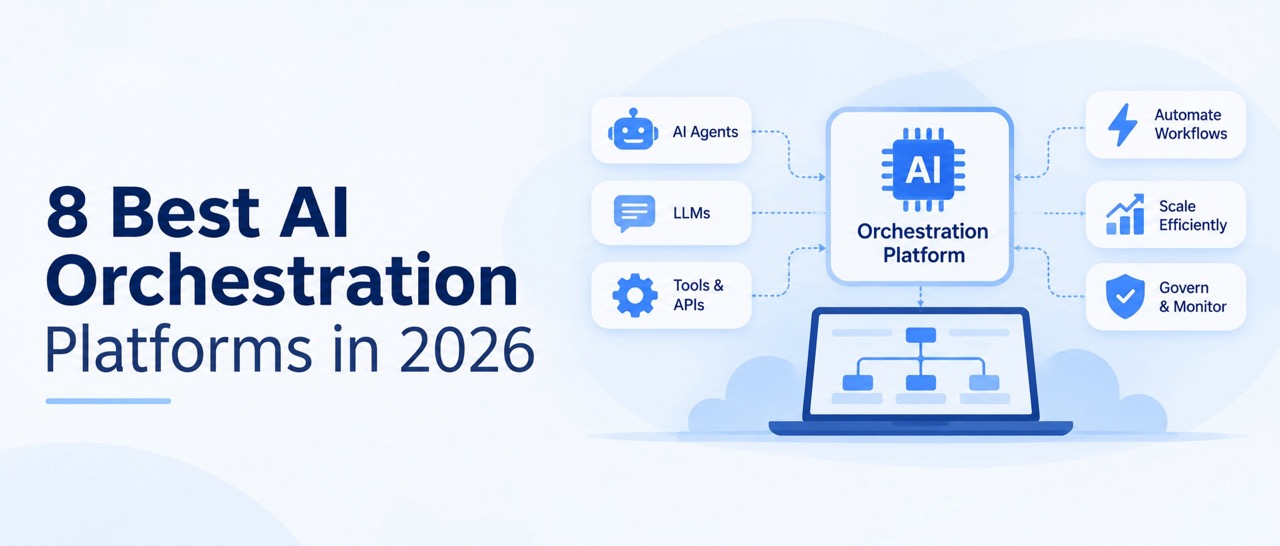
Agentic orchestration is the coordination of AI agents, tools, data, and workflow steps to complete a larger objective. Instead of treating each agent call as an isolated task, an orchestration layer manages the flow between them. It can:
- Decompose an objective into tasks
- Assign tasks to the appropriate agent or tool
- Pass context and state between steps
- Evaluate intermediate outputs
- Route the workflow based on results
- Handle retries, exceptions, and human approvals
- Trigger downstream actions
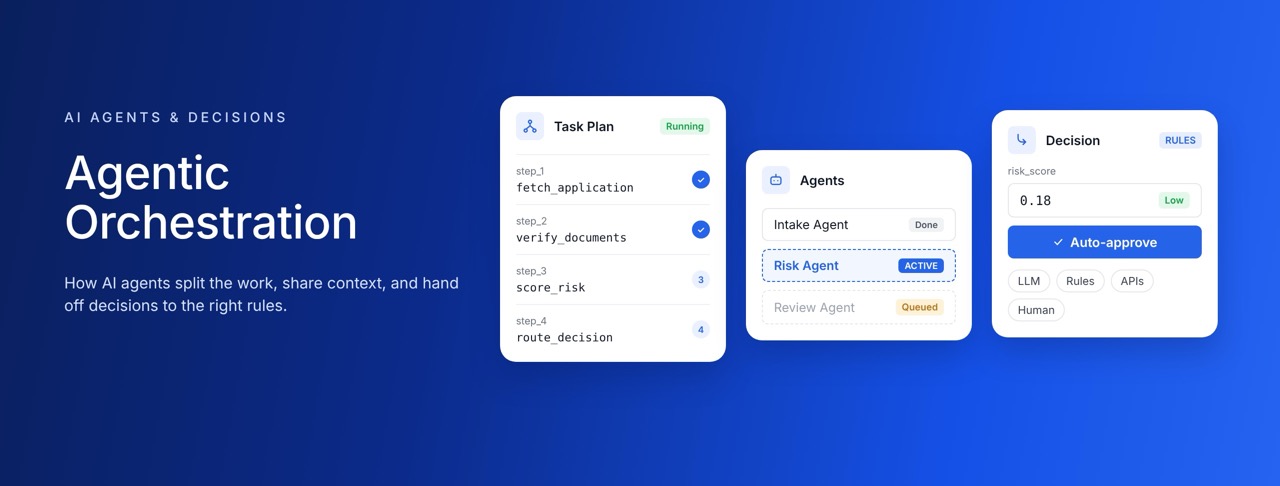
For example, a customer onboarding workflow could use one agent to extract information from documents, another to assess risk, and an API to verify customer details. The orchestrator controls how these steps are connected and determines what happens after each result. In simple terms, an agent performs a task; an orchestrator manages how multiple tasks come together to achieve the overall objective.
Also Read: Mastering Automation: Your Guide to Orchestration Engines
Why Does Agentic Orchestration Matter?
Agentic workflows become harder to manage when multiple agents, APIs, tools, and business systems are involved. The workflow needs to handle task dependencies, context, state, routing, failures, and decisions across these components.
Consider a lending workflow. One agent extracts applicant data from documents, an API retrieves financial information, another agent assesses the application, and business rules check eligibility. If the application needs additional review, the workflow routes it to a human before updating the lending system.
These steps depend on each other. The risk assessment needs verified data, and the final action depends on both the assessment and the applicable rules.
The orchestration layer manages these dependencies. It determines what runs next, what context moves between steps, and how failures or exceptions are handled.
An agent's output also does not have to become the final action. A model may recommend approving an application, while a deterministic rule still needs to validate eligibility before the system proceeds. This makes orchestration the control layer between AI reasoning, business logic, and application actions.
How Agentic Orchestration Works
Agentic orchestration starts with a goal and determines how agents, tools, and application systems should work together to achieve it. The workflow typically moves through these steps:
- Define the goal: The system receives a user request, event, or business objective. This becomes the target the workflow needs to complete.
- Break the goal into tasks: The orchestrator identifies the tasks required to reach the goal and their dependencies. Independent tasks can run in parallel, while dependent tasks wait for the required outputs.
- Select agents and tools: The orchestrator assigns each task to the appropriate agent, model, API, database, or external tool based on what the task requires.
- Pass the required context: The relevant inputs and outputs from previous steps are passed to the next agent or tool. This allows each step to work with the information it actually needs.
- Execute the task: The selected agent or tool performs the operation and returns its output to the orchestration layer.
- Evaluate the output: The result is checked for validity, completeness, or compliance with required conditions. This can involve another agent, data validation, or deterministic business rules.
- Decide what happens next: The orchestrator uses the result to determine the next action. It can continue the workflow, branch to another task, retry a failed operation, request more information, or route the case to a human.
- Complete and record the outcome: Once the required conditions are met, the workflow triggers the final action and records the execution state and outcome.
The workflow is therefore not always a fixed sequence. An intermediate result can change the next step:
Goal → Task → Agent/Tool → Result → Evaluation → Next Action → Outcome
This is the core role of orchestration: coordinating execution while allowing the workflow to respond to what happens at each step.
Also Read: Rule Engine vs Workflow Engine: Key Differences
Agentic Orchestration vs. Traditional Workflow Automation
Traditional workflow automation follows predefined steps, conditions, and branches. Agentic orchestration can adapt the workflow based on context, agent outputs, and task requirements.
The table below compares how they differ in execution, decision-making, inputs, control, and predictability:
Agentic Orchestration Architecture
Agentic orchestration connects AI agents with the tools, data, and business systems they need to complete a task. A simplified architecture looks like:
User / Event
    ↓
Orchestration Layer
    ↓
Agents / Models ↔ Tools / APIs
    ↓
Data / Shared State
    ↓
Business Systems
Here is what each layer does:
- Orchestration layer: Decides which task runs next, routes work to the right agent or tool, passes context between steps, and handles retries or exceptions.
- Agents / models: Perform tasks such as classification, extraction, reasoning, planning, and generation.
- Tools / APIs: Give agents access to databases, search, CRM platforms, internal services, and external applications.
- Data / shared state: Stores the information and execution context required across multiple steps.
- Business systems: Apply the final actions, such as updating a customer record, creating a ticket, processing an order, or triggering a transaction.
Also Read: What is AI Decision Engine: The Complete Guide to Smarter, Faster Automated Decisions
Agentic Orchestration Patterns
The orchestration pattern determines how agents, tools, and workflow steps are coordinated. The choice depends on task dependencies, execution time, and how much control the workflow needs. Here are the main agentic orchestration patterns:
Sequential Orchestration
Sequential orchestration runs tasks one after another, where each step depends on the output of the previous step. For example, a document workflow may follow extraction → validation → risk assessment → decision. The next step starts only when the required output from the previous step is available. This pattern works well for workflows with clear dependencies and a defined execution path.
Also Read: Top 10 Workflow Orchestration Tools (2026 Guide)
Parallel Orchestration
Parallel orchestration runs independent tasks at the same time and combines their outputs before continuing. For example, a customer support workflow can simultaneously analyse the customer message, retrieve order history, check delivery status, and fetch product information. The orchestrator then combines the required results for the next step. This reduces latency when tasks do not depend on each other.
Hierarchical Orchestration
Hierarchical orchestration uses a supervisor or coordinator to delegate work to specialised agents. For example, a supervisor agent may assign separate tasks to research, data, and analysis agents, then evaluate their outputs before continuing the workflow. This is useful for complex workflows where the required tasks can change based on the objective or intermediate results.
Event-Driven Orchestration
Event-driven orchestration starts or changes a workflow when an external event occurs. For example, a payment failure event can trigger an investigation agent, followed by an account check and a resolution workflow. Events can come from webhooks, message queues, application events, or database changes. This pattern is useful for long-running workflows where the next action depends on an external event.
Human-in-the-Loop Orchestration
Human-in-the-loop orchestration adds a human review or approval step before a workflow performs a sensitive action. For example, an agent can recommend an action, a policy check can validate it, and the workflow can pause for human approval before executing it. This is commonly used where an incorrect automated action can have significant consequences, such as financial transactions, compliance, access control, or healthcare workflows.
Challenges in Production Agentic Orchestration
An agent workflow that works in a controlled prototype can behave differently in production, where multiple agents, tools, APIs, and business systems interact.
The main challenges are:
- Agent failures and retries: Agents can fail because of model errors, unavailable APIs, tool failures, timeouts, or incomplete outputs. The orchestration layer needs retry policies, timeouts, fallback paths, and mechanisms to prevent the same action from being executed repeatedly.
- Context and state management: Multi-step workflows need to preserve the right information across agents. Passing too little context can produce incorrect decisions, while passing the entire conversation or application state to every agent increases cost and complexity.
- Permissions and access control: Agents should not automatically inherit unrestricted access to application systems. Tool access should be scoped to the actions and data required for each task, with authorization checks before sensitive operations.
- Observability and tracing: A final incorrect result may originate from an agent response, a tool call, a routing decision, or a stale piece of context. Production systems need traces that show which agents ran, what tools they called, what decisions were made, and where execution failed.
- Cost and latency: Multi-agent workflows can generate several model calls and API requests for a single user request. Parallel execution can reduce latency, but it can also increase concurrent resource usage. Production systems therefore need controls around model selection, retries, task fan-out, and execution limits.
- Guardrails: Agents may generate outputs that are technically plausible but outside business or compliance requirements. Guardrails can restrict which tools an agent can call, validate outputs, enforce policy constraints, and require human approval for specific actions.
Building Agentic Workflows with Nected
AI agents can interpret documents, reason over inputs, and make recommendations. But business policies such as eligibility, approval limits, pricing, routing, and compliance conditions need consistent and predictable decisions.
Putting these rules inside an agent prompt creates a control problem. The rules can be difficult to test, audit, or update independently of the AI workflow.
Nected can act as the deterministic decisioning layer within an agentic workflow. The agent handles interpretation and reasoning, while Nected evaluates the business rules that must produce a consistent outcome.
A typical flow is:
User input → AI agent → Nected decision → Orchestrator → API / Agent / Human approval
The workflow can be built as follows:
- Let the agent process the input: The agent extracts or interprets the information required for the decision. For a loan application, this could include applicant details, requested amount, income, risk indicators, and other relevant fields.
- Send the required inputs to Nected: The orchestration layer passes the relevant structured data to Nected through its decisioning interface. The agent does not need to contain the business policy itself.
- Evaluate the business rules: Nected evaluates the configured rules against those inputs. For example, the rules can determine whether the applicant is eligible, whether the requested amount requires additional approval, or whether the application needs manual review.
- Return the decision to the workflow: Nected returns the resulting decision to the application or orchestration layer. The workflow can then use that result to determine what happens next.
- Route the next action: Based on the decision, the orchestrator can call another agent, invoke an API, route the case for human approval, reject the request, or continue the workflow.
This separation keeps AI reasoning and deterministic business logic independent. Agent behaviour can evolve without embedding business policies in prompts, while business rules can be updated without changing the agent itself.
Bottom Line
Agentic orchestration is about coordinating agents, tools, data, and business systems so a workflow can adapt to changing inputs and intermediate results. But production workflows still need deterministic controls around decisions that cannot be left to model behaviour.
Using a decisioning layer such as Nected alongside agentic orchestration allows agents to handle reasoning while business rules handle explicit policies, approvals, routing, and constraints. This separation makes agentic workflows easier to control, update, and operate in production.
FAQs
What is agentic orchestration?
Agentic orchestration is the coordination of AI agents, models, tools, data, and application workflows to complete a multi-step objective. The orchestration layer manages task execution, context, state, routing, failures, and decisions between individual agent actions.
How is agentic orchestration different from workflow automation?
Traditional workflow automation generally follows predefined sequences and rules. Agentic orchestration can dynamically select tasks, agents, or tools based on context and intermediate results. In production systems, both approaches can be combined, with agents handling reasoning and deterministic workflows controlling predictable business processes.
What is the difference between an AI agent and an orchestrator?
An AI agent performs a task using a model, context, and potentially external tools. An orchestrator coordinates the larger workflow by deciding which tasks should run, passing information between them, handling dependencies, and determining what happens after each result.
What are the main agentic orchestration patterns?
The main patterns include sequential, parallel, hierarchical, event-driven, and human-in-the-loop orchestration. Sequential workflows handle dependent tasks, parallel workflows run independent tasks concurrently, hierarchical workflows use a supervisor to delegate work, event-driven workflows respond to system events, and human-in-the-loop workflows introduce human review at defined points.
How do you control and monitor agentic workflows?
Production agentic workflows need scoped permissions, tool-level access controls, output validation, guardrails, logging, execution tracing, retry policies, and human approval for sensitive actions. Observability should make it possible to trace agent calls, tool calls, decisions, failures, and workflow state across an execution.
Can business rules work with AI agents?
Yes. Business rules can provide deterministic constraints around AI-generated outputs. An agent can interpret information or generate a recommendation, while a business-rule engine evaluates explicit conditions such as eligibility, approval thresholds, routing, or compliance requirements before the workflow takes action.