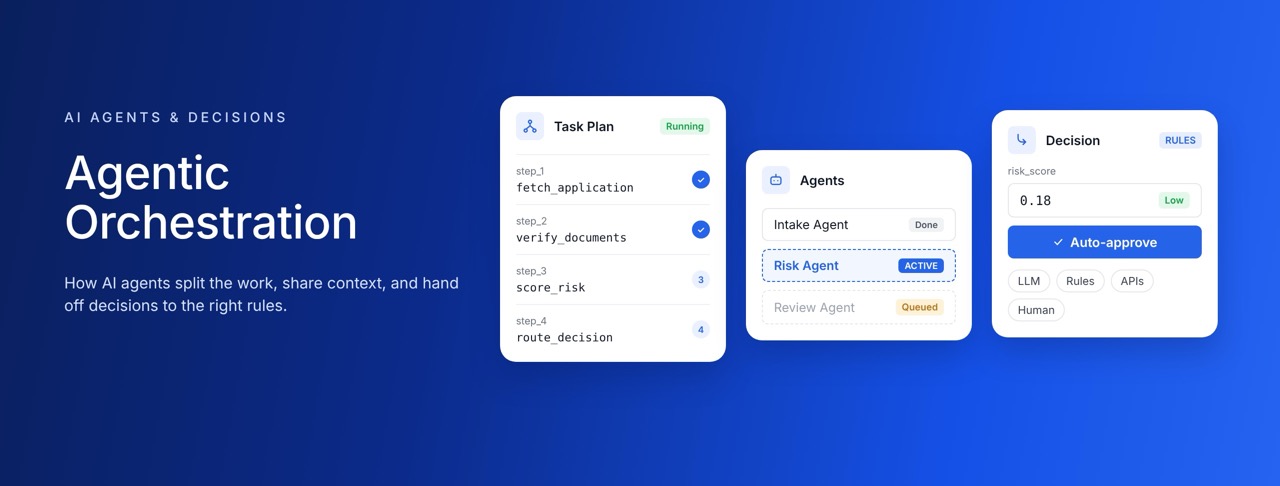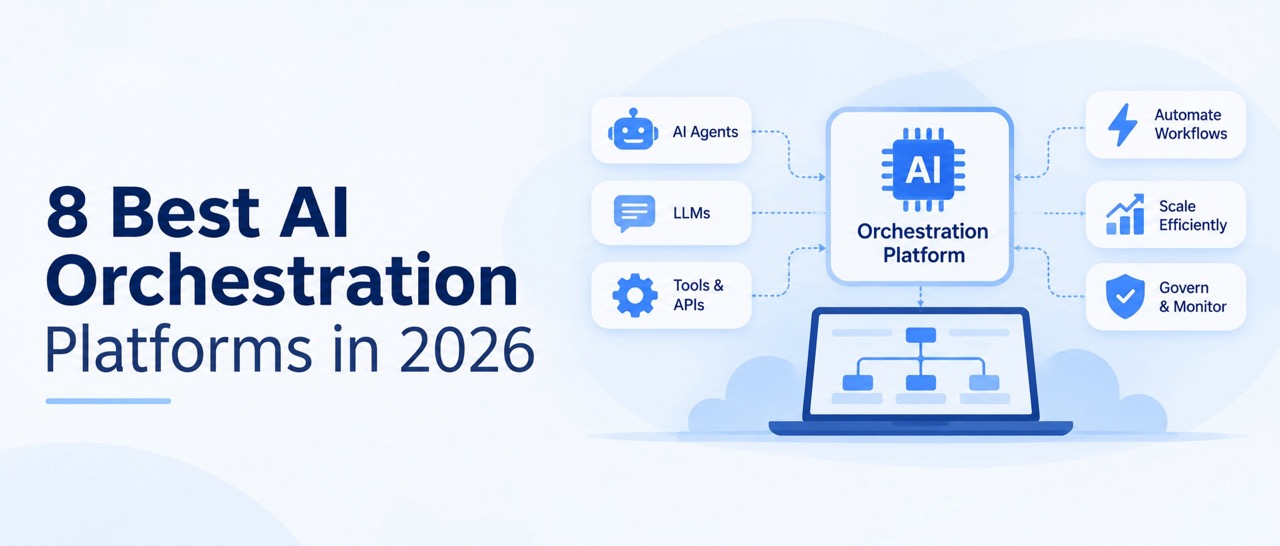



AI systems are moving from standalone model calls to production workflows that involve multiple models, agents, APIs, business rules, enterprise applications, data sources, and human approvals. Once these components need to work together reliably, orchestration becomes a core part of the architecture.
AI orchestration platforms coordinate these moving parts, managing execution order, state, dependencies, failures, decisions, tools, and handoffs. The right platform depends on what needs to be orchestrated: business decisions, durable workflows, enterprise processes, AI agents, or data pipelines.
What to Consider When Evaluating AI Orchestration Platforms
We compared these platforms based on the capabilities that matter when moving AI workflows from prototypes into production.
- Orchestration capabilities: Ability to coordinate agents, models, tools, APIs, workflows, business rules, and human actions.
- Workflow execution: State management, dependencies, retries, timers, failure recovery, and long-running execution.
- AI and agent support: Support for LLMs, agents, tool calling, multi-agent workflows, and AI-driven decisions.
- Integrations: APIs, databases, SaaS applications, cloud services, and existing enterprise systems.
- Business rules and decisioning: Ability to combine probabilistic AI output with deterministic business logic.
- Security and governance: Identity, access controls, audit trails, observability, data protection, and policy enforcement.
- Scalability: Concurrency, throughput, latency, fault tolerance, and production workload support.
- Implementation: Developer experience, visual modelling, low-code capabilities, deployment options, and operational complexity.
- Pricing: Platform fees, execution or usage charges, infrastructure costs, and implementation overhead.
Also Read: Top 10 Workflow Orchestration Tools (2026 Guide)
The List at a Glance
Microsoft Foundry Agent Service
Microsoft Foundry Agent Service is a managed agent runtime for deploying prompt-based and hosted agents. Its runtime manages conversations, tool calls, agent lifecycle, scaling, and session state, while hosted agents allow teams to bring their own agent code and frameworks.
Its distinguishing layer is the combination of agent execution with Microsoft Entra identity, Azure RBAC, managed toolboxes, MCP endpoints, versioning, tracing, and Azure networking controls. This makes Foundry particularly suited to teams that want Microsoft to operate the agent runtime while retaining control over the agent's tools, identity, and deployment lifecycle.
Key features:
- Prompt and Hosted Agent Runtime: Runs configured prompt agents or customer-owned agent code through Foundry-managed endpoints, scaling, identity, and session management.
- Managed Toolboxes and MCP: Packages web search, file search, code interpreter, MCP servers, and custom functions into reusable, centrally governed tool collections.
- Microsoft Agent Governance: Uses Entra identities, Azure RBAC, version snapshots, evaluations, tracing, and virtual-network controls around deployed agents.
Pros:
- Foundry-managed agent lifecycle: Hosting, scaling, publishing, versioning, and agent endpoints are handled by the service rather than built separately.
- Entra-backed agent identity: Each deployed agent can receive a dedicated Microsoft Entra identity for scoped access to resources and APIs.
- Bring-your-own agent code: Hosted agents can use frameworks such as LangGraph, OpenAI Agents SDK, Anthropic Agent SDK, or custom code while Foundry handles the hosting layer.
Cons:
- Microsoft-centric control plane: Teams outside Azure must adopt Foundry's identity, networking, publishing, and project-level management model to gain its full value.
- Managed-service pricing: Agent costs combine inference and tool usage with the relevant Foundry/runtime resources rather than being represented by one flat orchestration licence.
- Not a durable workflow engine: Teams needing Temporal-style event-history recovery or Camunda-style BPMN process execution need a different orchestration layer.
Also Read: Mastering Automation: Your Guide to Orchestration Engines
Temporal
Temporal is a durable execution runtime in which workflow state and execution history are persisted so a workflow can reconstruct its state after worker crashes, network failures, or service interruptions. Its core abstraction is the Temporal Workflow Execution rather than an AI agent.
For AI applications, model calls, tool calls, API requests, approvals, and other operations can be implemented as workflow Activities. Temporal then controls their execution through task queues, retries, timers, Signals, and event history. This makes it particularly different from agent platforms that primarily provide a managed environment for running an agent loop.
Key features:
- Event-history-based durability: Replays a Workflow Execution's recorded history to reconstruct state instead of restarting the workflow from scratch after a worker failure.
- Activities and Task Queues: Separates failure-prone external work from workflow logic and routes Activity Tasks to workers through task queues.
- Timers and Signals: Allows workflows to remain active while waiting for time-based events or external input, including human actions.
Pros:
- Replay-based recovery: A failed worker can reconstruct the workflow from Event History and continue from its recorded state.
- Explicit execution primitives: Developers can directly control Activities, Task Queues, Signals, Timers, retries, and child workflows.
- Long-running execution: Workflows can remain active for days, weeks, or months without requiring application-level checkpointing.
Cons:
- Code-first execution model: Workflow behaviour is primarily expressed through application code rather than a visual process canvas.
- No native agent runtime: Temporal provides durable execution for agent components but does not itself define the agent reasoning loop.
- Workflow-engine learning curve: Teams need to understand deterministic workflow code, workers, Activities, replay, and Temporal's execution model.
Nected
Nected is a decisioning and workflow orchestration platform built around executable business logic rather than a cloud-specific agent runtime. Its rule layer supports Simple Rules, Decision Tables, Decision Trees, Rule Sets, and Rule Chains, while its workflow layer connects those rules with APIs, databases, loops, switches, delays, and AI components.
The key distinction is that Nected can place deterministic decision logic directly inside an AI-enabled workflow. An AI component can analyse or classify an input, while rules determine the permitted business outcome and workflow nodes execute the resulting action. Rules and workflows can also be tested, versioned, staged, rolled back, and triggered through APIs, webhooks, or schedulers.
Key features:
- Decision Tables, Rule Sets and Rule Chains: Represents multi-condition business logic as reusable rule entities rather than embedding every condition in application code.
- Rule-to-workflow execution: Combines rule nodes with REST APIs, database operations, loops, delays, switches, and AI Agent Nodes in the same workflow.
- Rule lifecycle controls: Provides staging, versioning, Git sync, rollback, testing, and controlled publishing for rule and workflow changes.
Pros:
- Decision logic stays outside application code: Business conditions can be changed through Nected's rule layer instead of requiring application recompilation.
- No-code decision structures: Decision Tables, Decision Trees, Rule Sets, and Rule Chains provide different structures for expressing business logic.
- AI inside rule-driven workflows: AI Agent Nodes can perform tasks such as text analysis and document classification without requiring a separate AI service to be scripted into the workflow.
Cons:
- Not a durable-execution runtime: Nected's workflow model is not a substitute for Temporal's event-history-based recovery architecture.
- Not BPMN process orchestration: Teams that need formal BPMN/DMN process modelling and process-level human-task orchestration require a different layer.
- Decision quality depends on defined logic: Nected executes the rules and conditions configured by the organisation; it does not independently determine an organisation's policies or thresholds.
Also Read: What is AI Decision Engine: The Complete Guide to Smarter, Faster Automated Decisions
Camunda
Camunda is a process orchestration platform built around BPMN and DMN, where AI agents, APIs, decisions, events, and human tasks can participate in the same executable business process. Its defining architectural choice is to keep the process model as the control layer while allowing AI agents to handle judgment-heavy steps inside that process.
This means an agent does not control the entire workflow by itself. The BPMN process can determine when the agent runs, which tools it can access, whether a policy check is required, when human approval is needed, and what happens after an agent response. Camunda also supports agents and models from different providers through its open orchestration architecture.
Key features:
- BPMN-controlled agent execution: Places AI agents inside executable BPMN processes alongside services, decisions, events, and human tasks.
- DMN decision layer: Separates structured business decisions from process flow so rules can govern where work proceeds.
- Process-enforced guardrails: Approval steps, policy checks, escalations, and human reviews become process elements rather than instructions contained only in an agent prompt.
Pros:
- BPMN remains the control layer: The process, not the LLM, defines the permitted execution path.
- AI-provider independence: Camunda can coordinate different LLMs and agent frameworks within the same process.
- Built-in human escalation paths: Human approvals and reviews can be represented directly as process steps instead of being handled externally.
Cons:
- BPMN/DMN expertise required: Teams must understand process and decision modelling to exploit the platform fully.
- Process-engine overhead: A small agent workflow may not need a full business-process orchestration layer.
- Not an agent-hosting replacement: Camunda governs agent execution within processes; teams may still use external agent runtimes to host the agents themselves.
Amazon Bedrock AgentCore
Amazon Bedrock AgentCore is a collection of managed services for deploying and operating AI agents, including Runtime, Memory, Gateway, Identity, Observability, and other agent capabilities. Runtime provides serverless execution and scaling, while Gateway exposes APIs, Lambda functions, and existing services as agent-compatible tools.
Its defining characteristic is the composable AWS agent infrastructure layer. Runtime can host agents built with different frameworks and models, while Memory manages short- and long-term context, Gateway handles tool access, and Identity controls access to AWS and external resources. The orchestration loop itself can remain customer-defined when using Runtime, distinguishing it from a platform that imposes one fixed agent execution model.
Key features:
- AgentCore Runtime: Provides isolated, serverless execution for dynamic agents and tools with managed scaling and session handling.
- AgentCore Gateway: Converts APIs and Lambda functions into MCP-compatible tools and connects agents to existing MCP servers.
- Composable agent services: Memory, Identity, Observability, Browser, Code Interpreter, and other services can be added around the Runtime rather than being bundled into one fixed agent implementation.
Pros:
- Bring-your-own framework and model: AgentCore Runtime supports multiple open-source agent frameworks and models from inside or outside Amazon Bedrock.
- AWS-native tool gateway: APIs, Lambda functions, and MCP servers can be exposed to agents through AgentCore Gateway.
- Composable runtime architecture: Teams can adopt Runtime, Memory, Gateway, Identity, and other AgentCore services according to the architecture they need.
Cons:
- AWS service surface: Building a complete agent architecture can require understanding multiple AgentCore services and AWS infrastructure concepts.
- Runtime does not supply the agent loop: With AgentCore Runtime, the customer writes the orchestration logic; the service supplies the hosting environment.
- Not a BPMN decision/process engine: Organisations needing process diagrams, DMN decisions, or process-enforced human approvals need another orchestration layer.
Also Read: Rule Engine vs Workflow Engine: Key Differences
Gemini Enterprise Agent Platform
Gemini Enterprise Agent Platform is Google's platform for building, deploying, governing, and optimising enterprise agents. It combines Agent Studio, Agent Development Kit, managed runtime capabilities, Agent Gateway, Agent Identity, Model Garden, and evaluation/observability tooling across the agent lifecycle.
Its distinctive architecture is the combination of a low-code visual agent canvas and a model-agnostic development framework with Google-managed agent governance. Teams can build through Agent Studio or ADK, use models from Google's Model Garden, and apply Agent Gateway and Agent Identity controls to agent interactions and permissions.
Key features:
- Agent Studio + ADK: Supports visual agent design through Agent Studio and code-based development through the modular Agent Development Kit.
- Agent Gateway and Identity: Provides a central layer for securing agent interactions and assigning granular permissions to agents.
- Model Garden integration: Gives agents access to Google's Gemini models alongside third-party and open models available through Google's model ecosystem.
Pros:
- Two development paths: Teams can move between Agent Studio's visual canvas and ADK-based code development instead of adopting only one authoring model.
- Model Garden access: The platform is not restricted to Gemini-only development and supports third-party and open models.
- Agent-specific security controls: Agent Identity and Agent Gateway provide controls specifically around agent permissions and runtime interactions.
Cons:
- Google Cloud platform dependency: The development, model, identity, gateway, and governance stack is centred on Google's cloud ecosystem.
- Agent-platform scope: Teams that only need deterministic workflow execution do not need its full agent-development stack.
- Multiple development surfaces: Teams must choose and manage the relationship between Agent Studio, ADK, runtime, gateway, identity, and evaluation components.
IBM watsonx Orchestrate
IBM watsonx Orchestrate is an agent orchestration and management control plane designed to coordinate agents and manage them across enterprise environments. Its current architecture extends beyond IBM-native agents: the AI Gateway can discover and import agents built on Amazon AgentCore, Microsoft Foundry, and Gemini Enterprise Agent Platform into the same control plane.
That cross-platform management layer is what separates watsonx Orchestrate from cloud-specific agent runtimes. Instead of requiring every agent to move onto one runtime, IBM can place agents from different environments into a common inventory and apply gateway-level policies and management across them.
Key features:
- Cross-platform agent discovery: AI Gateway can discover agents running on AgentCore, Microsoft Foundry, and Gemini Enterprise Agent Platform.
- Central agent control plane: Imported and native agents can be viewed and managed through a common management layer.
- Agent identity and governance: IBM's current platform includes agent identity capabilities and shared gateway-level controls across connected agent environments.
Pros:
- Multi-cloud agent inventory: Agents from different cloud agent platforms can appear in the same control plane.
- Gateway-level policies: Controls can be applied across connected agents instead of being recreated separately in every underlying runtime.
- Agent identity management: Provides a dedicated identity model for agents rather than treating every agent simply as an application credential.
Cons:
- Control-plane overhead: Organisations running agents on only one platform may not need an additional cross-platform management layer.
- Does not eliminate underlying runtimes: Agents can remain on their originating platforms, so watsonx Orchestrate complements rather than necessarily replaces those runtimes.
- Multi-platform governance requires architecture work: Connecting, discovering, importing, and governing agents across clouds adds another management layer.
Apache Airflow
Apache Airflow is a DAG-based workflow scheduler and orchestrator in which tasks, dependencies, schedules, and execution conditions are explicitly defined. A DAG determines when tasks run and how upstream and downstream relationships control execution.
For AI, Airflow is most relevant when model inference is one task within a larger pipeline. Data extraction, transformation, feature generation, model execution, validation, and downstream publishing can each be represented as tasks with explicit dependencies. Airflow does not provide the agent reasoning loop or persistent agent memory found in dedicated agent platforms.
Key features:
- DAG execution model: Represents workflow tasks and their upstream/downstream dependencies explicitly.
- Python TaskFlow: Allows pipeline tasks to be defined as Python functions alongside Airflow operators and sensors.
- Scheduling and dependency control: Runs tasks according to schedules, dependency conditions, branching rules, retries, and other DAG execution rules.
Pros:
- Explicit pipeline dependencies: The DAG makes the order and conditions between data, inference, validation, and downstream tasks visible.
- Python-native task authoring: ML and data teams can use Python functions directly as TaskFlow tasks.
- Purpose-built scheduling: Airflow's scheduler determines when DAG tasks become eligible to execute based on their defined dependencies and schedules.
Cons:
- No agent reasoning loop: Airflow schedules and executes tasks but does not provide an autonomous agent's planning or reasoning cycle.
- Acyclic DAG model: Workflows must fit Airflow's DAG execution structure, which is not a natural representation for every conversational or continuously adaptive agent flow.
- Pipeline rather than agent orchestration: Teams looking for agent memory, tool reasoning, or agent-to-agent delegation need an agent-specific platform.
Bottom Line
There is no single best AI orchestration platform for every architecture. Foundry, AgentCore, and Gemini fit managed agent execution, Temporal fits durable and failure-sensitive workflows, and Camunda fits structured business processes with AI and human tasks. Nected stands out for workflows where AI decisions need to be combined with deterministic business rules, conditions, and actions. watsonx Orchestrate is suited to governing agents across different platforms, while Airflow works best for data-heavy AI and ML pipelines.
Choose the platform based on what you need to orchestrate, agents, decisions, business processes, durable execution, or data pipelines.
FAQs
What are the best AI orchestration platforms in 2026?
Microsoft Foundry, Temporal, Nected, Camunda, Amazon Bedrock AgentCore, Gemini Enterprise Agent Platform, IBM watsonx Orchestrate, and Apache Airflow are strong options, depending on the orchestration layer required.
What is an AI orchestration platform?
It coordinates models, agents, tools, APIs, workflows, data, and business rules so they execute as part of a reliable AI system.
What is the difference between agent and workflow orchestration?
Agent orchestration manages agents, tools, and reasoning, while workflow orchestration manages execution order, state, dependencies, retries, and recovery.
Which platform is best for long-running AI workflows?
Temporal is a strong choice for durable, failure-resistant workflows. Camunda fits better when those workflows also involve business processes and human tasks.
Which platform is best for AI with business rules?
Nected is suited to workflows where AI outputs need to be combined with deterministic rules and business conditions.
What is the difference between Nected, Temporal, and Camunda?
Nected focuses on decisions and workflows, Temporal on durable execution, and Camunda on end-to-end business process orchestration.
Do AI orchestration platforms replace agent frameworks?
Not always. Platforms such as AgentCore can host agents built with different frameworks, while Temporal and Camunda can orchestrate agent components without replacing their underlying runtimes.
Can AI orchestration platforms integrate with existing APIs?
Yes. They can connect APIs, databases, services, tools, and enterprise applications, although the integration approach varies by platform.
How much do AI orchestration platforms cost?
Pricing varies by platform and architecture, including runtime, execution, AI usage, infrastructure, and operational costs.
Which AI orchestration platform is best for enterprises?
It depends on the architecture: Foundry for Azure agents, AgentCore for AWS, Gemini Enterprise Agent Platform for Google Cloud, Temporal for durable workflows, Camunda for business processes, and Nected for decisioning.