.svg)

Quick Summary
GoRules is the rules engine engineering teams reach for when Drools feels too heavy. No JVM, no KJar, no DRL — rules live as JSON files, evaluated by a stateless Go engine, deployed as containers alongside your existing services. Visual decision tables, instant rule loading, and a Kubernetes-native deployment model. A working decision goes from zero to production in days, not months.
The limits surface around month six. GoRules evaluates rules — it does not manage them. Complex multi-step decisions, heterogeneous data structures, auto-scaling, approval workflows, RBAC, audit trails, and SOC 2 certification are all outside the platform. Teams that need governed decisioning spend 4–8 months and $40K–$120K engineering those capabilities themselves, on top of the integration they just finished. Year 1 fully loaded at 100 TPS runs ≥$400K for GoRules. Nected — which ships governance, auto-scaling, and multi-step orchestration built-in — starts at ≥$20K.
What Is GoRules?
The GoRules platform ships six components, each covering a specific layer of the rules-as-code architecture:
- ZEN Engine: The core stateless rule evaluation engine written in Go. It reads JDM rule files and evaluates them at runtime against input data, returning structured decision outputs.
- JDM Editor: A visual web-based editor for authoring decision tables, decision trees, and scorecards. The editor produces JDM JSON files that can be stored in Git and loaded by the engine at runtime.
- REST API: A language-agnostic execution interface that allows any backend service to trigger rule evaluation over HTTP without Go-specific client dependencies.
- GitHub Sync: Rules are stored as JSON files and can be managed in Git repositories, enabling version control workflows that engineering teams already operate.
- Custom JS Code Nodes: Decision graphs can include custom JavaScript logic nodes for use cases that exceed the expressiveness of declarative decision tables. Code changes to these nodes require a container redeployment.
- GoRules Cloud: A managed cloud option for teams that want hosted rule execution without self-managed infrastructure.
GoRules rules do not require recompilation when rule logic is updated — if rules are loaded dynamically, the engine picks up changes without a redeploy. This is a meaningful operational advantage over compile-and-deploy engine architectures. However, the rule lifecycle outside of that narrow path — who can change rules, how changes are reviewed, what happens if a bad rule reaches production — is entirely the responsibility of the implementing team.
How We Analyzed GoRules's Abilities?
For this GoRules review, we focused on what actually determines success in production environments — not capability checklists, but operational reality. A feature that exists in theory but requires six months of custom engineering to work reliably is not equivalent to a feature that ships with the platform.
We structured our analysis around the eight parameters that define a production-ready decisioning system. Each maps directly to the in-depth feature sections that follow.
Our analysis draws from GoRules documentation, the gorules.io platform, comparison datasets maintained in this workspace, and real-world engineering estimates modeled at production scale.
How GoRules Works
GoRules uses a graph-based decision evaluation model — rule logic is represented as a directed decision graph (JDM) where nodes represent decision tables, trees, scorecards, or code logic, and edges represent the flow of data between them. Here is how a typical GoRules decision flow operates:
1. Rule Authoring: Business analysts or engineers use the JDM editor to build decision tables, trees, or scorecards visually. The editor produces a JSON file representing the decision graph. Rules can also be authored directly in JSON for teams comfortable with the format.
2. Rule Storage: The resulting JDM JSON files are stored in a file system, Git repository, or any storage layer the team configures. GoRules does not impose a specific persistence model — rules are files, and files go wherever your architecture puts them.
3. Engine Initialization: The ZEN engine loads rule files at startup or dynamically at runtime. When rules are loaded dynamically, the engine can evaluate updated rule logic without requiring a container restart or redeployment — which is a meaningful operational advantage for pure rule updates.
4. Decision Execution: At runtime, the application sends an input payload (JSON) to the ZEN engine via REST API or Go SDK. The engine traverses the decision graph, evaluates each node against the input data, and returns a structured JSON output with the decision results.
5. Result Handling: The calling application receives a JSON response with decision outputs. Basic execution tracing is available to inspect how the engine traversed the decision graph — useful for debugging, though the depth of observability is limited compared to purpose-built monitoring platforms.
6. Change Management: When rule logic needs to change, the JDM file is updated in the editor or directly in Git. For pure decision table and tree updates, changes can reach production without a container redeploy if dynamic loading is configured. For changes involving custom JS code nodes, a container rebuild and redeployment is required — which means engineering is back in the critical path.
This architecture gives engineering teams a fast, clean baseline for rules-as-code deployments. The challenge is that governance, access control, change review, and observability all live outside the engine — in the surrounding systems your team builds or buys.
Who Uses GoRules?
GoRules is used predominantly by organizations with the following profile:
Cloud-native engineering teams moving away from JVM-based rules engines: Teams that have operated Drools or similar Java-based engines and want a lighter, faster-to-adopt alternative that fits their container-first deployment model without JVM overhead.
API-first product engineering teams: Organizations building decision logic as a service behind REST APIs, particularly in fintech, insurtech, and SaaS platforms where speed of integration matters more than deep governance tooling.
Startups and scale-ups with lean infrastructure teams: Companies where infrastructure is managed in Kubernetes and the team is comfortable with Go/REST patterns, self-hosting, and DIY operational tooling.
Engineering-led teams in regulated industries at early stage: Financial services and insurance teams that need rules execution quickly but have not yet encountered the compliance review that surfaces governance gaps.
Architects evaluating modern BRMS alternatives: Teams researching what has changed in the rules engine landscape since Drools became the default, looking for whether a lighter, modern alternative can meet their execution requirements without the JVM baggage.
GoRules is generally a difficult fit for organizations where compliance teams, business analysts, or product managers need to participate directly in rule management without engineering mediation. The JDM editor lowers the barrier compared to DRL, but the absence of governance tooling means non-engineering stakeholders still depend on engineering teams to manage the full change lifecycle.
Reviews
- Runs natively across multiple programming languages without forcing a new tech stack
- Lightweight JSON-based rules with no proprietary rule format
- AI Copilot and MCP integration accelerate rule creation and AI workflows
- Active open-source community with regular releases and solid documentation
GoRules was exactly what we needed—a lightweight engine we could drop into our microservices stack without the JVM overhead. The JDM editor is intuitive enough that our backend engineers picked it up in a day, and the JSON-based rules make version control trivial.
The container-native deployment story is excellent. We run GoRules alongside our other services in Kubernetes with zero special handling. For teams that already live in a cloud-native stack, the onboarding experience is genuinely fast.
 Verified G2 Reviews
- Business users still depend on developers for rule changes
- Limited support for complex enterprise decision logic
- Advanced governance features require higher-tier paid plans and remain basic
- No built-in connectors for databases, APIs, or business applications
- AI Copilot is limited to simple rule generation tasks
We hit the governance wall about six months in. The engine is fine, but when compliance started asking for approval workflows and audit trails, we realized we were going to have to build all of that ourselves. That work took longer than the original integration.
GoRules works well when your rules are simple and your team is small. As soon as we needed multiple people to collaborate on rules with proper review cycles, we had to bolt on our own tooling. There is no native lifecycle management.
Verified Customer Reviews
In-Depth GoRules Features Analysis
1. Execution & Scale
The ZEN engine's stateless, Go-native design delivers genuinely fast execution for typical production workloads. In benchmarks against simple to moderately complex decision tables, GoRules consistently achieves sub-100ms P95 latency — a meaningful improvement over Rete-algorithm-based engines that carry significant working memory overhead. For teams migrating from Drools, the performance difference at low-to-medium rule complexity is immediately noticeable, and the absence of JVM warm-up latency makes GoRules more predictable at container startup.
Where the execution story becomes more qualified is at scale. GoRules is stateless by design, which means horizontal scaling via Kubernetes is architecturally straightforward — you add container replicas. The challenge is that GoRules does not abstract this process. Auto-scaling policies, load balancing configuration, health check endpoints, and capacity planning are all left to the implementing team. At 1,500+ RPS under sustained load, engineering teams must design and test their own scaling playbook, and performance under load depends on the quality of that infrastructure work.
For use cases that require intermediate state across rule firings — multi-step eligibility checks, sequential approval logic, or decisions where earlier results influence later conditions — the stateless architecture requires the calling application to manage that state externally and re-inject it on each call. This is not architecturally impossible, but it adds application complexity that stateful session models handle natively.
Strengths:
- Fast for simple rules — no JVM overhead, evaluates quickly.
- Low memory footprint — runs on smaller servers than Java-based engines.
- Rule updates load dynamically — no restart needed for pure rule changes.
Drawbacks:
- Your team manages all scaling — no auto-scaling built in. Nected scales automatically.
- Multi-step decisions need custom code in your app to chain results. Nected handles this natively.
- No throughput guarantee — performance depends entirely on your infrastructure setup.
2. Build & Author
The JDM editor is GoRules' most compelling differentiator relative to legacy engines like Drools. Where Drools requires DRL expertise — a programming language — GoRules enables visual authoring of decision tables, decision trees, and scorecards through a browser-based editor that produces JSON. Engineers who have never touched Go or JDM can build working decision logic within hours. For straightforward decisioning use cases — tiered pricing, eligibility rules, risk scoring — the editor is genuinely accessible and the output is clean, testable, and Git-diffable.
The limitation surfaces when rule complexity grows beyond what decision tables and trees can represent. Complex conditional logic, multi-step orchestration, or calculations that require imperative code land in JavaScript code nodes. These nodes work, but they require engineering to write, test, and maintain — and critically, any change to a JS code node requires rebuilding and redeploying the container. This breaks the dynamic-update story that makes GoRules operationally attractive in the first place, and reintroduces engineering as the bottleneck on every change to code-heavy rule logic.
There is also no shared attribute or variable library. Teams that manage dozens or hundreds of rules must manually coordinate shared definitions across JDM files, which creates maintenance debt at scale. When a shared data attribute changes — a field name, a data type, a default value — every rule file that references it must be updated by hand. This is manageable at small scale and becomes a meaningful operational burden as the rule library grows.
Strengths:
- Visual editor works for engineers and technical analysts — much lower barrier than writing DRL or Java.
- Rules chain naturally — outputs from one step feed directly into the next.
- Rules are stored as JSON — easy to version in Git, move between environments, and diff.
Drawbacks:
- Business teams can't change rules themselves — every update still goes through engineering. Nected lets non-developers do it directly.
- Logic changes in code nodes require redeploying the container — engineering stays in the loop for anything beyond pure rule edits.
- AI only handles simple prompts — can't take a PRD and build a full decision flow. Nected's AI does.
3. Operate & Govern
This is the dimension where the gap between GoRules' free-tier adoption experience and its production-readiness becomes most apparent. GoRules does offer approval flows, RBAC, audit logs, and SSO — but these governance features are locked behind the paid plan (≥€500/month), and even then they are basic in depth. The ZEN engine's free tier has no built-in concept of rule lifecycle — no draft state, no review queue, no approval routing, no role-based access at the rule or environment level.
In practice, teams using GoRules in regulated environments on the paid plan get a starting point for governance, but not the full control layer. Audit logs exist but are limited in retention and depth; approval flows are present but lack the structured maker-checker routing that financial services and insurance auditors require; RBAC is role-based at a broad level rather than granular at the rule or folder level. The result is that teams in regulated industries either budget for the paid plan and accept governance gaps, or spend months building supplementary control tooling on top — an investment that a purpose-built decisioning platform ships with out of the box.
The absence of platform-level rollback compounds the governance gap. Even on paid plans, reverting a bad rule to a prior version requires working through Git rather than a platform UI — which puts engineering back in the critical path for production incident response.
Strengths:
- Has governance on the paid plan (≥€500/mo) — better than Drools, which ships with none at all.
- Git-backed rules work with PRs, code review, and branching engineers already use.
- Rules are portable JSON — migrating away is moving files, not a vendor extraction project.
Drawbacks:
- Governance is locked behind a paid plan — and even then it's basic. Nected ships approval flows, RBAC, and audit trails on all plans.
- Compliance and business teams have no self-service path — engineering has to build them a custom tool just to review changes.
- Rolling back a bad rule means Git operations, not a button — engineering stays in the loop during production incidents.
4. Integrations & API
GoRules' REST API is clean and well-designed, and it is the primary integration surface for most teams. Any backend service that can make an HTTP call can execute a GoRules decision, which means there is no language-specific client dependency — a meaningful practical advantage over Java SDK-dependent integrations. GitHub sync is a natural strength because rules are files: any standard Git workflow works for managing them, and CI/CD pipelines that promote rule changes between environments are straightforward to build.
The integration limitation is on the data enrichment side. When a decision needs to pull data from an external database, third-party API, or internal service before evaluating rules — which is the common case for real-world decisioning scenarios — that enrichment logic must be written by the application team. There is no connector marketplace, no visual data source configuration, and no built-in multi-source orchestration. Every data source is a custom integration, which adds engineering scope to every new decisioning use case that requires live contextual data.
Webhook support enables event-triggered rule evaluation, which is a genuine operational capability for teams building near-real-time decisioning flows. However, the absence of native event streaming integration (Kafka, SQS, Pub/Sub) means high-volume event-driven architectures require custom application-layer orchestration to bridge between the event bus and the GoRules execution API. This is standard engineering work for experienced teams, but it is scope that a platform with native connectors handles without custom code.
Strengths:
- REST API works with any tech stack — no language-specific client library needed.
- Git-based rules plug into CI/CD pipelines engineers already use.
- Webhooks let you trigger rule evaluation from events.
Drawbacks:
- Every integration is custom dev work — no built-in connectors for databases or APIs. Nected ships these out of the box.
- No platform import/export — rule files are managed manually. Nected handles it natively.
- No event streaming support built in — you build that plumbing yourself.
5. Support / SLA
GoRules' support model is tiered: community-first for developer users, with commercial support available on paid plans. The GitHub repository is actively maintained, the documentation covers core concepts and API usage clearly, and the community Discord provides a reasonable channel for common questions. For teams with strong internal engineering capability who can debug rule evaluation issues, interpret documentation, and build their own operational runbooks, the community tier is workable for development and early production.
The gap opens under production incident conditions. When a rule is producing incorrect decisions at 2am on a self-hosted deployment, the fastest path is GitHub issues and community Discord unless a paid support plan is in place. Uptime on self-hosted deployments is entirely determined by the quality of the Kubernetes infrastructure your team operates — GoRules the platform has no opinion on that. For organizations where incorrect decisioning has financial, regulatory, or customer impact, this support posture requires compensating engineering investment in monitoring, alerting, and incident playbooks.
Strengths:
- Active GitHub — maintainers respond to bug reports and the docs cover the basics well.
- Basic analytics dashboard included — some operational visibility without custom tooling.
Drawbacks:
- No uptime SLA — reliability depends on your own infrastructure.
- No dedicated engineer or SLA-backed support on standard plans.
- No migration help — you're on your own switching from another platform.
6. Security & Compliance
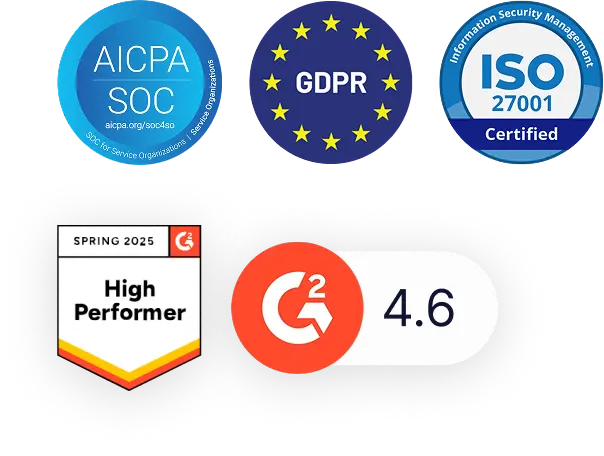
GoRules holds SOC 2 Type II certification — a meaningful baseline that distinguishes it from self-hosted open-source engines like Drools that carry no platform-level certifications. ISO 27001 and GDPR certifications are absent, which matters for European regulated deployments. Organizations that require all three certifications — as most financial services, insurance, and healthcare enterprises do — must supplement GoRules with their own compliance engineering to cover the ISO 27001 and GDPR gaps. This is achievable for teams with security engineering capability, but it adds ongoing maintenance scope that a fully certified platform does not impose.
Multi-tenancy is an architectural gap with no current roadmap item as a platform feature. Teams that need to serve multiple business units, product lines, or customers with rule isolation must build that isolation themselves — typically at the namespace, deployment, or application layer. White labelling the rule editor or management interface for business-user access requires a custom front-end build. Neither of these are insurmountable engineering challenges, but they each represent months of work that a purpose-built platform would ship on day one.
Strengths:
- Self-hosted — you control where data lives, full stop.
- Kubernetes-native — standard security tooling (network policies, pod security, encryption) applies.
- Small, auditable Go binary — simpler to security-scan than JVM-based engines.
Drawbacks:
- Only SOC 2 Type II — no ISO 27001 or GDPR certification. Most regulated industries need all three. Nected has all three.
- Multi-tenancy requires building it yourself — no platform support.
- Security hardening is your team's job — nothing is set up for you by default.
7. Logs / History / Reports
GoRules has improved its observability story in recent versions — the basic analytics dashboard and execution tracing capabilities are genuinely useful for engineers debugging rule behavior. The tracing view shows which nodes in a decision graph were evaluated and what outputs were produced at each step, which reduces the time to diagnose incorrect decisions significantly compared to a black-box execution model. For engineering-led teams doing active development and debugging, these features are a meaningful step forward from earlier versions.
The limitation is the audience and depth of observability. Execution tracing in GoRules is an engineering tool — it surfaces data in a format that makes sense to someone reading a decision graph, not to a compliance officer asking "why was this loan application declined?" Building an explainability layer that translates execution traces into business-readable decision summaries is a separate engineering project. Log retention at 7 days is insufficient for most regulated environments, and extending it requires either a custom log pipeline to external storage or significant engineering investment in a purpose-built logging infrastructure.
Without tags, folders, or organizational metadata, managing large rule libraries becomes increasingly difficult as the number of rules grows. Teams that start with ten rules and scale to three hundred find themselves navigating a flat file structure with no platform-native search or categorization. This is a day-to-day operational friction point that compounds as decisioning scope expands.
Strengths:
- Execution tracing shows which rules fired and what they produced — useful for debugging.
- Basic analytics dashboard is included — no custom setup needed.
Drawbacks:
- No business-readable reports — compliance teams can't answer "why did this fire?" without engineering help. Nected ships this built-in.
- 7-day log retention isn't enough for regulated environments — you build a custom pipeline or upgrade. Nected configures retention from day one.
- No tags or folders — rule libraries become impossible to navigate past a few dozen rules.
Pricing
GoRules' commercial pricing varies by plan and deployment model. The license is just the starting point — infrastructure, governance tooling, compliance, and engineering overhead add up fast. The table below shows the cost floor for each path teams actually evaluate. All figures represent the minimum starting cost; actual spend typically runs higher.
Total Cost of Ownership Comparison
What the Numbers Actually Mean
GoRules starts with a $0 license — but the ≥$400K Year 1 floor reflects middleware, governance build, training, and ops costs that all self-hosted engines carry. The license is the smallest line item.
Modern Rule Engine platforms (like DecisionRules) run as SaaS, which removes infrastructure ownership — but their Year 1 floor still starts at ≥$202K due to higher infrastructure costs at 100 TPS.
Enterprise BRMS platforms (like IBM ODM) ship governance built-in, but the ≥$120K annual license makes the premium visible immediately. Year 1 floor: ≥$540K.
Nected starts at ≥$40K. Middleware, training, ops, and enterprise feature overhead are included in the license — not itemized separately. At 100 TPS, that gap is immediate: ≥$60K for Nected vs. ≥$400K for GoRules and ≥$540K for an enterprise BRMS.
Top 3 GoRules Alternatives
The table below is a focused capability comparison across the dimensions that determine real production-readiness — not whether a feature technically exists, but whether it ships with the product or lands in your engineering backlog.
Looking for the full list of GoRules alternatives? See our deep-dive → Top 10 GoRules Alternatives for 2026
Why Teams Compare Nected Against GoRules
When teams evaluate GoRules for production decisioning, four specific gaps consistently surface — and every one shows up in the comparison above:
No auto-scaling. GoRules has no built-in auto-scaling. At 1,500+ RPS, you design and maintain the Kubernetes scaling infrastructure yourself. Nected scales automatically — no infrastructure engineering required.
No support for complex, nested, or multi-step decisioning. GoRules evaluates one decision graph per API call. When Rule Set A's outcome needs to feed Rule Set B — or when decisioning requires a mix of rule evaluation and workflow steps — the calling application must manage state across multiple calls and reassemble results. Decisions drawing from heterogeneous or nested data structures also require manual normalization before each call. Nected handles multi-step decisioning, rules-plus-workflow orchestration, and varied data structures natively — no application-layer coordination required.
Governance is gated and basic on paid plans. GoRules approval flows, RBAC, audit logs, and SSO are only available on the paid plan (≥€500/mo) — and even then they are basic. There is no formal maker-checker routing, no granular rule-level access control, and no deep audit history. Teams in regulated environments that need those controls must supplement with custom tooling. Nected ships maker-checker approval flows, granular role-based access, and full audit history across all plans — no upgrade required, no custom build.
Business teams cannot participate in rule management. GoRules is a file-and-API system. Compliance officers, product managers, and business analysts have no interface to manage rule changes — engineering must mediate every update. Nected's no-code editor and governed draft/publish lifecycle let non-engineering stakeholders own rule changes directly, without opening a ticket.
Year 1 costs run 3–4× higher. At 100 TPS, GoRules floors at ≥$400K when governance build, training, and ops are fully accounted for. Nected floors at ≥$40K — because those costs are included in the platform, not itemized separately. Nected is used by 500+ teams including PUMA, Bajaj Auto, and TATA 1mg.
Final Verdict
GoRules is a well-designed modern rules engine. The ZEN engine is fast, the JDM format is clean, the container-native deployment model is genuinely modern, and the JDM editor gives engineering teams a visual authoring experience that is materially better than DRL. For teams migrating off Drools or evaluating their first rules engine, GoRules is a credible and honest starting point that will not disappoint on execution speed or developer experience.
The honest limitation is that GoRules solves the execution problem while leaving the governance problem entirely to you. In 2026, that is not a product gap that most production teams can afford to treat as acceptable technical debt. Compliance requirements, multi-stakeholder rule ownership, audit readiness, and operational SLAs are table stakes in most industries where rules engines matter — and building those capabilities on top of GoRules is a six-to-twelve-month engineering investment that applies on top of, not instead of, the initial integration.
For teams that only need technical rule execution in a controlled engineering context — internal tooling, experimentation, low-stakes automation — GoRules delivers well and the DIY governance model is manageable. For teams that need faster cross-functional delivery, built-in governance, SLA-backed operations, and a clear path for business users to own policy changes, a platform-first approach like Nected represents materially lower total complexity and cost over a realistic three-year horizon.
Frequently Asked Questions
Cloud SaaS on AWS (US East default; EU on Growth+). Self-hosted on Enterprise — Docker, Kubernetes, on-prem on your VPC. Air-gapped deployments supported for regulated industries.


Prabhat Gupta is the Co-founder of Nected and an IITG CSE 2008 graduate. While before Nected he Co-founded TravelTriangle, where he scaled the team to 800+, achieving 8M+ monthly traffic and $150M+ annual sales, establishing it as a leading holiday marketplace in India. Prabhat led business operations and product development, managing a 100+ product & tech team and developing secure, scalable systems. He also implemented experimentation processes to run 80+ parallel experiments monthly with a lean team.