.svg)

.svg)


.png)
.webp)
Decisions in the digital world are no longer confined to “if-this-then-that.” Advanced systems now incorporate such things as customer behavior analysis, fraud alerts, API results, workflow triggers, compliance checks, and AI outcomes into their decision-making process. This is driving companies to reevaluate their approach to operational logic management.
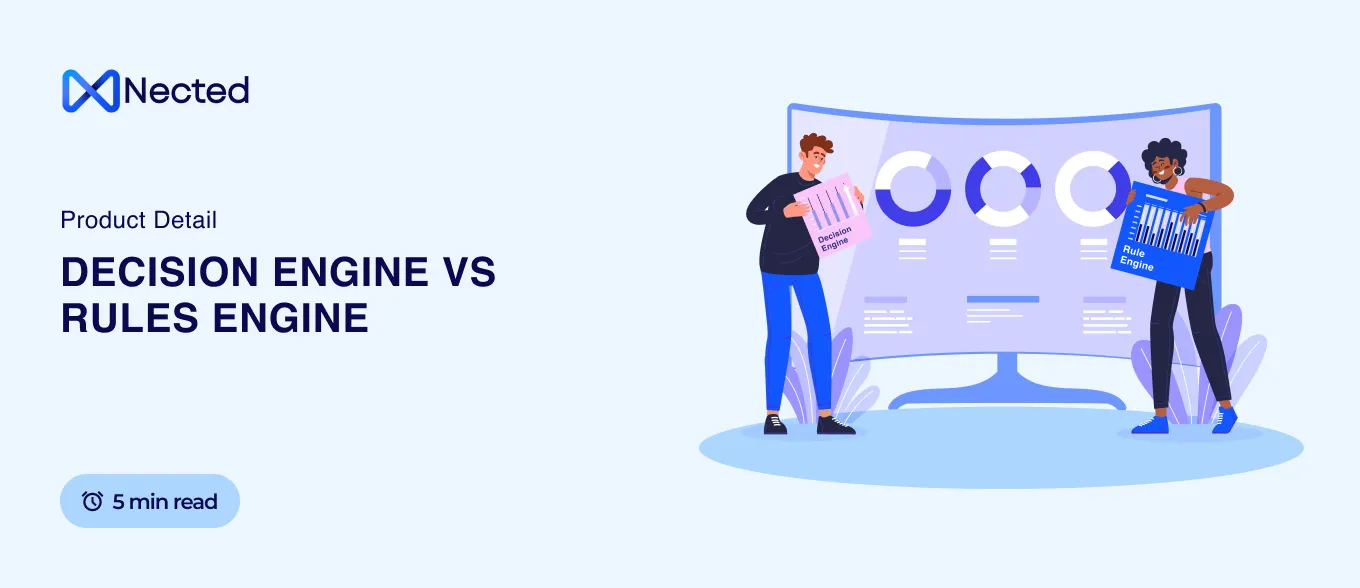
Rule engines have always been quite efficient at managing business rules. But as workflows began to connect and work in real-time environments, it became clear that companies needed more than just rule engines. And this is when the discussion of the classic rule engine vs decision engine became relevant.
Although both techniques tackle the challenge of decision-making similarly, they vary significantly in terms of architecture and functionality. Such solutions as Nected belong to this new class of decision-making software.
What is a Classic Rule Engine?
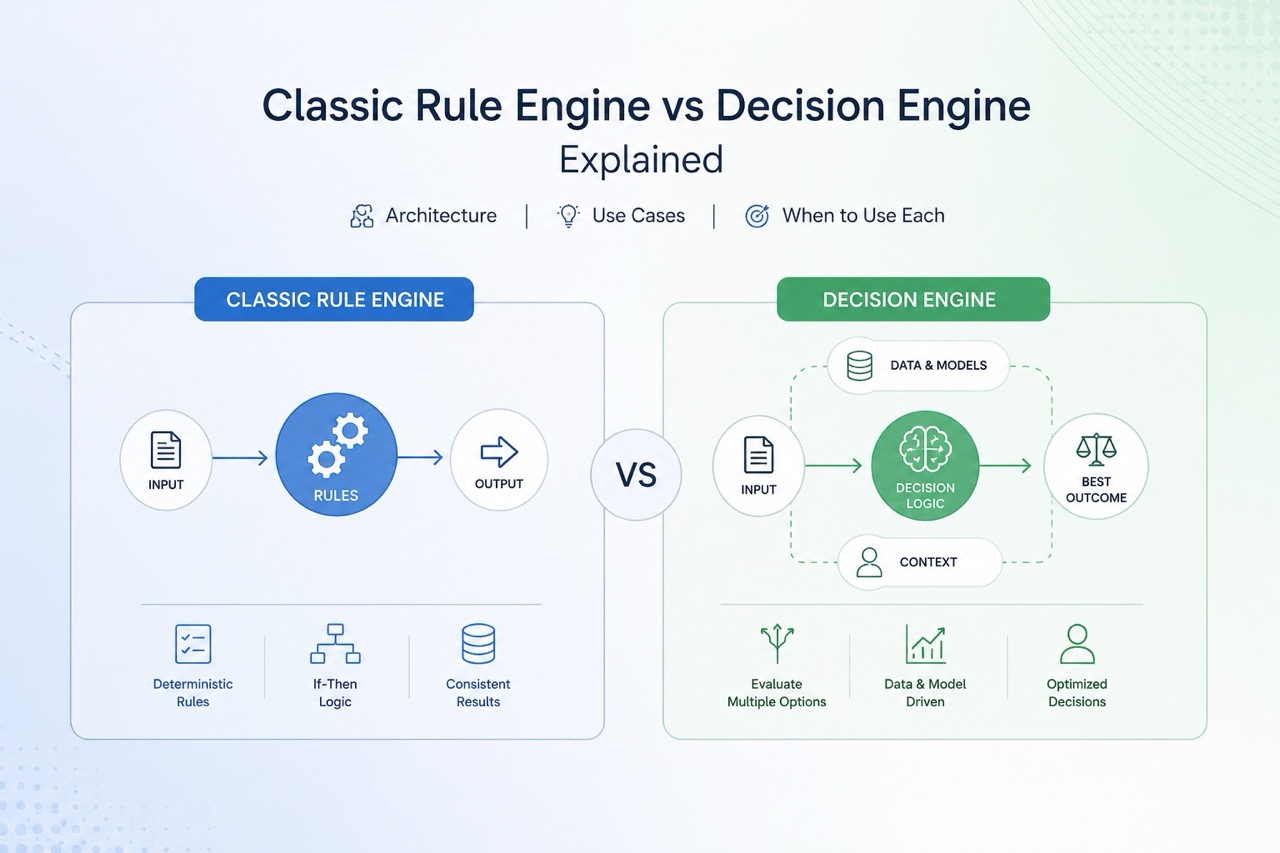
A classic rule engine is a software system that makes decisions based on predefined business rules. It works using simple condition-based logic. Given certain criteria, the engine executes the specified function.
Some examples are as follows:
IF customer_age > 18
AND credit_score > 700
THEN approve_loan
As you can see, the outcome will always be predictable as the conditions are set beforehand. The engine evaluates the input and produces a result according to predefined conditions.
The typical use case for classical rule engines is when business logic is fixed and repetitive. Here are some examples:
- Checking loan application criteria
- Calculating taxes
- Validating insurance policies
- Offering coupons based on conditions
- Setting up fraud detection rules
- Setting user access permissions
A huge benefit of using a rule engine is the separation of business logic from application code. Therefore, it becomes possible to change rules without having to make any changes to an app.
Traditional rule engines, however, were not designed to perform other functions apart from executing rules. As business processes become more dynamic, companies often start looking toward decision engines instead.
What is a Decision Engine?
A decision engine goes beyond simple rule evaluation. Unlike a conventional rule engine, which only evaluates predefined conditions, it uses rules, workflows, APIs, external systems, and data streams to make decisions.
It represents a kind of decision layer, which involves many actions before delivering any results. For instance, when processing an expensive transaction request by an e-commerce company, the system will check such conditions as:
- Risk of fraud
- Purchase history of the customer
- Availability of inventory
- Payment verification
- Shipping limitations
- Risk assessment with artificial intelligence
A regular rule engine will perform individual assessments of these factors. But coordinating all of them at once requires using an entire system.
That's when companies should consider solutions from Nected. The reason for that is their approach to creating a decision layer from rules, workflows, APIs, and services instead of evaluating rules only.
Some common applications of decision engines include:
- Dynamic price calculations
- Fraud detection
- Evaluation of customer creditworthiness
- Automated customer journeys
- Approvals made by artificial intelligence
- Multistep operation workflows
The difference is quite obvious since a rule engine concentrates on the process of evaluation of rules, while a decision engine is about coordinated business decision-making involving multiple systems.
Rule Engine Vs Decision Engine
Once you understand the difference between rule engine and decision engine systems, the distinction becomes clearer.
Basic Difference
A decision engine goes further by combining:
- Rule execution
- Workflow orchestration
- API integrations
- External data sources
- Real-time evaluations
- AI-driven outputs
Rule engines solve isolated business logic problems. Decision engines solve connected operational decision-making problems.
This is where teams usually get confused. Both systems can execute rules, but only one is designed to orchestrate broader business decisions.
Feature Comparison Table
Architectural Difference
Architecturally, a rule engine usually acts as an isolated logic evaluator inside an application. The decision engine works more in the manner of an orchestration layer that exists between multiple systems.
For instance:
- CRM platforms
- Fraud checking APIs
- Payment gateways
- Risk scoring tools
- Workflow automation platforms
Nected fits into this wider umbrella due to the integration of workflow, integrations, and operations automation.
This distinction matters when comparing rule engine vs decision engine architectures for enterprise-scale systems.
Why Businesses Are Adopting Modern Decision Engines Like Nected?
Operational systems have become more interconnected than they were a decade ago.
A lending company may now require:
- Fraud scoring APIs
- Real-time credit bureau checks
- KYC validation
- Dynamic pricing
- Workflow approvals
- AI-generated recommendations
Trying to manage all of that through isolated rule execution creates operational bottlenecks quickly. This is why businesses are moving toward centralized decision orchestration systems.
Nected enable business teams to integrate rules, workflows, APIs, databases, and layers of automation into one workflow, rather than managing separate systems for each element.
Speed is another essential factor. Teams require that:
- Pricing updates can be implemented rapidly
- Updates can be made to operational guidelines
- Changes to approval workflows can be made
- Campaigns can be tested
- Conditions related to fraud detection can be changed
All without being fully dependent on backend deployments. This shift is one reason the discussion around decision engine vs rules engine systems has become more relevant in modern architecture conversations.
Where Classic Rule Engines Still Make Sense
Not every organization needs a full decision orchestration platform.
Classic rule engines still work extremely well for:
- Stable business logic
- Lightweight validation systems
- Fixed operational workflows
- Predictable conditions
- Smaller internal tools
For example:
- Tax calculations
- Basic coupon eligibility
- User access validation
- Static insurance checks
A rule engine is often simpler to maintain when workflows are straightforward and rarely change.
This section matters because many articles overcomplicate the discussion. Decision engines are not automatically better. They solve a different category of operational problems.
In some cases, even an open source decision engine may introduce unnecessary complexity for smaller systems with stable logic.
When is a Decision Engine the Better Choice?
A decision engine becomes valuable when business logic extends beyond isolated conditions.
It occurs when:
- Many systems make decisions together
- The workflows keep changing
- Orchestration in real time is important
- Artificial intelligence evaluates decisions.
- Business logic evolves dynamically.
For example, fraud detection in banking involves several aspects:
- User activity;
- Past transactions;
- Device recognition;
- Risk management;
- Fraud detection APIs;
- Compliance regulations.
And it is hard to do without the proper process coordination, as the above aspects cannot be managed with rules alone. That’s why modern companies opt for decision engines that incorporate the functionality of classic rule engines.
Nected is widely used in such systems to implement workflow orchestration, integrations, and operational decision-making in one stack, instead of using different layers.
Classic Rule Engine vs. Decision Engine: Examples in Real-World Scenarios
- Banking & Lending
Rule engines in banks work for simple eligibility verification processes.
However, complex lending platforms typically need:
- Fraud analysis;
- Dynamic underwriting;
- Credit scoring;
- Real-time compliance;
- Workflow approvals;
And this is when decision engines come into play.
- Insurance
Insurance companies use rules for policy validation and claim checks.
But larger claim workflows may involve:
- OCR extraction
- Fraud scoring
- Approval routing
- Compliance automation
- Third-party verification systems
Decision orchestration becomes important quickly.
- E-Commerce
Traditional rules work fine for simple promotions. Current e-commerce systems handle the following:
- Personalization campaigns
- Dynamic pricing
- Stock-driven promotions
- Decision-based payment processing
- Recommendation systems in real time
Such processes may need wider orchestration support.
- Logistics and Transportation
Routing systems today evaluate:
- Delivery priority
- Fuel optimization
- Weather conditions
- Warehouse availability
- SLA commitments
This level of operational coordination usually goes beyond traditional rule execution.
Common Pitfalls in Rule and Decision Automation
Teams often underestimate how quickly operational complexity grows.
- Poor Rule Governance
Without proper structure, rule repositories become difficult to maintain.
- Conflicting Logic
Two valid rules may accidentally trigger opposite actions. This is one of the most common operational issues.
- Overengineering
Some businesses adopt large orchestration systems before they actually need them. A simpler rule engine may work perfectly fine for stable workflows.
- Visibility Issues
As processes become automated, visibility into the reasoning behind such processes is sometimes reduced. Auditability plays a very important role, particularly in regulated environments.
- Workflow Orchestration Issues
Automations that are isolated within different departments end up creating workflow sprawl.
How to Choose Between a Rule Engine and a Decision Engine?
The answer depends on operational complexity.
A classic rule engine makes sense when:
- Business logic is stable
- Workflows are predictable
- Decisions are isolated
- Systems are relatively simple
A decision engine becomes the better choice when:
- Multiple systems participate in decisions
- Workflow orchestration matters
- Operational rules change frequently
- AI integrations are required
- Real-time processing matters
Most businesses do not start with complex orchestration requirements. They evolve into them over time.
That evolution is usually the turning point in the when to use rule engine vs decision engine discussion.
Key Takeaways
- Rule engines focus on deterministic business rule execution.
- Decision engines coordinate workflows, integrations, APIs, and operational logic across systems.
- Both approaches solve different operational problems.
- Smaller systems often work well with traditional rule engines.
- Complex systems now depend on decision orchestration tools.
FAQs
Are decision engines replacing rule engines?
No, as rule engines function efficiently where business logic remains stable and simple.
When should businesses opt for decision engines?
Decision engines become necessary where workflows are complex, require orchestration and integration, include AI, or involve dynamic business logic.
Can a decision engine run business rules?
Yes. Almost all decision engines support rule processing along with workflow control.
Which industries apply decision engines?
Banks, insurance companies, e-commerce sites, hospitals, logistics providers, and fraud detection systems frequently implement decision engines.
Is Nected a rule engine or a decision engine?
It is better to think of Nected as a more advanced decision automation tool combining rules, workflow, integrations, and orchestration features.
Is there such a thing as open-source decision engines?
Certainly. Many free platforms offer decision orchestration and rules processing functionality.
Should small businesses deploy decision engines?
Not necessarily. Small applications can get by without a decision engine, using only rule engines.


.webp)
.svg.webp)

%2520(3).webp)
.webp)


.webp)



.webp)