.svg)

.svg)


.png)
.webp)
In the past, business automation was straightforward enough to predict. A certain condition would be checked, and if met, a series of actions would be executed based on set logic. However, nowadays, things look quite differently: a company gathers behavioral information, actions performed by customers, fraud indicators, API replies, and predictions by machine-learning algorithms before making decisions.
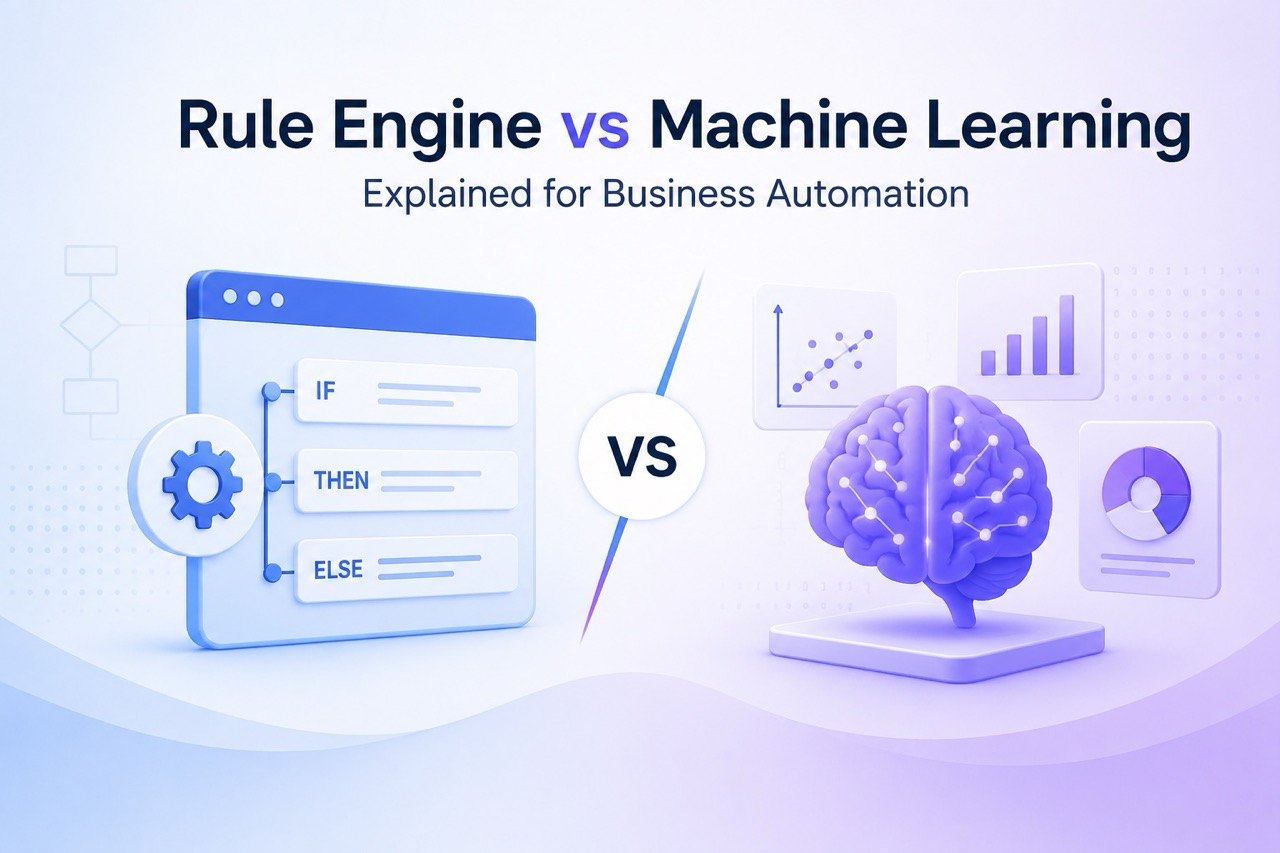
As a result, a heated debate around rule engines and machine learning algorithms emerged, each of which is used to solve different problems. One can see companies that still depend heavily on deterministic rule engines and other enterprises that implement machine learning algorithms that adapt to the situation on the go, based on statistical patterns in historical data.
The problem is that most often, people tend to view these two approaches as competitors; however, understanding when to implement one or another solution is crucial for building effective automation systems.
What is a Rule Engine?
A rule engine is a system that makes decisions using predefined business rules. These rules are written as conditions and actions.
In simple terms, the system follows: “If this condition is true, perform this action.”
For example:
IF transaction_amount > 10000AND country = "high-risk"THEN trigger_manual_reviewThe engine checks the conditions and executes the matching action. Every decision follows rules that were already defined by developers or business teams.
Rule engines are commonly used in those industries where decisions have to be based on certain policies and logic, for example:
- Finance
- Insurance
- E-commerce
- Logistics
- Healthcare
- Compliance
Common examples of use include:
- Loan eligibility rules
- Detection of fraudulent transactions
- Validating coupons
- Processing insurance claims
- Calculating taxes
- Authorization processes
The first significant advantage that rule engines offer is predictability, as all the rules are written clearly, allowing teams to determine the reasons behind particular decisions.
The second advantage is logical segregation. Rules are separated from the business logic in back-end applications so that frequent changes in policies do not require code modifications.
What is Machine Learning?
Unlike rule engines, which have pre-defined rules that should be written out explicitly, machine learning algorithms learn rules and patterns from historical data.
In fraud detection, the model can consider:
- Transactional history
- Behavioral pattern of device usage
- Behavioral pattern of user activities
- Purchase frequency
- Geographical location patterns
From this information, the algorithm can identify what type of fraudulent behavior is.
It all boils down to this distinction:
- Rule engines operate on predetermined rules and conditions.
- Machine learning models learn from data.
Machine learning is commonly used for:
- Recommendation systems
- Fraud detection
- Predictive analytics
- Customer segmentation
- Dynamic pricing
- Forecasting
- Behavioral analysis
A streaming platform is a simple example. A rule engine might use logic like:
IF user likes action moviesTHEN recommend action moviesA machine learning model goes further. Machine learning uses watch history, time watching, searching, clicking, and other user behaviors to predict which video they will watch next.
This explains why machine learning is applicable when behaviors vary constantly, and static rules cannot suffice.
Nevertheless, there are drawbacks to using machine learning. One major drawback is that predictions cannot be certain, only probabilistic. Many times, users may not know why a certain prediction has been made by the system.
This is particularly important in sectors like finance, health care, and insurance.
Rule Engine vs Machine Learning Key Differences
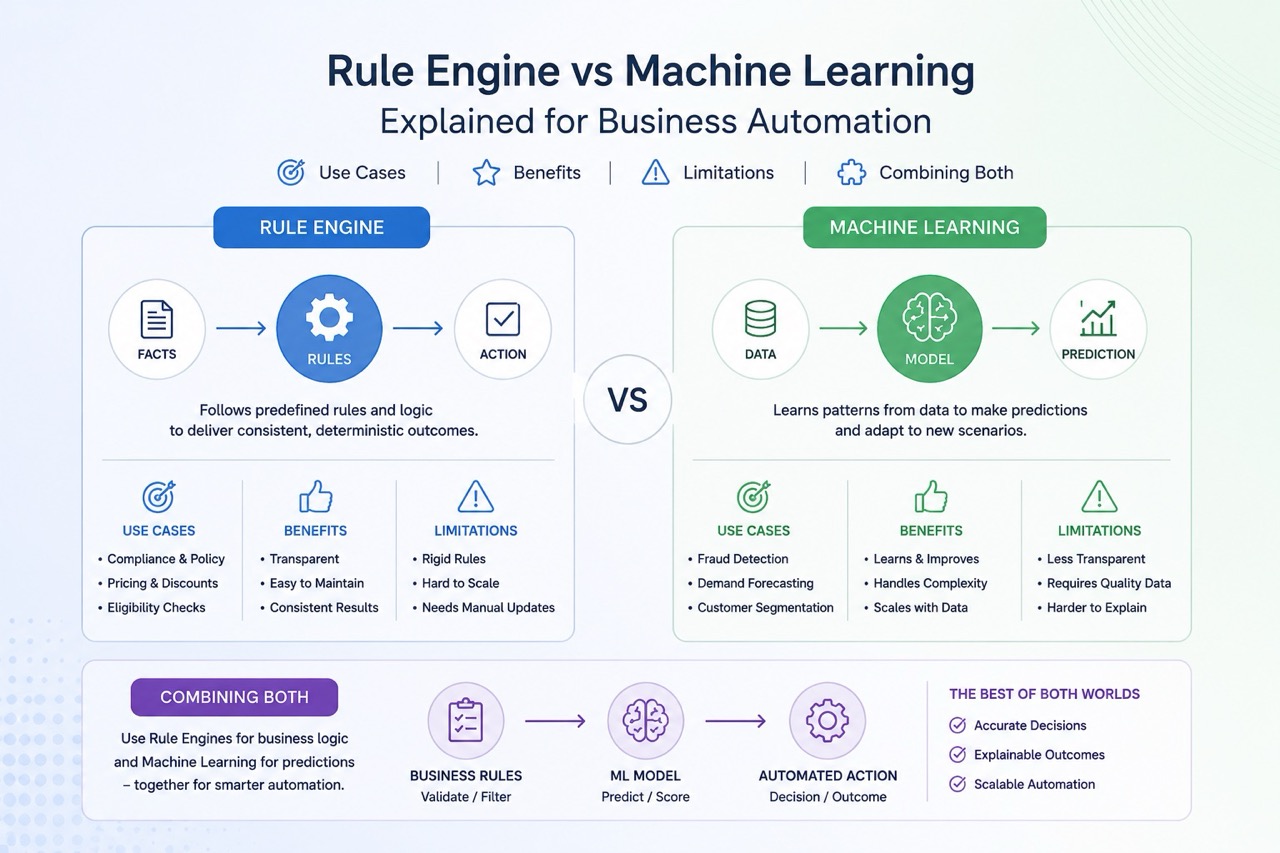
The ambiguity in rules engine vs ml technology comes due to the similarity in their purpose, i.e., automating decision-making. However, the way that both technologies automate decisions differs significantly.
- Predictability: Rule engines are deterministic. For a rule engine, if the input data remains constant, the results will never differ. Because machine learning techniques operate using probabilities, they will predict varying results for the same conditions during training.
- Transparency: Being that all conditions are listed, rule-based systems are transparent compared to machine learning techniques. Deep learning systems can sometimes become black boxes, which is why financial and healthcare companies continue to widely use rule-based technologies.
- Adaptability: Machine learning is more flexible in dealing with pattern changes. A rule-based system requires explicit changes each time conditions change. Fraud detection is a good example. Fraud behavior evolves constantly, making static rules difficult to maintain alone.
- Data Dependency: Rule engines can work with relatively small datasets. Machine learning systems depend heavily on large amounts of quality historical data. Without sufficient training data, ML systems perform poorly.
- Maintenance Style: Rule engines require rule management. Machine learning systems require:
- Training pipelines
- Model monitoring
- Retraining cycles
- Feature engineering
- Training pipelines
The operational complexity is very different.
Comparison Table
Understanding these differences is critical when evaluating when to use rule engine vs machine learning approaches inside automation systems.
When Businesses Should Use Rule Engines?
Rule engines work best when decisions need:
- Consistency
- Predictability
- Explainability
- Operational control
This is especially important in regulated environments.
For example:
- Insurance approvals
- Tax calculations
- Compliance validation
- Loan eligibility
- KYC workflows
In these systems, businesses often need to explain exactly why a decision occurred.
A healthcare provider rejecting an insurance claim cannot simply say:
“The AI predicted it.”
There must be a clear operational logic behind the outcome.
Rule engines also make sense when:
- Business policies change frequently
- Teams need operational visibility
- Workflows are deterministic
- Conditions are clearly defined
This is where teams usually benefit from a practical rule engine guide before deciding whether machine learning is actually necessary.
Modern automation platforms like Nected are increasingly used in these scenarios because they allow teams to manage rules, workflows, and integrations without repeatedly modifying backend services.
When Businesses Should Use Machine Learning?
The value of machine learning becomes obvious when the decision-making process needs to follow patterns that humans find impossible to describe using static rules.
Such use cases include:
- Recommendation systems
- Behavioral analytics
- Fraud prevention
- Demand prediction
- Customer segmentation
- Predictive maintenance
An example of e-commerce fraud systems can be a model taking into account such parameters as:
- Device behavior
- Transaction time
- History
- Network activity
- Geographical discrepancies
Trying to cope with all of these factors manually is simply impractical.
ML shines when:
- Large datasets are available
- Patterns change regularly
- Accuracy outweighs logical consistency
- Continuous adaptation is required
Streaming services, advertisement networks, and financial risk management applications widely apply machine learning since user behavior is hard to predict and describe using rule-based systems. However, machine learning does not mean better results automatically.
Many enterprises complicate their processes with machine learning models when it could have been easily done with static rules.
Operational specialists need to consider real business requirements rather than jumping on the bandwagon of machine learning.
Advantages and Disadvantages of Both Technologies
Both rule engines and ML models address certain business problems successfully, but there are always trade-offs.
Rule Engine
Pros:
- Explainability
- Predictability
- Better compliance control
- Faster updates
- Greater governance
Cons:
- Needs manual updating
- Bad fit for evolving patterns
- Challenging to implement in highly dynamic scenarios
- Becomes hard to maintain with big rule sets
Machine Learning
Pros:
- Learns from data
- Detects hidden patterns
- Adapts to changing behavior
- Handles large-scale prediction problems
Cons:
- Requires significant training data
- Lower explainability
- Potential bias issues
- Continuous monitoring requirements
- Higher operational complexity
Can Rule Engines and Machine Learning Work Together?
Yes, and this is increasingly becoming the modern approach. Many organizations now combine deterministic rules with predictive machine learning systems.
For example:
- ML models generate fraud risk scores
- Rule engines decide operational actions
A fraud model might predict:
“87% probability of suspicious activity.”
The rule engine then decides:
- Block transaction
- Trigger manual review
- Request additional verification
This combination provides:
- Predictive intelligence
- Operational control
- Auditability
- Explainability
This is where the idea of combining a rule engine and machine learning becomes extremely practical. Instead of replacing one technology with the other, businesses use each for what it does best.
Modern platforms like Nected support this type of architecture by integrating APIs, workflows, AI models, and business rules inside connected automation systems rather than treating them as isolated layers.
In practice, many companies now rely on:
- Machine learning for predictions
- Rule engines for governance and execution
That hybrid approach is becoming common in banking, insurance, logistics, healthcare, and e-commerce workflows.
Key Takeaways
- Deterministic business logic operates via rule engines, which use predetermined conditions.
- Rule engines are easier to justify and control.
- Machine Learning is more flexible in dealing with behavioral changes and large data sets.
- Organizations need to select technologies according to their needs and not to trends.
- Currently, there are many cases where both approaches are used by systems.
- Nected offers solutions for automated decision-making processes that use workflows, rules, and machine learning systems.
FAQs
What is the biggest difference between rule engine vs machine learning systems?
The biggest difference is how decisions are made. The rule engine is based on logic designed and programmed by people, whereas machine learning discovers patterns from data itself. One needs pre-programmed logic while the other relies on statistics.
Is machine learning replacing rule engines in today's organizations?
No, many organizations still use rule engines in places where decisions have to be transparent and traceable. The machine learning algorithm will typically supplement the rule engine by providing more predictive capabilities.
When should one choose a rule engine vs. a machine learning solution for a company's decision-making problems?
In general, business entities will prefer using rule engines when consistency, traceability, and governability are required. Machine learning solutions will be useful when the detection of behavioral patterns and adaptation to change are required.
Are there rule engines and machine learning applications available for smaller companies?
Yes, both the rule engine and machine learning technologies have become easily available through modern automation tools that support low-code development and the visual development of rules as well as APIs. Companies start by building their business rules and then move forward to use machine learning, as necessary.
Why do industries with heavy regulation opt for machine learning vs business rules solutions?
Regulated businesses, such as banks, insurers, or healthcare institutions, require transparency from their automated decision-making. In other words, such organizations will integrate predictive machine learning models with rule-based validation mechanisms.


.webp)
.svg.webp)

%2520(3).webp)
.webp)

.webp)




.webp)