.svg)

.svg)




.png)
.webp)
In fintech, decision logic isn’t a back-office concern—it’s the core of underwriting, risk, compliance, and customer experience. In 2026, leading financial services firms treat it as decision intelligence: a strategic layer that combines deterministic rules, workflow orchestration, and AI-augmented authoring to drive lending decisions, fraud detection, KYC/AML flows, and regulatory compliance at speed.
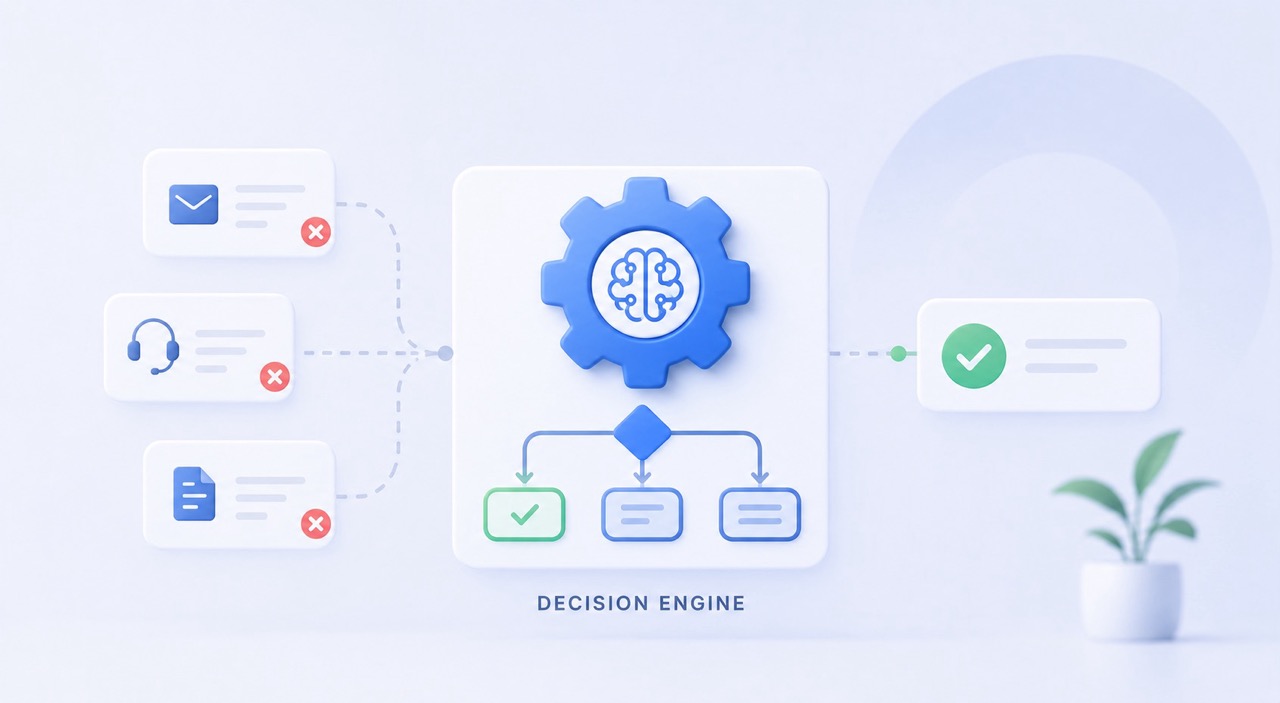
The shift is clear: fintechs aren’t just buying “a rules engine” or “a workflow tool.” They’re investing in decision intelligence platforms that unify rules, workflows, data, and AI so business and engineering can own, iterate, and govern decisions—from loan eligibility to fraud scoring—without redeploying code.
This blog compares the top 5 decision intelligence platforms for fintech—Nected, Taktile, Inrule, Pega, and FICO—with a focus on AI-native decisioning and core decision engine capabilities so you can choose the right platform for lending, risk, compliance, and customer-facing financial flows.
Decision Intelligence Platform vs. Rules Engine: What’s the Difference?
A rules engine evaluates predefined logic: if this condition, then that outcome. It’s well-suited for eligibility, pricing, risk checks, and compliance in fintech.
A decision intelligence platform goes further by combining:
- Rules + workflow — Decision tables, decision trees, rule chaining, and multi-step workflow orchestration (e.g. underwriting flows, KYC pipelines) in one place.
- Data + integrations — Direct connectors for credit bureaus, core banking, CRMs, and APIs so decisions can pull live data without custom glue code.
- Governance — Versioning, rollback, audit trails, maker-checker approvals, and controlled rollout—critical for regulated financial services.
- AI-native decisioning — AI Copilot, AI Agents, and ML integration to accelerate authoring, testing, and optimization while keeping decisions deterministic and auditable.
In short: a decision intelligence platform lets you model, run, and govern complex financial decision flows—with AI built in—instead of stitching rules, workflows, and tooling together.
What’s Happening in the Decision Intelligence Market for Fintech (Data-Backed)
Decision intelligence is moving from “tooling” to “strategy” in financial services
Two adjacent markets explain why:
- BRMS (Business Rules Management Systems) are growing as organizations need agility, governance, and real-time decisioning. The global BRMS market is valued at ~$1.5–1.6B (2025) and is projected to reach $2.56B by 2034, with cloud deployments at ~61% of revenue share. Source: Global Growth Insights — BRMS Market Report (2025–2034)
- Decision Management (rules + orchestration + analytics + optimization) is growing faster. The Business Research Company’s 2026 report estimates the market at $8.09B (2025), growing to $9.68B (2026) (19.6% CAGR) and $17.86B by 2030 (16.6% CAGR). Source: TBRC Decision Management Market Report 2026
Fintechs and banks are buying a decision layer that combines rules, workflows, and AI—one that can be updated quickly, governed safely, and observed in production for lending, risk, and compliance.
Why AI-native decisioning matters for fintech
- Gartner (2025) forecasts that by 2027, 50% of business decisions will be augmented or automated by AI agents for decision intelligence, shifting enterprises from rigid, hard-coded logic to dynamic, auditable decisioning. Source: Gartner — Top Data & Analytics Predictions 2025
- McKinsey reports 88% of organizations use AI in at least one business function (up from 78% the prior year), and 62% are experimenting with AI agents. Source: McKinsey — The state of AI 2025
Platforms that offer AI Copilot, AI Agents, and ML integration out of the box are pulling ahead in fintech—because they compress the lifecycle from policy to production without sacrificing governance or explainability required by regulators.
Quick Comparison: Top 5 Decision Intelligence Platforms for Fintech
Evaluation for fintech typically centers on four risks:
- Change risk: Can you ship rule and workflow changes (e.g. underwriting, pricing, fraud rules) without redeploying code?
- Integration risk: Can you pull data from credit bureaus, core banking, and APIs without building glue code?
- Governance risk: Can you audit, version, approve, and rollback—essential for compliance and audits?
- Scale risk: Can the platform handle production traffic (e.g. real-time loan decisions, fraud checks) with observability and SLAs?
How AI Is Reshaping Decision Intelligence Platforms in Fintech?
AI is changing how financial decisions get built
AI in decision intelligence for fintech isn’t about replacing deterministic rules. It’s about shortening the end-to-end lifecycle:
- Turning credit policy and underwriting guidelines into executable rules faster
- Generating edge-case test data for risk and fraud scenarios
- Explaining decision paths to ops, compliance, and regulators
- Detecting conflicts and unreachable rules in complex eligibility and pricing logic
- Guiding refactors of large rule bases (e.g. loan pricing, KYC rules)
For fintech teams, “good AI” inside a decision platform means:
- Authoring: “Create rules for loan eligibility with these conditions…”
- Refactoring: “These underwriting rules overlap—suggest a merged decision table.”
- Testing: “Generate edge-case inputs to stress this ruleset.”
- Explainability: “Why did we reject this applicant? Show reason codes.”
AI becomes useful when the platform has a solid foundation: schemas, versioning, environments, replay, and observability. The platforms compared here are evaluated on whether AI-native decisioning is built in and governable for fintech, not bolted on.
Detailed Comparison: Top 5 Decision Intelligence Platforms for Fintech
Below is an in-depth look at each platform for fintech use cases, with Nected vs. competitor comparison tables.
1. Nected
Nected is a low-code/no-code decision intelligence platform that unifies a rule engine and workflow engine in one layer. It is built to streamline backend processes, decision logic, and experimentation workflows with decision tables, decision trees, rule chaining, and workflow orchestration—so fintech teams can ship underwriting, pricing, fraud, KYC, and compliance changes quickly, safely, and at scale for customer-facing and mission-critical flows.
What sets Nected apart for fintech is the combination of ease of authoring (for business users) with production-grade controls (for engineering and compliance), and AI-native decisioning (AI Copilot, AI Agents) so rules and workflows don’t depend on release cycles or specialist-only tooling.
Key Features:
- Intuitive low-code/no-code visual rule and workflow designer
- Decision tables, decision trees, rule chaining via workflow editor
- Triggers: API, webhooks, scheduler, events (upcoming)
- Direct connectors for databases and APIs (no-code UI)—ideal for credit data, core banking, CRMs
- Draft vs. published versions, versioning & rollback, parallel versions
- Audit trails, maker-checker approvals, import/export
- AI Copilot and AI Agents for accelerated authoring and optimization
- Cloud + private managed + self-hosted deployment
- SOC 2, GDPR, ISO compliant
- High scalability; response time within 100–200 ms; 99.9%+ uptime
Pros:
- Unified rules + workflow + AI in one platform—suited to lending, risk, and compliance
- 50% reduction in development time in reported use cases
- Non-technical users can manage rules and workflows without coding
- Fast iteration with built-in governance for regulated environments
- Flexible deployment and strong security posture
Cons:
- Teams new to structured decisioning may need a short onboarding
- Complex legacy core banking systems may require careful integration planning
In summary, Nected stands out as a leading decision intelligence platform for fintech because it unifies rules, workflows, and AI-native capabilities in a single layer. It offers a user-friendly interface, seamless integrations, and robust governance that suit both technical and non-technical users, making it a strong fit for lenders, neobanks, and insurers that want to optimize decision management and workflow automation with AI built in.
2. Taktile
Taktile is an AI decision management platform built for decision flows—especially in financial services (underwriting, risk, onboarding). It combines rules, ML scoring, and workflow-like orchestration in a flow-centric model. It is flow-first and AI-augmented; rule authoring is tailored to decision flows rather than large, general-purpose rule libraries.
Best suited for
Financial services teams building AI-augmented decision flows that prioritize policy orchestration and risk decisioning over broad, cross-industry rule management.
Key Features:
- AI-assisted decision flows
- Flow-first orchestration (underwriting, risk, onboarding)
- Integration with data providers and data warehouses
- User-friendly interface for non-technical users
- Strong focus on security, privacy, and governance
Pros:
- Strong flow-first experience for financial decisioning
- Designed for AI-assisted decision journeys
- Good fit for structured, regulated decision flows in BFSI
Cons:
- Not rules-engine-first for very large rule libraries
- Limited cross-industry flexibility vs. general-purpose decision platforms
- Cloud-first; deployment and data residency options can be constrained
- No native maker-checker / approval flows
- Response time often in seconds; suited to offline or long-running jobs
Get a detailed Nected vs Taktile comparison
3. Inrule
Inrule is an enterprise BRMS (Business Rules Management System) with a strong heritage in .NET and on-premises deployments. It provides rule authoring, versioning, and deployment for business logic, with support for decision tables and rule flows. It is rules-first; workflow orchestration and AI-native decisioning are limited compared to modern decision intelligence platforms. Implementation and change cycles are typically weeks to months, with higher TCO ($400K–$800K annually in many enterprise deployments) and a .NET-centric architecture that can create lock-in for non-.NET fintech stacks.
Best suited for
Organizations already standardized on .NET and Inrule who need enterprise rule governance for lending or compliance, and who can accept longer implementation times and higher licensing and operational costs.
Key Features:
- Enterprise rule authoring and deployment
- Versioning and audit (with limitations)
- .NET-centric architecture; integration with other stacks often requires service boundaries
- On-premises and cloud deployment options
Pros:
- Mature enterprise BRMS with governance
- Familiar to teams already on Inrule and .NET
Cons:
- No / limited AI-native decisioning (no built-in AI Copilot or AI Agents)
- Limited workflow orchestration; end-to-end underwriting or KYC workflows often need additional tools
- Complex UI; limited business-user self-serve
- Rule changes often take days to weeks; deployment can be heavy
- High TCO (licensing, infrastructure, change management)
- .NET lock-in for non-.NET services
Read detailed Nected vs Inrule comparison
4. Pega
Pega is a heavyweight enterprise platform for case management, workflows, and decisioning. It combines rules, workflows, and case handling in one ecosystem, with AI and automation capabilities across the platform. It is extremely capable but introduces complexity: longer rollouts, higher licensing costs, and heavier operational overhead. AI-assisted authoring is available but often requires specialist skills; business-user self-serve is not always “lightweight.” It is used by many banks and insurers for lending, servicing, and compliance.
Best suited for
Large financial institutions that want a unified case/workflow + decisioning platform and can invest in specialist talent, longer implementations, and higher ongoing platform costs.
Key Features:
- Rules, workflows, and case management in one platform
- Strong governance and controls for enterprise environments
- Extensive ecosystem and integration options
- AI and automation capabilities (platform-wide)
- Cloud, on-premises, and hybrid deployment
Pros:
- Powerful enterprise platform for workflows, cases, and decisioning
- Strong governance and controls—suited to regulated fintech
- Broad ecosystem and integrations
- AI capabilities available
Cons:
- High implementation and operational complexity (slower time-to-value)
- Often requires specialized skills; business-user self-serve can be heavy
- High licensing and platform overhead (TCO can be significant if you mainly need rules + workflows + AI decisioning)
Read detailed Nected vs Pega comparison
5. FICO
FICO (including FICO Blaze and the broader decisioning suite) is a long-standing leader in decision management for banking, insurance, and healthcare. It offers powerful rule authoring, decision modeling, and integration with FICO’s analytics and scoring ecosystem. It is rules- and decisioning-centric, with strong support for complex business logic and enterprise governance—widely used for lending, fraud, and collections. AI-native decisioning (Copilot/Agents-style authoring) is less prominent than in Nected or Pega; the platform is often developer- or analyst-centric, with moderate to high implementation effort and enterprise-level pricing.
Best suited for
Enterprises in finance, insurance, or healthcare that already use or plan to use FICO’s analytics and scoring stack and need a robust, governed rules and decisioning layer.
Key Features:
- Enterprise rule and decision management (e.g. FICO Blaze)
- Strong fit for banking, insurance, healthcare
- Integration with FICO analytics and data
- High scalability and governance
- Cloud, on-premises deployment
Pros:
- Deep decision management and rule capabilities
- Strong in regulated, analytics-heavy industries (lending, fraud, collections)
- Proven at scale
Cons:
- AI-native authoring (Copilot/Agents) less central than on modern decision intelligence platforms
- Non-tech friendly UI and self-serve can be limited
- Enterprise-level pricing and implementation (high TCO)
- Maker-checker / approval flows may require custom setup
Get a detailed Nected vs FICO comparison
How to Choose the Best Decision Intelligence Platform for Fintech
What’s driving demand in 2026
The global BRMS market is projected to reach approximately USD 2.48 billion in 2026, with a CAGR of ~8.15% through 2031. Gartner forecasts that by 2027, AI will augment or automate 50% of business decisions. Fintechs and banks are looking for decision intelligence platforms that combine deterministic rules, AI-driven authoring and optimization, workflows, and real-time governance—so business teams can own and iterate on underwriting, risk, fraud, and compliance decisions at market speed.
What to look for (fintech)
- AI-native decisioning — Built-in AI Copilot, AI Agents, or ML integration for authoring, testing, and explainability without giving up deterministic control (critical for audits and regulators).
- Rules + workflow in one — Can you model rules (tables, trees, chaining) and orchestrate workflows (approvals, KYC steps, underwriting pipelines) in the same platform?
- Business-user authoring — Can non-technical users (e.g. risk, product, compliance) create and update rules and flows without coding?
- Governance — Versioning, rollback, audit trails, maker-checker approvals, and controlled rollout—essential for regulated financial services.
- Integration — Direct DB and API connectors (credit bureaus, core banking, CRMs), no-code or low-code, to avoid glue-code sprawl.
- TCO and speed-to-value — Predictable costs, fast time-to-value, and low operational burden so you can ship lending and risk changes quickly.
Why Nected fits the 2026 fintech decision intelligence market
Nected was built as a unified rules + workflow platform with AI-native decisioning from the ground up. It combines:
- Visual rule authoring (decision tables, trees, chaining) with workflow orchestration (triggers, approvals, multi-step flows)
- Direct connectors for databases and APIs
- Governance (versioning, audit trails, maker-checker) built in
- AI Copilot and AI Agents for accelerated authoring and optimization
- Cloud + private managed + self-hosted deployment
- SOC 2, GDPR, ISO compliance
Fintech teams can run everything from simple eligibility rules to complex underwriting, fraud, and KYC workflows—with AI built in—without stitching multiple tools together.
Conclusion
The decision intelligence market for fintech in 2026 is less about “who can execute rules” and more about who can operationalize change:
- Can business and engineering collaborate safely on underwriting, risk, and compliance?
- Can you ship rule and workflow changes without redeploying apps?
- Can you govern and audit decisions at scale for regulators and audits?
- Can you integrate credit, core banking, and APIs without glue-code debt?
- Can AI accelerate the lifecycle without increasing risk?
If your rules and workflows sit in the blast radius of lending, fraud, pricing, onboarding, or compliance, your choice of decision intelligence platform is a long-term architecture decision. Choose the platform that makes safe change and AI-native decisioning the default, not the exception.
FAQs
What is a Decision Intelligence Platform?
A decision intelligence platform combines a rules engine, workflow engine, and AI-native capabilities (e.g. Copilot, Agents, ML integration) in one platform. It lets you create complex rules (decision tables, trees, rule chaining), automate multi-step workflows, and use AI to accelerate authoring, testing, and optimization—so you can model and run end-to-end decision flows with governance and explainability. In fintech, this applies to underwriting, risk, fraud, KYC/AML, and compliance.
What’s the difference between a Decision Intelligence Platform and a Rules Engine?
A rules engine executes predefined business logic (if/then). A decision intelligence platform adds workflow orchestration and AI-native decisioning—so you can automate rules, workflows, and the lifecycle (authoring, testing, explainability) in one place, often with non-technical user access. For fintech, that means unified control over lending, risk, and compliance flows.
Why does “AI-native” matter for decision platforms in fintech?
AI-native decisioning shortens the path from policy to production: turning credit and underwriting docs into rules, generating test cases, explaining outcomes to compliance and regulators, and refactoring rule bases—while keeping decisions deterministic and auditable. Platforms with built-in AI Copilot or AI Agents reduce dependency on specialists and accelerate iteration in regulated environments.
How do Decision Intelligence Platforms reduce risk in fintech?
By providing controlled change and governance: versioning, approvals, audit trails, test/sandbox environments, and monitoring/alerts. Rule and workflow changes become safer than app redeployments, and AI-assisted authoring can reduce errors and conflicts when combined with these controls—critical for lending, fraud, and regulatory compliance.
When should I choose a dedicated Decision Intelligence Platform over a general BRMS for fintech?
Choose a decision intelligence platform when you need rules + workflow + AI in one layer, with fast time-to-value, business-user authoring, and strong governance for underwriting, risk, fraud, or KYC. Choose a traditional BRMS when you are already standardized on it (e.g. .NET/Inrule, FICO stack) and mainly need rule execution and governance without workflow or AI-native tooling.



.svg.webp)






.webp)