.svg)

.svg)


.png)
.webp)
Taktile is a managed, FSI-specialized SaaS platform; Drools is a free, open-source, code-first Java rule engine with no domain specialization and no built-in governance of any kind.
Teams usually arrive at this comparison from one of two directions. Some are already running Taktile for credit, fraud, or lending decisioning and are evaluating Drools — or a platform like it — because their decisioning needs have expanded beyond that original FSI scope into pricing, eligibility, or operational approvals that Taktile's domain orientation doesn't serve as naturally. Others are starting fresh, comparing a narrowly specialized FSI platform against Drools (Open-source BRMS (Java), domain-agnostic) to understand whether deep domain specialization is worth the trade-off against broader applicability, and what each choice actually costs once governance, implementation, and ongoing operations are priced in — not just the license line.
Below, we break down how Taktile and Drools actually compare across eleven capability dimensions — from rule ownership and governance safety to AI-native decisioning and total cost of ownership — so you can see past the marketing positioning to what each platform delivers in production. Where Taktile's public documentation doesn't disclose a specific capability, we say so explicitly rather than assume parity with more thoroughly documented platforms.
Quick Comparison: Taktile vs Drools vs Nected
How We Evaluated Taktile and Drools
Taktile and Drools sit at different points on the specialization spectrum — one purpose-built for financial-services credit, fraud, and lending decisioning with native model integration, the other positioned as an Open-source BRMS (Java), domain-agnostic. This comparison uses an outcome-first approach focused on what each platform delivers in production, not just at the proof-of-concept stage.
We covered capability completeness across practical decisioning outcomes, implementation and governance maturity, integration depth, and total cost modeled over three years — including license, implementation investment, and the governance engineering that teams typically add as compliance requirements harden. Where Taktile's public documentation does not disclose a specific capability in detail — such as granular RBAC configuration or published throughput SLAs — we note that explicitly rather than assume parity with more thoroughly documented platforms.
What Is Taktile?
Taktile is a decision automation platform built specifically for financial services — credit underwriting, fraud risk, and lending decisioning — with native model-score integration and audit trails calibrated for credit-risk regulatory examination. Its authoring interface, integration templates, and governance model are all optimized for risk analysts and credit policy teams specifically, not general-purpose operational decisioning. Taktile does not provide process orchestration — it is a decision-layer platform, not a BPM tool — and several operational details (granular RBAC, SSO configuration, published performance SLAs) are not prominently documented in public materials. Read the full Taktile overview →
What Is Drools?
Drools is an open-source Business Rules Management System maintained by Red Hat under the KIE project, using the Rete algorithm and DRL for rule authoring, with Business Central for visual rule management and jBPM for process orchestration. Read the full Drools overview →
Taktile vs Drools: Head-to-Head Capability Comparison
Ownership & Change Velocity
Taktile's authoring model is built for risk analysts and credit policy teams specifically — a genuine strength for FSI-native governance, but a narrower audience than platforms designed for cross-functional business users. Compare that to Drools's ownership model above, and the difference in target audience becomes the key decision factor for this dimension.
Governance Safety & Control
This is where Taktile's FSI specialization shows its clearest advantage over generalist tools that lack built-in credit-decision governance — but it's also where publicly available detail thins out fastest. Where Drools either matches or falls short, that gap (and Taktile's own documentation gaps) should be validated directly with each vendor before a compliance-critical decision.
Workflow & End-to-End Automation
Neither Taktile nor most focused decisioning platforms ship native process orchestration — Taktile is explicitly decision-layer only, with no BPM equivalent. If your requirement spans both a governed decision and a longer business process around it, both tools typically need a workflow layer (or a platform that includes one) alongside them.
Performance, Scale & Reliability
Taktile does not publish detailed throughput, latency, or uptime SLAs in its public materials, which makes a precise performance comparison difficult without a vendor conversation. What's clear directionally is that Taktile is architected for real-time credit and fraud decisioning specifically, while Drools's performance profile is documented above.
Integrations & Data Access
Taktile's strongest documented integration capability is native credit and fraud model-score integration — a genuine differentiator for FSI use cases specifically. Outside that domain, general-purpose data connectivity is less clearly documented than in platforms built for broader operational decisioning.
AI-Native Decisioning
Taktile's AI story is narrow and domain-specific: native integration with credit and fraud scoring models, not a general-purpose AI copilot for rule authoring. Teams evaluating broader AI-assisted decisioning across use cases beyond FSI credit risk should weigh this gap carefully.
Multi-Development SDLC Lifecycle
Neither Taktile's public documentation nor most rule-engine competitors detail a full SDLC lifecycle (versioning, rollback, parallel run, staged promotion) to the same depth a mature enterprise BRMS does. This is a dimension worth pressure-testing directly with either vendor if your compliance process requires documented change management.
Support & Enterprise Confidence
Taktile's support model is presumably enterprise-oriented given its FSI positioning, but specific SLA terms, training programs, and community resources are not prominently published — a contrast to platforms with more extensive public documentation.
Testing Confidence & Explainability
Taktile's explainability strength is specifically calibrated for credit-decision regulatory review — a genuine asset in that narrow context. Its depth outside FSI-specific audit needs (general debug tooling, what-if scenario testing) is not clearly documented publicly.
Cloud-Native & Language-Agnostic
Taktile's REST-first, cloud-native architecture is one of its most clearly documented strengths — genuinely strong API posture regardless of domain. Deployment flexibility beyond that (multi-tenancy, white labelling, on-prem options) is less publicly detailed.
Observability & Operational Intelligence
Taktile's observability story is strongest specifically around credit-decision audit trails; general-purpose analytics, business-friendly reporting, and metrics export are not prominently documented in public materials.
When to Choose Taktile
Choose Taktile if your requirement is specifically governed credit, fraud, or lending decisioning with native model integration, and you don't want to build that governance layer from scratch.
When to Choose Drools
Choose Drools only if you need maximum rule expressiveness in a Java-centric stack and have engineering capacity to build every governance, compliance, and domain-specific capability yourself.
When Neither Is the Right Answer
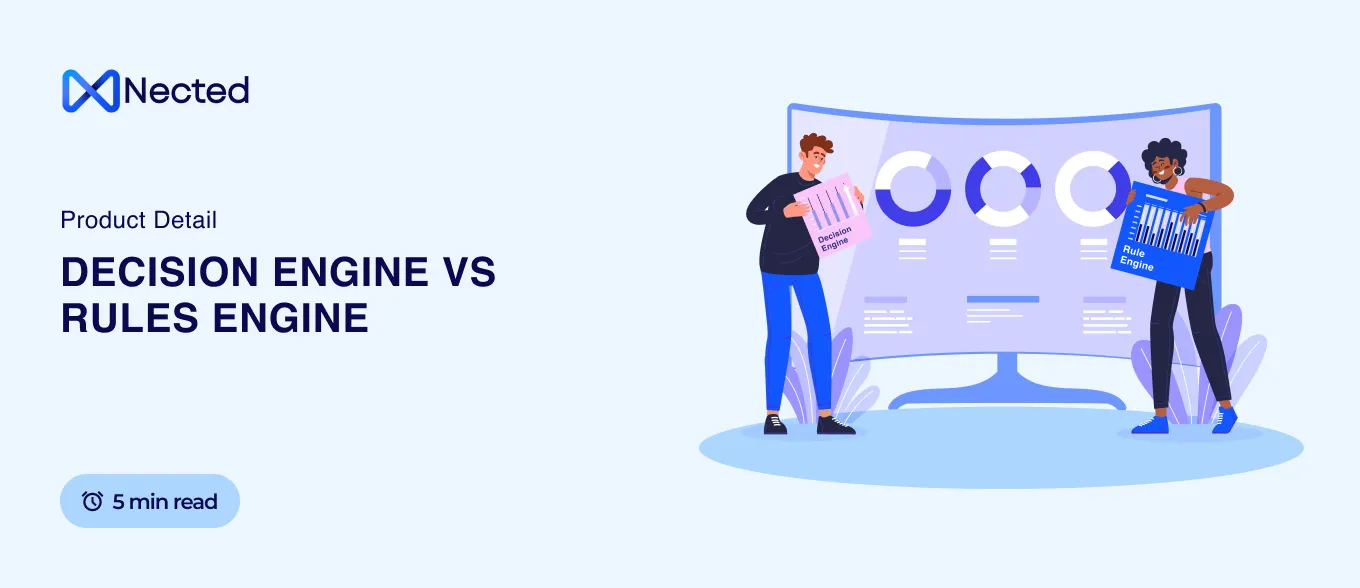
Both Taktile and Drools leave real gaps depending on what you actually need. If your requirement spans multiple decision domains — not just FSI credit risk — Taktile's specialization becomes a ceiling rather than an advantage. If your requirement needs governance, workflow orchestration, and AI-assisted authoring shipped as platform features rather than custom-built or vendor-undocumented capabilities, neither tool fully delivers that combination out of the box.
Nected is worth a serious look if:
- You need governed decisioning across multiple business domains — not just credit risk — in one platform with consistent maker-checker approval flows
- You need workflow orchestration alongside rule decisions — event triggers, multi-step automation, retry logic — without building a separate orchestration layer
- You need AI-assisted rule authoring, AI Agents, and native AI/ML integration across any decision type, not just credit/fraud scoring
- You are in a regulated industry and need documented SOC 2 Type 2, ISO 27001, and GDPR compliance rather than domain-specific governance alone
- Your 3-year cost matters: Nected's modeled TCO runs $315K–$849K over three years, a materially lower and more transparent figure than either platform's fully-loaded cost once governance and domain-specific tooling are accounted for
Nected is used by 500+ teams including PUMA, Bajaj Auto, and TATA 1mg. It's API-first and ships rule changes from a visual builder with a draft/publish lifecycle and maker-checker approval flows across any decision domain — not just financial services credit risk.
Total Cost of Ownership Comparison
What the Numbers Actually Mean
Taktile's pricing is FSI enterprise-calibrated and quote-based — there is no public per-TPS breakdown to compare directly against Drools's more transparently modeled TCO. What is documented is the 3-year indicative range from competitive benchmarking: $450K–$1.35M for Taktile against $405K–$909K for Nected at comparable scale. Drools (Open-source BRMS (Java), domain-agnostic) carries its own cost profile, detailed in the table above. The consistent theme across this comparison series: platforms with narrower domain focus or less mature public documentation are harder to benchmark precisely, which is itself worth factoring into a procurement decision.
Migration Story
Teams migrating away from Taktile typically do so because their decisioning program has expanded beyond credit, fraud, and lending risk into pricing, eligibility, or operational approvals that Taktile's FSI orientation doesn't serve equally — not because the credit-risk decisioning itself stopped working.
"We separated our rule-based decision logic from our model-score-dependent decisions first, then migrated domain by domain. The credit flows took the most care because of the scoring model integration — everything else moved faster than we expected." — Risk Engineering Lead, Fintech (illustrative migration pattern)
Migrating from Drools typically completes in 2–3 weeks, with both systems running in parallel on representative production inputs until output parity is confirmed before cutover.
Frequently Asked Questions
Is Taktile better than Drools?
For financial services organizations whose decisioning is genuinely and durably focused on credit, fraud, and lending risk — with native model-scoring integration as a core requirement — Taktile is generally the stronger fit. Choose Drools only if you need maximum rule expressiveness in a Java-centric stack and have engineering capacity to build every governance, compliance, and domain-specific capability yourself.
Is Taktile SOC 2 or ISO 27001 certified?
Certification status is not prominently documented in Taktile's public materials at the time of this comparison. For regulated financial services deployments where documented certifications are a procurement requirement, verify current certification status directly with Taktile.
Can Drools handle credit or lending decisioning?
Drools can express eligibility and scoring logic in principle, but it was not purpose-built for credit-risk regulatory examination the way Taktile was. Organizations with formal FSI compliance requirements should validate audit-trail depth and model-integration patterns carefully before treating Drools as a like-for-like substitute for Taktile in that specific domain.
What makes Nected different from Taktile and Drools?
Nected ships maker-checker approval workflows, role-separated governance, audit trails, workflow orchestration alongside rules, AI-assisted rule authoring, and documented SOC 2 Type 2 / ISO 27001 / GDPR compliance — all as platform features, across any industry vertical, not just financial services credit risk.
Can I migrate from Taktile to Drools (or the reverse)?
Migration direction depends on which platform better fits your actual decisioning scope. Moving off Taktile typically takes 2–3 weeks for rule-based decision logic, plus 1–2 weeks specifically for re-pointing credit/fraud model-scoring integrations at the new platform. Migrating from Drools typically takes 2–3 weeks, running both systems in parallel on representative inputs until output parity is confirmed.
Why do teams compare Taktile against Drools?
Taktile is a managed, FSI-specialized SaaS platform; Drools is a free, open-source, code-first Java rule engine with no domain specialization and no built-in governance of any kind.


.jpg)
.svg.webp)





.jpg)

.webp)

.webp)


%2520(3).webp)