.svg)

.svg)
.webp)


.png)
.webp)
Let's clear up the naming collision right out of the gate. Vendors use the terms "workflow engine" and "orchestration engine" interchangeably. They both look like flowcharts in a marketing pitch.
But if you're the engineer actually architecting the backend, confusing the two is a massive mistake.
One is built to wait for humans to click buttons. The other is built to babysit distributed microservices and prevent your database from corrupting during a network partition.
What is a Workflow Engine?
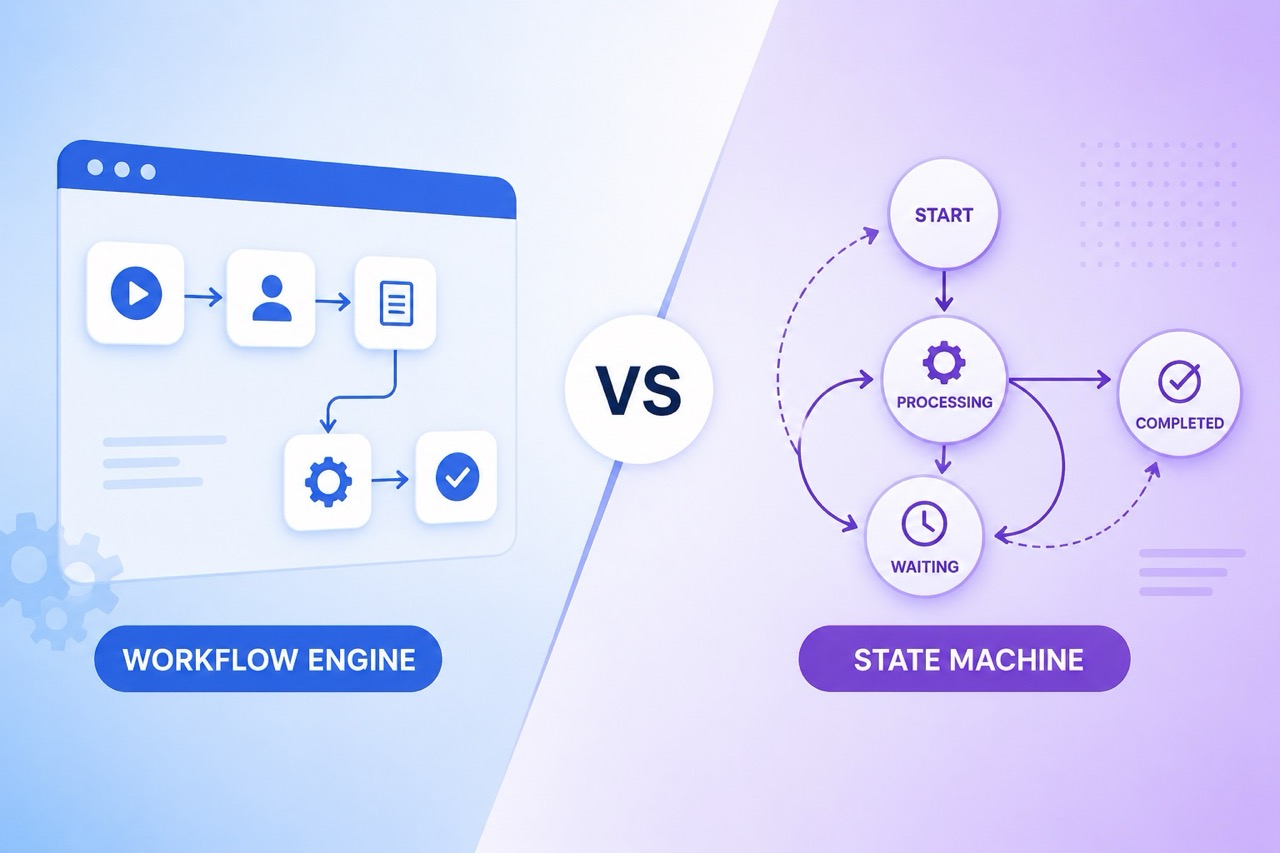
A workflow engine automates business processes. It cares deeply about document routing, approval chains, and state machines.
When you use a workflow engine, you are modeling a process that moves at the speed of a human being. Here is how it actually works in practice. You define a sequence of steps, often using visual BPMN diagrams. When a process starts, the engine executes the first automated step and then inevitably reaches a human task.
At this point, the engine writes its current state to a database and goes to sleep.
It stops consuming compute resources for that specific thread. A classic example is an expense report. An employee submits a receipt. The workflow engine updates a database row to say "Pending Manager Review" and routes a notification. Then it literally just sits there. Sometimes for three weeks. It only wakes up when an external trigger—like a manager clicking "Approve" in a web portal—tells it to move to the next step.
These engines are heavily tied to UI portals, active directory roles, and task assignment logic. They are designed to answer one fundamental question: "Who has the ball right now?"
What is an Orchestration Engine?
An orchestration engine doesn't care about human approvals. It exists to coordinate system-to-system interactions.
When you split a monolith into twenty microservices, you suddenly have to deal with distributed transactions. You can no longer wrap five database updates in a single SQL commit. This is where an orchestrator steps in.
Here is how it functions. The orchestrator executes strict, code-defined logic to manage APIs and background workers. It acts as the central conductor. If a user buys a laptop, the orchestrator hits the inventory API, then the payment API, then the shipping API. It does this at massive scale and sub-second speeds.
But networks fail. APIs go down.
When the shipping API crashes, the orchestration engine doesn't pause and assign a ticket to an IT manager. It reacts programmatically. It triggers built-in retry loops with exponential backoff. If the API remains dead after five tries, the orchestrator executes compensation logic. It automatically calls the payment API to issue a refund. It rolls back the transaction so you don't end up in a fractured, corrupted state.
Orchestrators are highly technical. They manage the Saga pattern, handle aggressive programmatic retries, circuit breakers, and sub-second execution speeds across thousands of concurrent nodes.
The Core Differences That Actually Matter
If you are trying to decide which system to stand up in your cluster, here is the brutally honest architectural breakdown:
Also Read: Top Workflow Orchestration Tools
A Side-by-Side Example
Think about hiring a new developer.
You need a workflow engine to handle the actual human onboarding. HR submits the offer letter. The engine pings the VP for approval. The VP is on vacation. The request sits there for four days. The engine doesn't care. It just waits in the database. Maybe it sends an automated nag email on day three. Eventually, the VP clicks 'Approve'. IT gets a notification to ship a laptop.
The whole thing takes a week. It’s clunky, it’s slow, and it needs a UI because humans are involved at every step.
Now look at what happens the second that VP clicks 'Approve'. That's where the orchestration engine takes over.
The system needs to create a directory account, provision cloud architecture roles, and add the dev to your code repository. It hits the directory API. Success. It hits the cloud API. Success. It hits the code repository. The repository API throws a 503 error.
This is where things usually break.
A workflow engine would just freeze or throw an error ticket to a support queue. The orchestration engine doesn't need a human. It instantly retries the repository API three times using exponential backoff. If it still fails, it executes a rollback. It automatically sends a delete request to the cloud and directory services to wipe the accounts it just created. You don't end up with a half-provisioned ghost user floating around your infrastructure.
The whole system-to-system process took 800 milliseconds.
This looks simple. It usually isn't. Try writing that rollback logic by hand in a standard REST API and see how quickly your database turns into a corrupted mess.
Real-World Use Cases
You will severely cripple your infrastructure if you use the wrong tool for the job.
When to use a Workflow Engine: Use this when building employee onboarding systems, loan origination portals, or compliance checklists. If the process involves a human reading a PDF, physically signing something, or navigating a multi-tiered management approval matrix, you need a workflow engine.
When to use an Orchestration Engine: Use this for financial transaction processing, video encoding pipelines, or complex e-commerce checkouts. If you need to hit a payment gateway, then hit a CRM, then hit your internal database—and you need to guarantee that either all three succeed or all three roll back automatically—you need an orchestration engine.
The debate usually ends the moment you look at the primary actor in your system.
If your bottleneck is waiting for the VP of Finance to approve a budget, you need a workflow engine to manage that state. If your bottleneck is managing partial failures across five flaky internal APIs, you need an orchestration engine. Stop trying to force a slow, heavy BPMN engine to act as a high-throughput microservice router. Pick the right tool for the bottleneck.
FAQs
Q: Can an orchestration engine wait for human input?
A: Yes, most support a "wait for external signal" feature. But building complex human-routing logic inside an orchestrator requires you to write a massive amount of boilerplate code. A true workflow engine gives you dynamic role assignment and out-of-office delegation out of the box.
Q: What is the Saga pattern?
A: It's the standard way orchestration engines handle distributed rollbacks. Because you can't wrap three different microservice APIs in a single SQL transaction, a Saga defines exactly what reverse-action (compensation) to take if a step fails halfway through the process.
Q: Do I need both in my architecture?
A: In a massive enterprise, yes. It's completely normal for a high-level Workflow Engine handling an insurance claim to trigger a low-level Orchestration Engine that handles the actual API calls to process the payout.
Q: Is "Choreography" better than Orchestration?
A: Choreography is an event-driven alternative. Microservices just listen to a message broker topic and react without a central orchestrator telling them what to do. It's incredibly decoupled. But it quickly turns into a massive debugging nightmare because there is no single place to see the state of an entire transaction.


.svg.webp)
.webp)
.webp)

.webp)
.webp)
%2520(3).webp)

.webp)