.svg)

.svg)



.png)
.webp)
Any lending decision revolves around one key question: How probable is it that this borrower will pay off their debts?
Traditionally, creditors have been using credit scores, financial reports, bank statements, and manual analysis to find the answer. While the process still remains relevant, it has become increasingly hard to adapt to the rapidly growing amount of lending, alternative sources of information, and customer demands. Modern companies want to get their loans approved in minutes rather than in days without raising default risks.
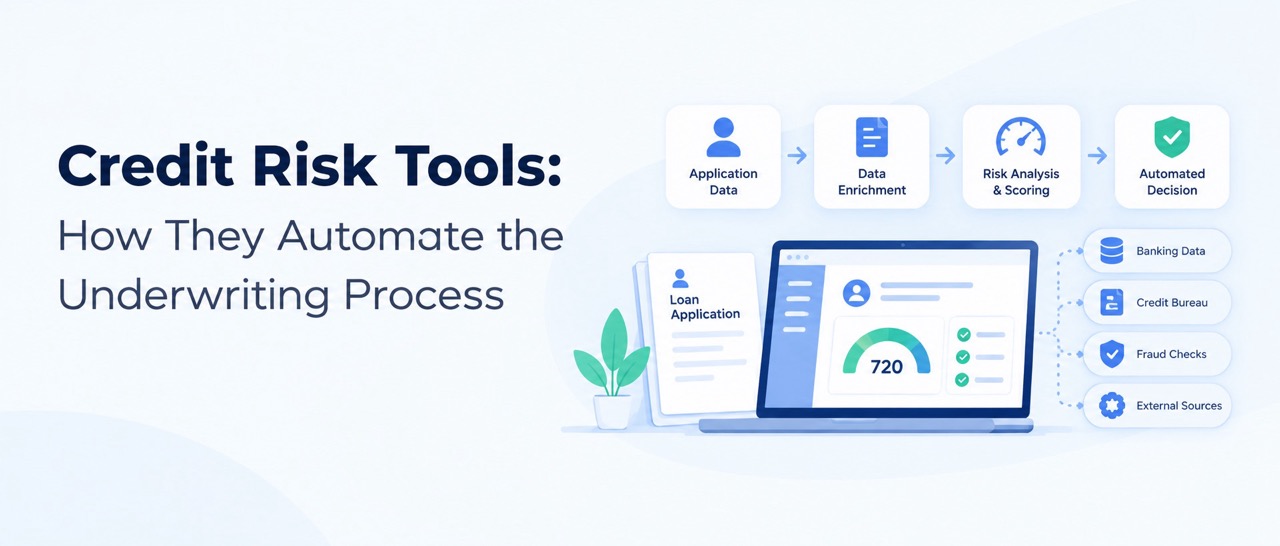
That's when AI credit underwriting enters the scene by helping lenders automatically collect required information, verify documents, assess borrowers' behavior, calculate their risks and make lending recommendations. Human underwriters will still be doing their job, but now spending much less time on repetitive tasks and dealing mostly with complicated cases.
This guide is aimed at helping you understand how AI-based underwriting works, what benefits you can receive from it, and how other organizations use it for improving credit risk assessments.
What is AI Credit Underwriting?
Credit underwriting is the process lenders use to evaluate whether a borrower is likely to repay a loan. During this process, lenders assess an applicant's financial health, repayment capacity, existing liabilities, income or business performance, and credit history to determine the level of lending risk. Based on this assessment, they decide whether to approve, reject, or modify a loan application.
AI credit underwriting uses artificial intelligence to improve this process. Instead of relying primarily on manual reviews and predefined rules, AI analyzes both traditional financial data and alternative data, such as cash flow patterns, banking transactions, payment behavior, and business performance, to assess risk more accurately and consistently.
Rather than replacing underwriters, AI helps them make faster, data-driven decisions while allowing complex or high-risk applications to remain under human review.
Traditional Underwriting vs AI-Powered Underwriting
Conventional underwriting has served the purpose of lending for a long time, but traditional underwriting was developed with lower amounts of application data in mind. With the growth of digital lending, lenders struggled with the issue of being able to retain their speed without having increased operating costs.
AI underwriting solves many of the issues mentioned above through automation of data collection and analysis.
The traditional method of underwriting assesses whether the applicant meets the predetermined criteria for borrowing. The AI system assesses the criteria for lending but discovers other patterns that affect repayment risk.
For instance, two companies may generate the same yearly income. When the lending is assessed manually, both companies will be treated equally. However, AI will see that one company has a stable income per month, while the other company has very seasonal income.
This additional information will enable borrowers to make better decisions without slowing down the process.
How AI Agents Improve Credit Risk and Underwriting
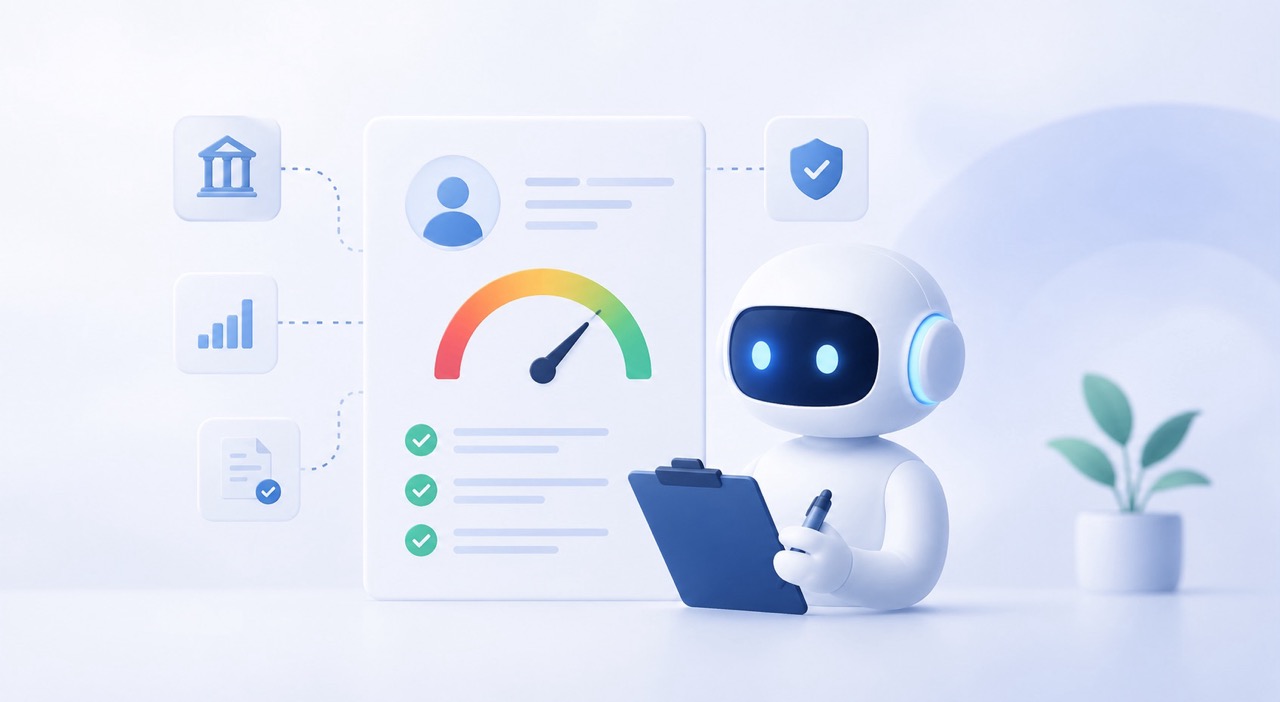
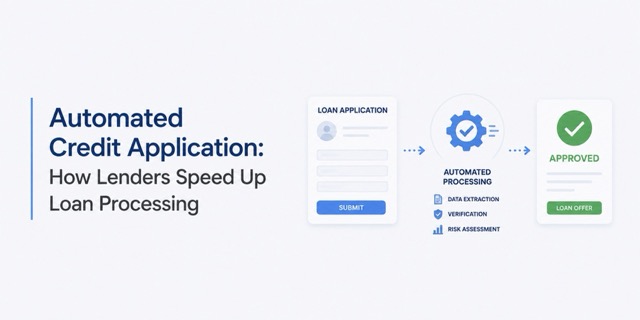
AI models generate predictions, but AI agents manage the operational work required to reach a lending decision.
Instead of doing one task, an AI agent manages multiple tasks using workflow orchestration in the underwriting process, saving time and making sure the application follows the mandatory process.
An example of an underwriting process may include the following steps:
- Collection of applicant data
This AI agent collects all the data from the applications, banks, accounting software, and CRM tools. The missing data can be found even before an application goes further.
- Verification of all provided documents
Instead of making underwriters verify all the documents submitted to the bank manually, the agent verifies them and finds inconsistencies in the documents such as bank statements, tax documents, income data, and other financial documents.
- Analysis of risk for a loan applicant
This involves the combination of financial data with loan policies, repayment behavior of the borrower, and a risk prediction model.
- Application of lending policies
It involves using business rules engines to decide if the application gets automatically approved or needs to be checked by a credit analyst.
- Support lending decisions
Rather than replacing underwriters, AI agents provide supporting evidence for recommendations. Underwriters have the ability to analyze the rationale behind these decisions, gather more information, or even overturn decisions.
This combination of automation and human control enables lenders to approve applications quicker without taking away responsibility from the decision-making process.
Consistency is another benefit. It is natural for manual evaluations to be variable based on experience, load, and judgment. AI agents assess each application based on the same decision criteria.
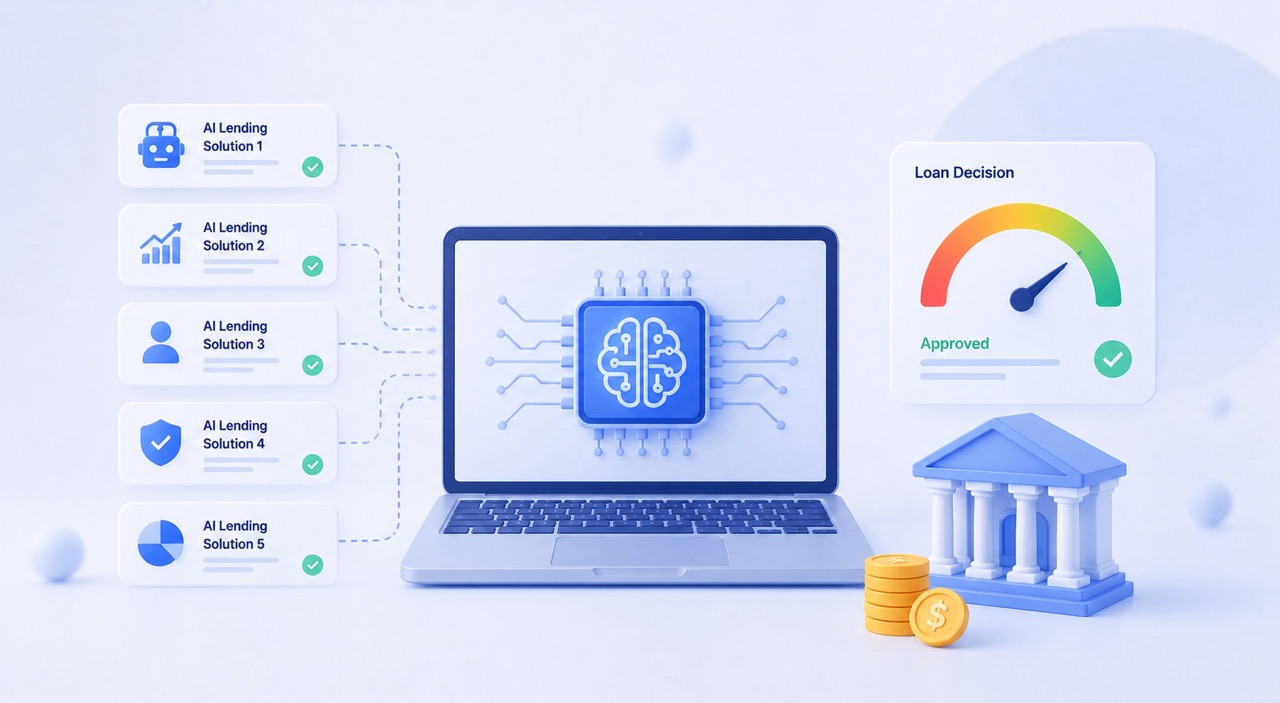
Top 5 AI-Driven Credit Risk and Underwriting Platforms
The right underwriting platform depends on what you're trying to improve. Some of the solutions aim at providing predictive credit scoring services, while others offer automation of underwriting processes, work with current lending software, or assist teams in developing their own decision engines.
Instead of searching for an all-in-one platform, pay attention to how a particular solution is suited to your current workflow, data sources, compliance requirements, and other necessary integrations.
1. Zest AI
Zest AI is an AI-powered credit underwriting platform that helps lenders improve credit decisions using machine learning models trained on historical lending data. Instead of relying only on traditional credit scores, it analyzes a broader set of financial and behavioral signals to predict repayment risk while providing explanations for its recommendations.
Best for
Banks, credit unions, and consumer lenders that want to improve credit approval accuracy, expand lending to more qualified borrowers, and use AI-driven risk assessment while maintaining explainable lending decisions.
Strengths
- Improves credit risk prediction by analyzing a broader range of borrower data than traditional score-based underwriting.
- Provides explainable AI outputs, allowing underwriters and compliance teams to understand why a recommendation was made.
- Helps lenders identify creditworthy applicants who may be overlooked by conventional underwriting methods.
- Supports fair lending initiatives by helping institutions evaluate lending decisions more consistently across applicants.
Considerations
- Uses its own machine learning models rather than serving as a workflow orchestration platform for external AI models.
- Organizations typically need additional systems to manage customer onboarding, business rules, approval workflows, and operational decisioning beyond the risk assessment stage.
2. Provenir
Provenir combines AI decisioning, credit risk assessment, fraud detection, and data orchestration in a single platform. This enables financial services to consolidate different data sources while developing unique decision-making approaches.
Best for:
- Digital banks/lenders
- FinTech startups
- Lending platforms
Strengths:
- Decision engine is customizable
- Multiple data integrations possible
- Decisioning in real time
Considerations:
Customizing the lending process to meet your needs may prove challenging.
3. Nected
Most AI underwriting platforms focus on building or providing predictive risk models. Nected takes a different approach.
Nected is a modern decisioning platform that helps financial institutions orchestrate the entire underwriting workflow. Instead of replacing your existing AI or machine learning models, it allows you to integrate them through APIs and build end-to-end credit decisioning workflows around them.
Whether your organization uses an in-house ML model, a third-party credit scoring service, fraud detection tools, or KYC providers, Nected brings them together into a single configurable workflow. This enables risk, operations, and business teams to manage underwriting logic without hardcoding business rules across multiple applications.
Best for
- Banks and financial institutions
- Fintech companies
- Embedded lending platforms
- Enterprise credit decisioning teams
Strengths
- Auto-scalable architecture that handles high transaction volumes and large data sources without additional operational overhead.
- Business-friendly configuration, allowing risk and operations teams to update decision logic without relying on engineering teams for every policy change.
- Human-in-the-loop decisioning, enabling complex or high-risk applications to be routed for manual review while low-risk cases continue automatically.
- Enterprise-grade deployment and support, designed for regulated financial institutions that require reliability, governance, auditability, and operational resilience.
Considerations
Nected is not an AI credit scoring or underwriting model. It complements existing AI and machine learning models by orchestrating decision workflows, business rules, approvals, and integrations across the underwriting lifecycle.
How Does Nected Help Build AI-Powered Credit Decisioning Workflows?
Most underwriting decisions rely on multiple systems, not a single AI model. A typical lending workflow may involve:
- Customer data collection
- Identity verification (KYC)
- Credit bureau checks
- AI or ML risk scoring
- Fraud detection
- Financial statement analysis
- Business rule evaluation
- Human review for high-risk applications
- Final approval or rejection
- Customer notifications
Without a decision-orchestration layer, these systems are often connected via custom code, making workflows difficult to maintain and update.
Nected allows organizations to integrate their existing AI models and external services through APIs, then configure the entire underwriting workflow using business rules and visual decision flows. Lending policies, approval logic, and routing rules can be updated without modifying application code.
One of Nected's biggest advantages is human-in-the-loop decisioning. While AI can automate routine underwriting decisions, larger banks and fintech companies often require manual review for high-value or higher-risk applications where accuracy and governance are critical. Nected makes it easy to combine automated decisioning with human approvals, ensuring organizations improve operational efficiency without sacrificing control or compliance.
4. Taktile
Taktile allows risk teams to design and control automated decision flows without being dependent much on engineering teams. It is an amalgamation of a rule-based system with AI models and third-party data integration.
Best for:
- Lending operations teams
- Risk teams
- Fintech startups
Strengths:
- No-code decision builder
- Policy updates
- Experiments
Considerations:
They may need to use other systems for servicing or managing loans.
5. FICO Platform
FICO is one of the most used credit decisioning platforms for the financial services industry. FICO uses predictive analytics, business rules, and decision management to lend to enterprises.
Best for:
- Large banks
- Financial institutions
- Enterprise lenders
Strengths:
- Mature decision management
- Analytics
- Ecosystem
Considerations:
It may require more implementation effort than cloud-based underwriting platforms.
Read More: What is Credit Risk Management & Why it Matters?
Real-World Applications of AI in Credit Risk Assessment
Nowadays, AI-powered underwriting is not exclusive to consumer loans anymore. Financial institutions and fintechs are using AI to facilitate underwriting across a range of lending products.
- Lending for Small Businesses
Small businesses may have limited credit history, which complicates underwriting.
AI algorithms assess cash flow, transaction history, accounting records, and payment patterns of businesses, which gives a more comprehensive understanding of business condition. That lets lenders make decisions about lending to businesses that would be hard to reach using traditional approaches.
- Embedded Lending
The practice of embedding loans into various marketplaces, payment providers, and SaaS platforms becomes increasingly common.
AI assesses the activity of customers, which is available within the platform already: the number of transactions, subscription-based recurring payments, etc., to decide whether the customer qualifies for getting offered financing.
- Consumer Lending
Banks and fintech lenders apply AI algorithms to automate underwriting of personal loans based on the combination of traditional credit bureau data and alternative data.
Those applications that meet certain criteria are approved instantly, whereas high-risk applications go through an additional screening process.
- Invoice Financing
Businesses often wait weeks or months for invoice payments.
Through the use of artificial intelligence, it is possible for lenders to be able to measure the quality of invoices, customers' payment histories, and even the performance of businesses in order to measure the risk of repayment.
- Supply Chain Finance
Manufacturers and suppliers need to have quick access to working capital. Artificial intelligence helps in measuring past purchasing behavior and the performance of suppliers.
Common Challenges of AI-Powered Credit Risk Analysis
AI improves underwriting efficiency, but successful implementation depends on more than selecting the right model.
- Data Quality
AI models depend on accurate, complete, and consistent data.
Incomplete financial data, stale customer data, or inconsistent transaction history will impact prediction quality irrespective of the complexity of the model used.
An organization needs to first ensure that data flows reliably through its pipeline before implementing AI-based underwriting.
- Explainability of the Model
The lenders will require understanding reasons for accepting or rejecting an application.
The use of highly complex AI models will allow accurate predictions but will make it hard to explain individual decisions to the customer, auditor, or regulatory authorities.
Predictive models combined with business rules make the process more explainable.
- Compliance
Financial organizations have regulations to comply with regarding their lending process, customer privacy, and equal treatment. AI will support compliance, but not replace it.
Organizations should keep the audit trail, document decision-making logic, and validate model performance periodically.
- Human Oversight
All decisions are not to be made using AI. Certain applications with higher amounts of loans, atypical financial situations, and conflicting data usually require human supervision.
AI works well when it supplements the experience of an underwriter rather than replaces him/her.
- Drift of the Model
Behavior of borrowers changes over time.
Economic environment, spending behavior, and repayment behavior could change the model performance.
Key Takeaways
- AI credit underwriting blends predictive modeling with automation to enhance loan decision-making.
- AI agents save time by gathering information, validating documents, calculating risk, and managing the underwriting process.
- Underwriting success requires accurate data, clarity of reasoning, and proper human intervention.
- A good underwriting system is one that best suits your loan process and other factors, not necessarily the number of AI tools used.
- Workflow orchestration systems such as Nected integrate AI models, business rules, API’s, and the entire approval process to form an effective decisioning workflow.
FAQs
What is AI credit underwriting?
AI credit underwriting uses artificial intelligence to evaluate loan applications, assess borrower risk, and support lending decisions using financial, behavioral, and alternative data.
How does AI improve underwriting?
AI is able to handle processes such as document validation, data collection, risk evaluation, application of business rules, and approval routing, so that an underwriter could concentrate on decision-making in more complicated situations.
Does AI replace human underwriters?
No. Typically, most lenders utilize AI to automate the process of decision-making while still holding human underwriters liable for dealing with exceptions and risky loans.
What kind of data does AI use to assess credit risk?
It depends on a lender, but AI is capable of evaluating credit history, banking transactions, financial reports, payment history, accounting data, cash flow, performance of a business, and any other financial indicators.
Is AI able to increase loan approval speed?
Yes, due to automation of data analysis and underwriting workflow, it is possible to evaluate loans within minutes instead of days.
What are the biggest challenges when implementing AI underwriting?
Problems may range from poor data quality to compliance, model explainability, model drift, and incorporating an AI model with the current loan application process.
How does workflow automation help AI underwriting?
Workflow automation helps tie together data feeds, the AI model itself, fraud detection technology, KYC service providers, business rules, and the approval process in an automated workflow.
Is AI underwriting appropriate for small lenders?
Yes. With the help of cloud underwriting platforms and workflow automation tools, small lenders and fintech companies can use AI technology without reinventing the wheel.


.svg.webp)



.webp)


.webp)

.webp)