.svg)

.svg)



.png)
.webp)
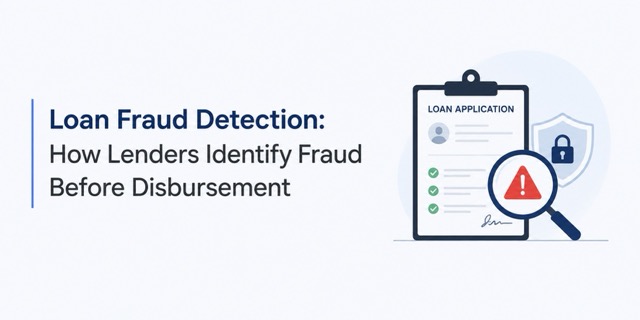
A fraudulent loan application does not always contain obviously false information. The identity may belong to a real individual, and income documents may be authentic while still being inconsistent with other information available to the lender. An application can also appear normal until it is compared with previous applications, credit data, or other verification signals.
That makes fraud detection in lending a cross-checking problem, not just an identity check. Lenders need to evaluate whether the information supporting an application is consistent before the application reaches approval and disbursement.
How Loan Fraud Detection Works Across the Lending Process
A loan fraud detection system should work alongside the lending process rather than appear as one final check before approval. Different signals become available at different stages, so fraud controls need to evaluate them as the application progresses.
A typical flow is:
Application → identity verification → document/income checks → credit and account checks → fraud signal evaluation → approve, verify, or refer
Fraud signals can appear at different stages of the application. An application may show inconsistent identity information, repeated use of the same contact details, or discrepancies between declared and verified information.
Identity verification provides one layer of evidence, while income, employment, bank-account, and document checks can provide additional evidence about whether the application information is consistent.
Lenders can also use signals from existing customer records, previous applications, credit data, device or channel information, and fraud databases.
The important part is how these signals affect the application path. A suspicious application should not continue through the same approval workflow while the lender waits for a manual review.
Why Loan Fraud Is Harder to Detect Before Approval
Fraud is difficult to identify early because lenders are making decisions with limited information. At the application stage, they may have only the information submitted by the borrower and a few external verification results.
The main issue is that one clean check does not validate the entire application. An identity can be genuine while the stated income is manipulated. A credit profile can be legitimate while the person applying is not the actual account holder. A bank account can belong to the borrower but still be associated with suspicious application activity.
Fraud detection therefore depends on comparing signals rather than treating each check independently.
Also Read: Best Loan Management Software & Systems
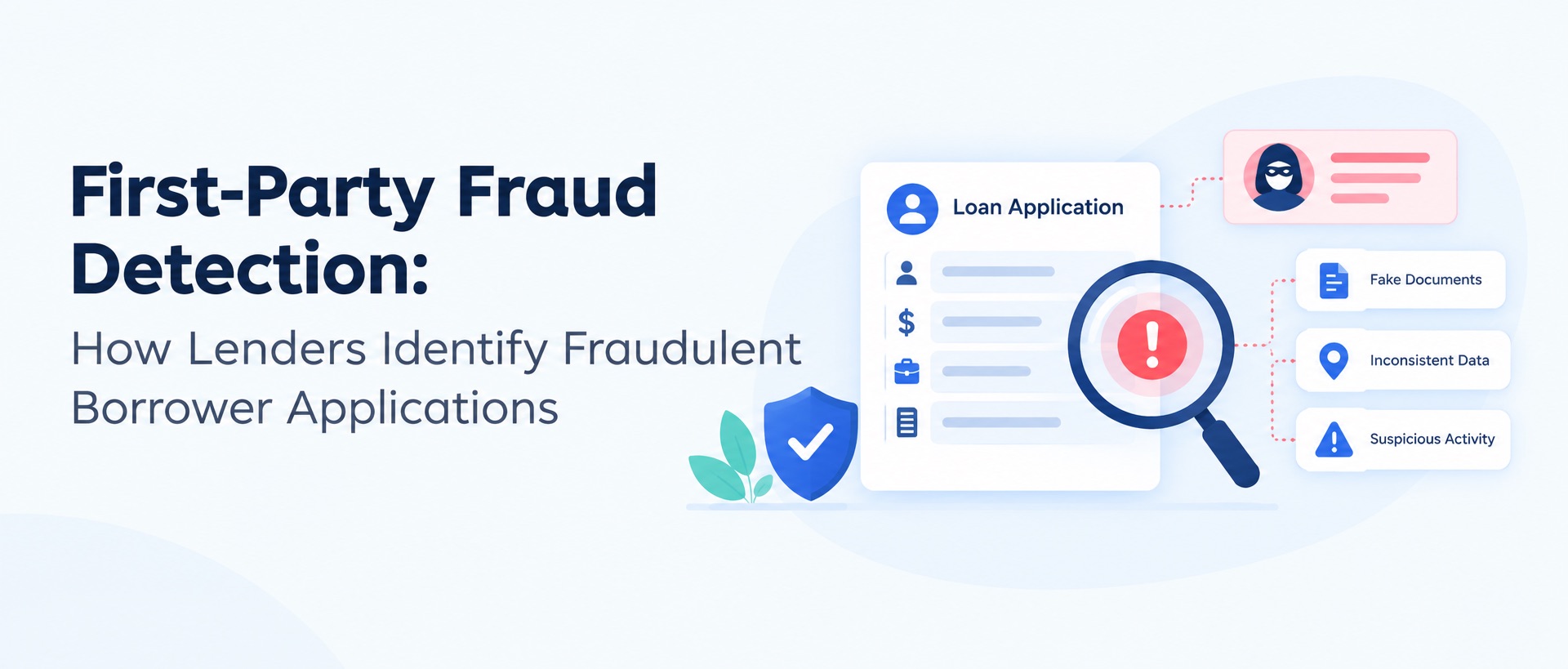
Which Signals Help Lenders Identify Suspicious Loan Applications?
Fraud detection through AI will prove useful in analyzing these signals, particularly in instances where there is an extensive number of applications being analyzed by the lenders, thus making it hard to notice any irregularities manually. These include:
- Identity discrepancies: Discrepancies in name, address, date of birth, phone number, identification data, or other information used to verify one’s identity can imply manipulation of information or that the information provided doesn’t belong to the applicant.
- Discrepancies in stated income: Stated income that is inconsistent with the verified payroll, bank, tax and/or employment data can prompt further investigation.
- Document irregularities: Manipulated payslips, bank statements, identification and any other documents presented with the loan application can indicate application fraud. Verification of the document is only one aspect of verifying data; it can’t be done separately from the data itself.
- Recurring applications: Applications being submitted repeatedly using associated identities, contact details, addresses, bank accounts, or any other information belonging to the borrower.
- Credit and existing-account signals: Strange credit behavior, current relationship, or contradictions within the application may provide further information related to fraud detection. These signals should not be treated as direct indicators of creditworthiness.
- Device and channel signals: For digital lending, unusual device, session, or application-channel patterns can add another fraud signal. They should generally support other evidence rather than determine the outcome by themselves.
When Should a Loan Application Be Approved, Flagged, or Referred for Review?
Fraud detection needs an operational response. Finding a suspicious signal is not enough if the system still sends every application through the same workflow.
A lender typically needs three paths:
- Approve: Verification results are consistent, and no material fraud conditions are present.
- Further verification: At least one discrepancy must be explained to continue the application process.
- Fraud investigation: Multiple or significant indicators warrant review by a fraud specialist or investigation team.
For example, an income discrepancy in itself can trigger yet another process of income validation. In case of income discrepancies coupled with discrepancies in identity as well as repetitive applications, fraud could be assumed.
It is important to understand that a fraud indicator is not equivalent to fraud itself. Declining all suspicious applications automatically will result in many false positives.
Loan Fraud Detection vs. Credit Risk Assessment: What's the Difference?
Loan fraud detection and credit risk assessment are two processes that can use the same borrower data, but they answer different questions.
A borrower can have high credit risk without committing fraud. Likewise, an applicant with an excellent credit profile can still present an identity or application fraud risk. Keeping these decisions separate prevents fraud controls from becoming a substitute for underwriting.
Also Read: Fraud Detection Examples
How Nected Helps Connect Fraud Signals to Lending Decisions?
Detecting a suspicious signal is only the first step. Lenders also need to determine what that signal should trigger within the lending workflow.
For example, an income mismatch may require additional verification for one loan product, while a combination of identity discrepancies and repeated applications may require fraud investigation.
These conditions can be represented as configurable rules:
Fraud signals → decision rules → workflow action
Action types might be additional verification, manual review, suspension of processing, or continuing processing. This policy may vary depending on whether the lender introduces new products, modifies threshold limits, or develops new patterns of fraud.
Nected can enhance the capabilities of your lending and anti-fraud applications by offering you a rule engine for implementing such policies and processes. Nected can process fraud indicators in conjunction with other application parameters and route the application appropriately.
Fraud and application data → Nected rules → Verification / Fraud Review / Continue Processing
This keeps fraud detection systems focused on identifying signals while the decisioning layer determines how those signals should affect the lending workflow.
Conclusion
Effective loan fraud detection is not about finding one suspicious field. It requires lenders to connect identity, income, document, application, account, and behavioral signals before money is released.
The goal is also not to flag every unusual application. Lenders need clear paths for applications that can proceed, cases that need additional verification, and cases that require fraud investigation.
That requires fraud signals to connect to configurable actions within the lending workflow. Nected can complement existing fraud and lending systems by providing the decisioning layer that turns those signals into defined next steps.
Frequently Asked Questions
What is loan fraud detection?
Loan fraud detection is the identification of inconsistencies or suspicious behavior in a loan application that could mean the loan was submitted under an assumed identity or through fraudulent information.
What are some signs of loan fraud?
Identity mismatch, inability to validate income, documentation issues, repeated applications, inconsistencies in data supplied by the borrower, patterns in applications, and certain signals from the devices/channels can help detect fraud.
Does the credit score alone help identify loan fraud?
No, since credit scoring deals with the probability of default while fraud detection looks into the authenticity of the application and its accompanying data.
Should every flagged application be rejected?
No. A flag can trigger additional verification or manual review. A suspicious signal does not automatically establish that fraud has occurred.
Where should fraud detection happen?
Fraud checks should begin during application and verification and continue as additional borrower and external data becomes available, particularly before approval and disbursement.
Why do lenders need configurable fraud rules?
Fraud patterns and lending policies vary. Configurable rules can help change the referral limits, verifications needed, and fraud process flows without changing the lending application’s core architecture.
How can Nected support loan fraud detection?
Nected can provide a configurable decisioning layer between fraud signals and lending workflows. It can apply lender-defined rules to determine whether an application should continue, undergo additional verification, or be routed for fraud investigation.


.svg.webp)






.webp)

.webp)