.svg)

.svg)



.png)
.webp)
A lender can have a modern loan origination system and still have a heavily manual lending operation.
An application may enter the LOS automatically, but an employee may still download an income document, check a bureau result, calculate an eligibility condition, request an approval, update another system, and notify operations when the loan is ready for disbursement.
That is the gap lending automation software addresses. It sits around the lending systems already in use and automates the steps that connect them: triggering verification, evaluating conditions, routing applications, requesting approvals, updating downstream systems, and handling exceptions.
The objective isn't to automate every lending decision. It is to remove manual coordination where the process already follows defined rules.
Where Manual Lending Processes Create Delays and Rework?
Manual lending becomes expensive when an employee has to repeatedly coordinate information that already exists in a system.
Consider a personal-loan application. The borrower submits income and employment details through the digital application. The lender then needs verified income, bureau data, fraud results, and existing exposure before applying its credit policy.
If those systems are disconnected, an employee may have to:
- Check whether the application is complete
- Trigger or retrieve income verification
- Pull or review bureau information
- Check fraud results
- Calculate affordability
- Apply the relevant product rules
- Request approval if a threshold is exceeded
- Update the application status
- Send the approved case to documentation or disbursement
None of these tasks is particularly complex. The problem is that they are dependent on one another. If income verification is pending, underwriting waits. If an approval is required, the application waits in another queue. If a document is missing, someone has to identify the gap and contact the borrower.
This becomes harder when the lender has different products with different conditions. A ₹5 lakh personal loan may have one approval path. A business loan for ₹25 lakh could involve more information and other types of exposures apart from approvals from the senior management. Treating both as the same workflow creates unnecessary manual intervention.
Also Read: Automated Underwriting Systems for Business Loans
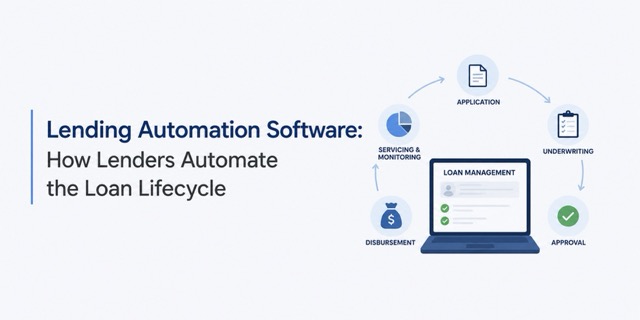
What Lending Automation Software Actually Automates Across the Loan Lifecycle
Automation is most useful at points where the lender already knows what needs to happen and under which conditions.
Application Intake
Upon receipt of an application, automation may be able to verify that the application contains all the required fields as well as all necessary documentation to proceed with further processing. For instance, an absence of the employment field or required document will be noticed straight away rather than by an underwriter at a later point.
Data and Document Verification
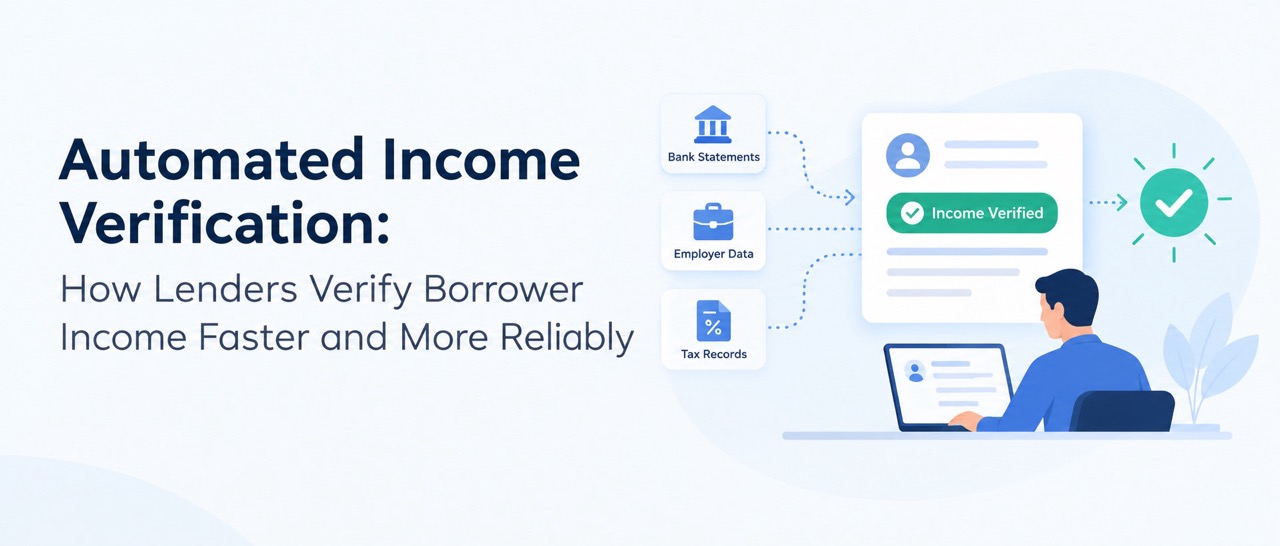
The workflow can trigger income, identity, employment, bank-account, or document verification based on the loan product. Once the result is returned, it can update the application and trigger the next step without an employee checking whether the verification has completed.
Credit Assessment
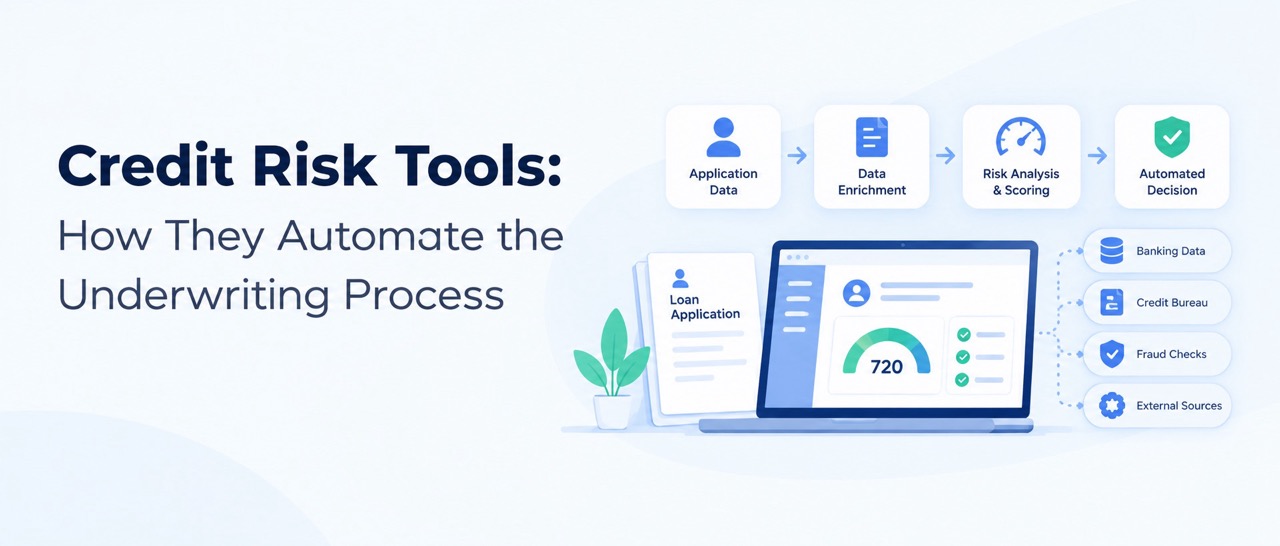
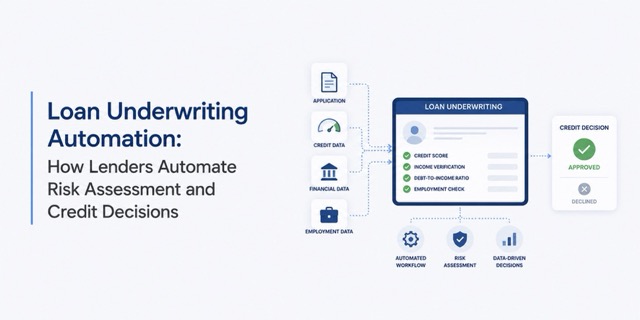
Verified information can be passed to bureau services, credit models, affordability calculations, and internal exposure checks. The results can feed the same decision flow rather than being reviewed separately and manually consolidated.
Approval Routing
Approval requirements can depend on amount, borrower segment, product, risk level, or policy exceptions.
For example:
Loan amount within automated limit → Continue
Amount above limit → Senior approval
Income verification failed → Additional verification
Policy exception → Credit review
Documentation and Disbursement
Once approved, the system may be able to automate the creation of documents, approval by the borrower, checking for conditions, and the instructions for disbursement.
A loan should not be ready for disbursement merely because the credit decision is approved. The conditions before disbursement will still need to be met.
Loan Servicing and Collections
Automation could occur even after the loan funding process. An issue such as non-payment or missed installments can trigger an automated process rather than requiring the identification of the problem by the operations officer.
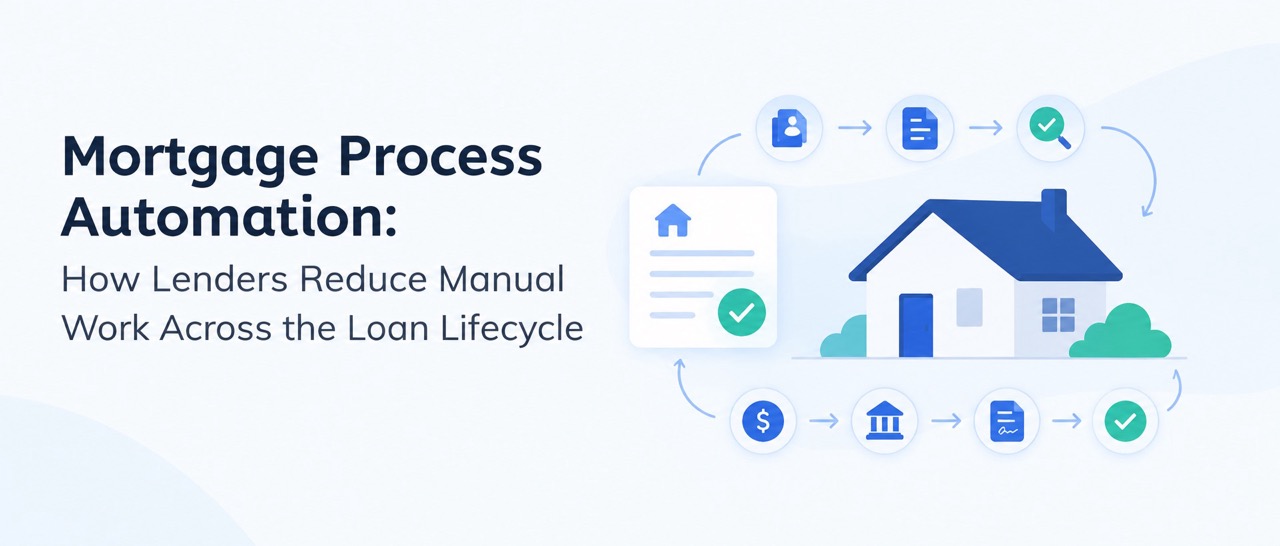
This is what makes automation a loan-lifecycle capability rather than just an application-processing feature.
From Application Intake to Disbursement: Where Automation Fits in Lending Operations
The individual tasks above become more useful when they are connected into a single lending workflow. A typical process can be represented as:
Application → Verification → Credit Assessment → Decision → Approval → Documentation → Disbursement
But real lending workflows are rarely this linear. A verification failure can send an application backward. A policy exception can send it to a senior approver. A missing document can pause it. A successful approval can still be held until a pre-disbursement condition is completed.
A useful automation layer needs to handle these branches:
- Application
The borrower submits the application. The workflow checks whether the minimum information required for that product is available.
- Verification
The workflow triggers the required checks. For a consumer loan, that might include identity, income, employment, bank data, and bureau information. For SME lending, it could include business registration, bank transactions, financial statements, tax information, ownership data, and existing liabilities.
- Assessment
The verified results become inputs to the lender's underwriting process. For example, verified income can be combined with existing debt to calculate affordability. Bureau information can be combined with internal exposure. Fraud results can determine whether the application can proceed.
- Decision
The lender's rules determine the appropriate path. A standard application can move forward automatically. An application outside the policy can be referred. A failed verification can trigger another check.
- Approval and Funding
Once the required approval conditions are satisfied, the workflow can trigger documentation and disbursement. Automation should follow the actual dependencies in lending, not simply create a sequence of screens.
When Lending Automation Makes Sense, and When It Doesn't
Lending automation works well in instances when there are regular checklists, criteria, and handoffs that take place in many cases.
This is especially applicable where the product has a set of criteria for qualification, verification, approval, and referrals. Personal loans, credit cards, and online lending products in general are examples of such products.
Other instances when automated lending can be quite effective are in situations where the application process requires data from several sources. For instance, the loan company may require a combination of bureau information, income verification, fraud screening, and internal exposure levels before deciding. A complex commercial loan may require a credit team to assess business performance, collateral, ownership, and unusual financial circumstances.
The practical rule is simple: automate repeatable decisions; refer judgment-heavy cases to people.
Also Read: Best Platforms for Adding Credit Lines to SMB Workflows
Lending Automation vs. Loan Origination Software: Where They Differ
A Lending Origination Software and a lending automation layer can perform related functions, but they do not necessarily serve the same architectural role.
For example, an LOS may hold the application while separate systems handle income verification, fraud checks, bureau data, documents, and payments.
If employees are manually moving information between these systems, replacing the LOS may not solve the problem. Lending automation addresses the coordination layer between them.
What Lenders Should Check Before Automating a Lending Process?
Before any automation of a lending procedure takes place, the lender needs to lay out the logic, data, and exception paths that will govern that particular process. It is not just about automating more processes; it is about ensuring that each one has inputs, conditions, and outputs.
Credit Policy and Decision Rules
Start with the lender's actual credit policy and identify which decisions can follow predefined conditions.
- Eligibility rules: Define conditions for income, credit score, debt-to-income ratio, loan amount, product eligibility, and other approval criteria.
- Decision rules: Identify which applications can be approved automatically and which require credit-team approval.
- Exception rules: Define what happens when verification fails, thresholds are exceeded, or an application falls outside standard policy.
- Policy changes: Make sure these rules can be updated without changing the core lending application.
For example:
Income verified + DTI within limit + loan amount within approval authority → Automated approval
Income verification failed → Additional verification
Loan amount exceeds approval authority → Senior credit review
Data and System Integration
There is also a need for the automated process to have reliable access to the data needed at each stage of the process. These could be data from the credit bureaus, verification data, banking data, fraud results, exposure data, and documentation.
It should also indicate what should happen when data sources fail to provide data. A failed bureau call, for example, should not be treated as a successful check.
Exception and Audit Handling
Not every application will follow the standard path. The workflow should record why an application was referred and what condition triggered the referral.
For example:
Data received → rules evaluated → condition that failed → action taken
DTI: 47% → Maximum permitted: 40% → Policy threshold exceeded → Credit review
This provides a valid reason for the credit referral process and leaves behind a trace of how this decision was made.
All of these requirements provide one thing clearly: the need for an automated lending process is not only system integration but also a configuration to apply credit rules to the data collected.
How Nected Helps Connect Lending Rules, Data, and Workflows
Nected can complement an existing LOS and lending stack by providing a configurable decisioning and workflow layer. It can bring application data, external data, business rules, and workflow actions together without requiring every lending policy to be embedded directly into the core application.
For example:
Application data → Nected rules → Automated approval / Additional verification / Senior review
A lender can use this logic to automate standard applications while routing cases that fall outside defined conditions to the appropriate team.
Because the decision logic is configurable, lenders can also update eligibility conditions, approval thresholds, and referral rules as their lending policies change, without rebuilding the broader lending workflow.
It makes it possible for the existing loan systems to still perform their primary tasks, with Nected managing the process and policy decisions of what should happen next.
Conclusion
Lending automation is most valuable when it reduces the manual coordination between the systems, rules, and teams involved in the loan lifecycle. It can automate repeatable checks, move applications between stages, and route exceptions to the appropriate teams while keeping judgment-heavy cases with human reviewers.
For lenders with an existing LOS, this does not necessarily mean replacing the core lending platform. The Nected solution can enhance the existing lending platform with a configurable decisioning and workflow layer to integrate lending data, business logic, and further actions. It is about automating the repetitive parts of the lending process without losing its flexibility.
Frequently Asked Questions
What is lending automation software?
The lending process automation software manages the automation of various processes throughout the lifecycle of the loan, which includes loan applications, verification, underwriting, approvals, documentation, funding, servicing, and collections.
What is the difference between lending automation and loan origination?
Loan origination focuses primarily on creating and processing a loan application through underwriting and approval. Lending automation can extend across the wider lifecycle and coordinate activities between the LOS and other lending systems.
Can lenders automate processes without replacing their LOS?
Yes. An automation layer can connect an existing LOS with verification providers, credit bureaus, fraud systems, document platforms, payment systems, and other applications.
What lending tasks are good candidates for automation?
These will typically be high-volume tasks where there is an input and expected outcome. Examples include application testing, validation triggers, document routing, approval processes, payment reminders, and collections triggers.
Does automation of lending make loan decisions automatically?
The decision paths are automatable, but not every lending decision has to be automated. Cases that fall outside the criteria specified by the lender can be forwarded to the underwriting team for analysis.
Why does exception handling matter in lending automation?
Because real applications do not always follow the standard path. Missing documents, failed verification, conflicting data, policy exceptions, and system failures all require a defined next action.
Can lending workflows use different rules for different loan products?
Yes. Each one of a personal loan, automobile loan, and SME facility can have unique criteria for verification, approval, and referrals because workflow and rules can be configured.
What should lenders automate first?
Begin by looking at a lending process that is high volume, but whose workflow currently contains measurable manual handoffs. Begin mapping the system, decisions, exceptions, and approvals, and then move on to automate other processes or products.
How can Nected support lending automation?
Nected offers a customizable layer for decisioning and workflows which integrates lending data, business rules, and next steps. This can enable lenders to automate routine processes and direct deviations to further verification and approvals.


.svg.webp)

.webp)
.webp)