.svg)

.svg)


.png)
.webp)
Every insurance policy begins with a risk decision. Before coverage can be issued, insurers must determine whether a risk should be accepted, under what conditions, and at what price. That decision depends on evaluating customer information, policy requirements, historical data, underwriting guidelines, and product-specific rules.
As insurers expand into new products, digital distribution channels, and embedded insurance models, underwriting has become significantly more complex. Applications now include information from external data providers, medical reports, property inspections, telematics, credit data, and regulatory checks, all of which influence underwriting outcomes.
Managing this growing volume of information through manual reviews or fragmented processes makes it difficult to maintain both speed and consistency. Modern underwriting systems help insurers coordinate these evaluations, apply underwriting policies consistently, and support better risk decisions across high-volume insurance operations.
This article explores why underwriting has become more challenging, how underwriting systems support the decision-making process, and why configurable business logic has become just as important as automation.
Why Underwriting Decisions Have Become Harder to Scale
Insurance products have become more specialized, customer expectations have shifted toward faster policy issuance, and insurers now evaluate far more information before making underwriting decisions than they did even a few years ago.
Every application may require different combinations of customer information, claims history, inspection reports, medical records, third-party data, regulatory checks, and product-specific eligibility criteria. The complexity increases further when insurers operate across multiple products, regions, or distribution channels.
While experienced underwriters can evaluate these factors effectively, maintaining the same level of consistency across thousands of applications becomes increasingly difficult as volumes grow.
The challenge isn't simply processing more applications. It's ensuring similar risks are evaluated consistently while allowing exceptions to receive the additional review they require. Modern underwriting systems help insurers standardize this evaluation process without removing professional judgment from complex or high-risk cases.
Also Read: Top Insurance Underwriting Softwares
What Happens Between an Insurance Application and an Underwriting Decision?
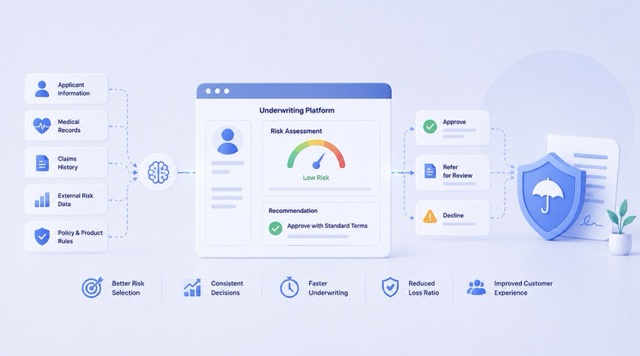
An underwriting decision rarely depends on a single piece of information. Before approving, declining, or referring an application, insurers evaluate multiple operational and risk-related factors that together determine whether coverage can be offered.
Although the exact process varies by insurer and product, most underwriting workflows follow a structured sequence of evaluations before a final decision is made. Each stage contributes to the overall risk assessment, ensuring that underwriting decisions are based on complete and verified information rather than a single risk indicator.
- Application Validation: Before assessing risk, insurers verify that all required applicant information has been submitted correctly. Missing or inconsistent information often prevents underwriting from progressing until the application is complete.
- Risk Data Collection: Underwriters combine application data with additional sources such as claims history, inspection reports, medical information, telematics, property data, or third-party risk services to build a more complete understanding of the applicant.
- Eligibility Assessment: Each product includes underwriting guidelines that determine whether an applicant satisfies predefined eligibility requirements. Applications that fall outside these criteria may require referral or additional review.
- Risk Evaluation: Underwriters assess the overall level of risk by considering both applicant-specific information and product-specific underwriting policies. Depending on the findings, the application may be approved, declined, or escalated for further assessment.
- Pricing and Underwriting Outcome: Once the risk evaluation is complete, underwriting determines the outcome, including premium adjustments, coverage conditions, exclusions, or referral decisions before the policy moves toward issuance.
Why Manual Underwriting Breaks Down as Risk Complexity Grows
Manual underwriting works well when insurers process relatively straightforward applications with stable underwriting guidelines. As products diversify, data sources expand, and regulatory requirements evolve, maintaining consistent underwriting decisions becomes significantly more challenging.
The challenge isn't the number of applications alone. It's the increasing number of variables that must be evaluated before every underwriting decision.
Before examining how underwriting systems address these challenges, it's important to understand where manual underwriting processes typically become difficult to scale.
- Inconsistent Risk Decisions: Different underwriters may interpret underwriting guidelines differently, particularly when applications fall outside standard acceptance criteria. Over time, similar risks may receive different outcomes depending on who reviews the application, making consistency difficult to maintain across the organization.
- Time Spent Collecting Information: Risk evaluation often depends on information from multiple sources, including medical records, inspection reports, claims history, property databases, telematics, or third-party risk providers. Gathering and verifying this information manually increases underwriting turnaround time before the actual risk assessment even begins.
- Growing Referral Volumes: As insurers introduce more products and distribution channels, applications that don't meet predefined underwriting criteria often require manual referrals. Without structured referral management, underwriters spend considerable time reviewing routine exceptions, reducing capacity for complex risk assessments.
- Changing Underwriting Policies: Risk appetite, regulatory requirements, and product guidelines evolve continuously. When underwriters rely on static documents or locally interpreted guidelines, applying updated underwriting policies consistently across teams becomes increasingly difficult.
- Limited Visibility into Underwriting Decisions: Manual underwriting often provides limited insight into why an application was approved, declined, or referred. Without a structured record of the decision process, insurers find it more difficult to review underwriting outcomes, identify operational bottlenecks, or refine underwriting strategies over time.
How Underwriting Systems Bring Consistency to Complex Risk Decisions
Underwriting systems don't replace underwriting expertise. They provide a structured environment for evaluating risk consistently while allowing underwriters to focus on applications that require professional judgment.
Rather than treating every application differently, underwriting systems standardize how information is collected, evaluated, and routed throughout the underwriting process. The following capabilities help insurers maintain consistency as underwriting operations grow in scale and complexity.
- Standardized Risk Evaluation: Underwriting systems ensure every application follows the same evaluation process by applying predefined underwriting criteria consistently across products, channels, and underwriting teams. This reduces variation in routine decisions while allowing exceptions to be handled separately.
- Centralized Access to Risk Information: Instead of collecting information from multiple applications manually, underwriters can review customer data, external risk information, claims history, inspection reports, and supporting documents within a single underwriting workflow. This improves both efficiency and decision quality.
- Structured Referral Management: Not every application qualifies for straight-through processing. Underwriting systems route referrals based on predefined conditions, helping senior underwriters focus on cases that genuinely require additional assessment while routine applications continue through the standard workflow.
- Integration with External Data Sources: Modern underwriting increasingly depends on external information. Underwriting systems integrate with data providers, fraud detection services, property databases, medical information systems, and regulatory platforms so risk assessments are based on current and complete information.
- Auditability and Decision Traceability: Every underwriting decision should be supported by a clear record of the information reviewed, business rules applied, referrals generated, and final outcome. Maintaining this decision history helps insurers support internal governance, regulatory audits, and continuous improvement of underwriting operations.
Also Read: How to Transform your Business using Insurance Automation?
Why Modern Underwriting Needs Configurable Decisions, Not Just Automated Decisions
Automating an underwriting workflow doesn't automatically improve underwriting decisions. Every application still needs to be evaluated against underwriting guidelines, product eligibility criteria, regulatory requirements, and internal risk policies before a decision can be made.
As insurers expand their product portfolio and adjust their risk appetite, these business rules change regularly. Referral thresholds, document requirements, eligibility criteria, and approval conditions must evolve without disrupting day-to-day underwriting operations.
When these decisions are embedded directly into application code, even small policy changes can require development cycles, testing, and deployments before new underwriting logic reaches production.
This is why many insurers are moving toward configurable decision management alongside their underwriting systems.
Instead of embedding underwriting logic across multiple applications, insurers can centralize business rules, decision flows, and approval conditions in a dedicated decision layer. This makes it easier to adapt underwriting policies while maintaining consistent decision-making across products and distribution channels.
Nected enables insurers to orchestrate underwriting decisions by combining configurable business rules, AI models, external data, and workflow logic. Rather than replacing an existing underwriting system, it complements it by making underwriting policies easier to manage and adapt as business requirements evolve.
Conclusion
Every underwriting decision influences pricing, policy issuance, portfolio quality, and ultimately an insurer's profitability. As insurers evaluate more data sources, support additional products, and operate across multiple distribution channels, maintaining consistent underwriting decisions becomes increasingly difficult through manual processes alone.
Underwriting systems help insurers standardize how applications are evaluated by bringing together risk information, underwriting workflows, referral management, and decision support within a structured process. This allows underwriters to spend less time on repetitive reviews and more time assessing risks that require professional expertise.
However, consistent underwriting depends on more than workflow automation. As underwriting policies, eligibility criteria, and regulatory requirements continue to evolve, insurers also need a flexible way to manage the decisions that drive underwriting outcomes.
By combining underwriting systems with configurable decision management, insurers can improve operational consistency, respond more quickly to changing business requirements, and scale underwriting operations without compromising governance or risk quality.
Frequently Asked Questions
What is an insurance underwriting system?
An insurance underwriting system is a platform that supports the evaluation of insurance applications by managing underwriting workflows, risk assessments, referrals, and underwriting decisions. It helps insurers apply underwriting policies consistently across different products and distribution channels.
How does an underwriting system differ from policy administration software?
An underwriting system focuses on assessing risk before a policy is issued. Policy administration software manages the policy after an underwriting decision has been made, including policy issuance, endorsements, renewals, cancellations, and ongoing servicing.
Why are manual underwriting processes difficult to scale?
As insurers process more applications and rely on additional data sources, manual underwriting requires significant effort to gather information, apply underwriting guidelines, manage referrals, and document decisions. This increases turnaround times and makes it harder to maintain consistent underwriting outcomes across teams.
What capabilities should insurers look for in an underwriting system?
Key capabilities include standardized underwriting workflows, centralized access to risk data, referral management, integration with external data providers, configurable underwriting rules, decision traceability, and audit support.
Can underwriting systems integrate with existing insurance platforms?
Yes. Modern underwriting systems typically integrate with policy administration platforms, claims systems, CRM applications, document management solutions, external risk data providers, fraud detection services, and analytics platforms to support a connected underwriting process.
Why are configurable business rules important in underwriting?
Underwriting policies change as insurers introduce new products, adjust their risk appetite, or respond to regulatory requirements. Configurable business rules allow insurers to update eligibility criteria, referral thresholds, approval conditions, and underwriting policies without modifying the underlying application, helping maintain consistent decisions while adapting to changing business needs.


.svg.webp)





.webp)

.webp)


%2520(3).webp)
.webp)