.svg)

.svg)




.png)
.webp)
Insurance has always been a data-driven business. Every underwriting decision, policy issued, claim settled, and fraud investigation depends on evaluating large volumes of information against established business rules.
What has changed is the volume, variety, and speed of that information. Insurers now process structured policy data alongside medical records, inspection reports, images, telematics, IoT data, customer interactions, and third-party risk information. Managing these inputs through traditional processes makes underwriting, claims, and customer servicing increasingly difficult to scale.
Artificial intelligence is helping insurers process this information more efficiently by identifying patterns, extracting insights, and supporting operational decisions across the insurance lifecycle. Rather than replacing core insurance systems, AI is becoming a capability that improves how insurers assess risk, process claims, detect fraud, and deliver customer experiences.
This article explores how AI is reshaping the insurance value chain, where it delivers measurable business value, and why successful AI adoption depends on combining intelligence with structured business processes.
Why Insurers Are Rethinking Traditional Insurance Operations
Insurance operations have become significantly more data-intensive. Every underwriting decision, policy update, and claim now requires insurers to evaluate information from internal systems, third-party data providers, documents, images, and customer interactions.
While traditional rule-based processes remain essential, they struggle to keep pace with increasing data volumes and operational complexity. Manual reviews delay underwriting, extend claim settlement times, and create inconsistent customer experiences, particularly for high-volume insurers.
AI addresses this challenge by helping insurers process large volumes of structured and unstructured data more efficiently. It can extract information from documents, identify patterns across multiple data sources, and surface relevant insights before decisions are made.
Rather than replacing underwriting or claims expertise, AI enables insurance teams to spend less time processing information and more time making informed decisions.
Also Read: AI Agents for Credit Risk & Underwriting
How AI Fits Into the Insurance Lifecycle: From Underwriting to Claims
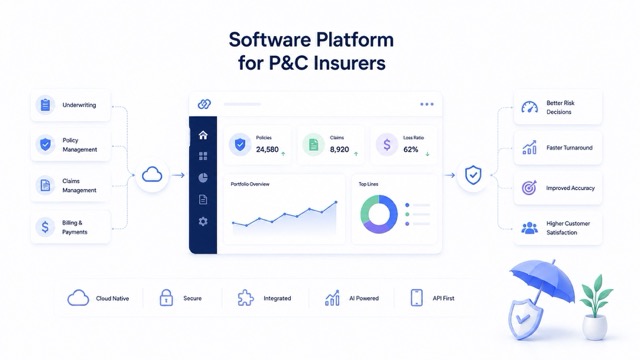
AI creates value throughout the insurance lifecycle because every operational function depends on evaluating information before taking action. Rather than replacing existing systems, AI strengthens decision-making by helping insurers process larger volumes of structured and unstructured data more efficiently.
Before expanding AI initiatives, insurers should focus on a few operational priorities.
- Underwriting
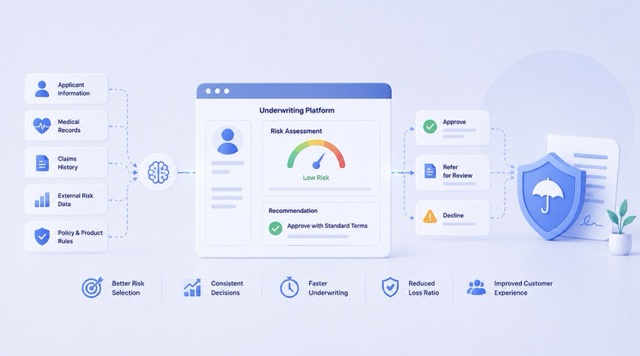
AI helps underwriters analyze application data, external risk information, medical records, property inspections, and historical claims to identify potential risk factors before a policy is issued. This allows routine applications to move faster while highlighting cases that require deeper review.
- Policy Servicing
Policy servicing teams process endorsements, renewals, cancellations, reinstatements, and customer requests every day. AI can classify requests, extract information from submitted documents, and assist customer support teams by surfacing relevant policy information, reducing manual effort for routine servicing tasks.
- Claims Processing
Claims involve collecting documents, validating coverage, reviewing evidence, estimating damages, and identifying potential fraud. AI helps organize claim information, extract data from images and documents, detect anomalies, and prioritize claims based on complexity, allowing adjusters to focus on investigations rather than administrative work.
- Fraud Detection
Insurance fraud often becomes visible only after reviewing multiple data points together. AI models can identify unusual claim patterns, inconsistent customer information, repeated repair estimates, or abnormal payment behavior that may require additional investigation before settlement.
- Customer Experience
AI-powered virtual assistants and intelligent search improve policyholder experiences by answering common questions, helping customers locate policy information, guiding claim submissions, and routing requests to the appropriate teams when human intervention is required.
Across these functions, AI doesn't replace insurance operations, it helps teams process information faster so operational decisions can be made with greater speed, consistency, and confidence.
Where AI Creates the Greatest Business Impact for Insurers
The value of AI in insurance isn't measured by how many tasks it automates. It's measured by how effectively it improves operational decisions across underwriting, policy servicing, claims, and customer interactions.
The greatest impact comes from helping insurers process more information, reduce manual effort, and improve decision quality without compromising governance or regulatory compliance.
The following areas demonstrate where AI is helping insurers improve operational efficiency while enabling faster and more informed decision-making.
- Faster Underwriting Decisions
Traditional underwriting often requires reviewing applications alongside external risk data, historical claims, inspection reports, and supporting documents. As application volumes grow, this manual analysis slows policy issuance.
AI helps consolidate and analyze these inputs, enabling underwriters to assess routine risks more quickly while highlighting applications that warrant closer review. This shortens underwriting turnaround times without removing human oversight from higher-risk decisions.
- More Efficient Claims Operations
Claims teams spend a significant amount of time collecting information before they can evaluate a claim. Policy documents, photographs, invoices, repair estimates, medical reports, and customer communications all need to be reviewed together.
AI accelerates this process by extracting relevant information, organizing supporting evidence, and identifying inconsistencies that require further investigation. This allows adjusters to focus on claim assessment instead of administrative work.
- Improved Fraud Detection
Insurance fraud rarely depends on a single suspicious event. It often emerges from patterns spread across multiple claims, policies, repair histories, customer records, and third-party data.
AI can analyze these relationships at a scale that would be difficult through manual review alone, helping insurers prioritize investigations based on risk indicators rather than reviewing every claim with the same level of scrutiny.
- Better Customer Service
Customers expect quick answers when updating policies, renewing coverage, checking claim status, or requesting policy documents. Many of these requests involve retrieving information rather than making complex insurance decisions.
AI helps classify customer requests, surface relevant policy information, and assist support teams with accurate responses, reducing wait times while allowing service representatives to focus on more complex interactions.
- Smarter Operational Planning
AI also provides operational visibility beyond customer-facing processes. By analyzing underwriting volumes, claim trends, processing times, and policy servicing activities, insurers can identify bottlenecks, allocate resources more effectively, and continuously improve operational performance.
Across these areas, AI improves how insurers work with information. The final business decision, however, still depends on business policies, regulatory requirements, and organizational rules.
Also Read: AI Powered Credit Scoring for Banks
Why AI Alone Can't Run Insurance Operations?
AI has become an important capability for insurers, but it doesn't replace the operational controls that insurance businesses depend on every day.
Insurance decisions are governed by underwriting guidelines, regulatory obligations, internal approval policies, compliance requirements, and product-specific business rules. These rules determine whether a policy can be issued, when a claim requires escalation, which documents are mandatory, or when additional review is needed.
An AI model can estimate risk, summarize documents, or detect unusual claim patterns, but it cannot independently determine how an insurer's business policies should be applied. Those decisions must remain transparent, auditable, and consistent across every transaction.
For example, an AI model may identify an application as low risk. Whether that application qualifies for straight-through processing, requires a senior underwriter's approval, or needs additional documentation depends on business rules defined by the insurer—not the AI model itself.
The same principle applies to claims. AI may detect potential fraud indicators, but decisions such as holding a payment, requesting further evidence, or escalating the claim follow predefined operational policies and regulatory procedures.
Successful AI adoption therefore isn't about replacing existing processes. It's about combining AI-generated insights with structured decision logic so operational outcomes remain explainable, compliant, and consistent.
Bringing AI, Decision Rules, and Workflows Together in Modern Insurance
As insurers expand the use of AI, one challenge becomes increasingly clear: generating insights is only one part of the decision-making process. Those insights still need to be evaluated against business rules and incorporated into operational workflows.
Consider an underwriting process where AI estimates applicant risk. The final outcome may also depend on product eligibility rules, geographic restrictions, regulatory requirements, policy limits, customer history, and internal approval thresholds. Similarly, in claims processing, AI may identify potential anomalies, but routing the claim for investigation or approving settlement follows predefined operational policies.
This is why many insurers are moving beyond standalone AI initiatives toward decision orchestration.
Decision orchestration brings together AI predictions, business rules, external data, and workflow automation into a single decision process. Instead of embedding logic across multiple applications, insurers can manage how operational decisions are made while keeping those decisions transparent and easy to adapt as business requirements evolve.
Nected support this approach by enabling insurers to combine AI models with configurable business rules and workflows. Rather than replacing core insurance systems, they help operationalize AI within existing underwriting, policy servicing, and claims processes, ensuring decisions remain consistent, explainable, and aligned with business policies.
What Should Insurers Prioritize When Scaling AI Initiatives?
Many insurers have already started experimenting with AI through pilots in underwriting, claims, customer service, or fraud detection. The bigger challenge is expanding these initiatives across the organization without creating disconnected systems or inconsistent decision-making.
Scaling AI successfully requires more than deploying additional models. It requires building an operational framework where AI supports business processes rather than operating independently.
Before expanding AI initiatives, insurers should focus on a few operational priorities.
Start with High-Impact Processes
Not every insurance process benefits equally from AI. Focus first on areas where teams handle large volumes of repetitive decisions, such as underwriting assessments, document processing, claims intake, fraud screening, and policy servicing. These functions typically offer the greatest opportunity to reduce manual effort while improving operational efficiency.
Keep Humans in Critical Decisions
Insurance decisions often involve financial, legal, and regulatory implications. AI should assist professionals by providing recommendations and accelerating information analysis, while experienced underwriters, claims adjusters, and investigators retain responsibility for high-impact decisions.
This approach improves productivity without compromising accountability or customer trust.
Build Explainable Decision Processes
Insurance operations require decisions that can be understood, audited, and justified. Whether evaluating policy eligibility or processing a claim, insurers should be able to explain why a particular outcome was reached.
As AI becomes part of operational workflows, maintaining clear decision logic becomes essential for regulatory compliance, internal governance, and customer transparency.
Integrate AI with Existing Systems
AI delivers the most value when it works alongside policy administration, claims management, billing, CRM, and document management platforms. Instead of creating isolated AI applications, insurers should focus on integrating intelligence into existing operational workflows where decisions are already being made.
Continuously Measure Business Outcomes
The success of an AI initiative should be measured through operational improvements rather than technical metrics alone. Faster underwriting turnaround, reduced claim processing times, improved fraud detection, lower operational costs, and higher customer satisfaction provide a clearer picture of business value than the number of AI models deployed.
Organizations that continuously monitor these outcomes can refine both their AI models and operational processes over time.
Conclusion
Artificial intelligence is reshaping the insurance value chain by helping insurers process information more efficiently, improve operational decisions, and deliver faster customer experiences. From underwriting and policy servicing to claims processing and fraud detection, AI is becoming an important capability across every stage of the insurance lifecycle.
However, successful AI adoption depends on more than predictive models. Insurance operations still rely on business rules, regulatory requirements, approval workflows, and human oversight to ensure decisions remain consistent, compliant, and explainable.
As insurers continue to modernize, the greatest value will come from combining AI with structured decision-making and workflow orchestration. Organizations that integrate these capabilities into their existing operations will be better positioned to improve efficiency while maintaining the governance and reliability that insurance processes demand.
Frequently Asked Questions
What is AI in insurance?
AI in insurance refers to the use of technologies such as machine learning, natural language processing, and computer vision to analyze data, support decision-making, automate repetitive tasks, and improve operational efficiency across underwriting, policy servicing, claims, fraud detection, and customer support.
How is AI used in the insurance value chain?
AI supports multiple stages of the insurance lifecycle, including risk assessment during underwriting, document processing, policy servicing, claims analysis, fraud detection, customer service, and operational analytics. It helps insurers process information faster while improving decision quality.
Can AI replace insurance underwriters or claims adjusters?
No. AI is designed to assist insurance professionals rather than replace them. It helps analyze data, identify patterns, and prioritize work, while underwriters and claims adjusters continue to make complex decisions that require expertise, regulatory knowledge, and professional judgment.
What challenges do insurers face when implementing AI?
Common challenges include integrating AI with legacy systems, maintaining data quality, ensuring regulatory compliance, explaining AI-assisted decisions, governing business rules, and scaling AI initiatives consistently across different operational teams.
Why are business rules important when using AI in insurance?
AI provides predictions and recommendations, but insurance decisions must also follow underwriting guidelines, compliance requirements, approval policies, and product-specific rules. Business rules ensure that AI-assisted decisions remain consistent, transparent, and aligned with organizational and regulatory standards.


.svg.webp)






.webp)

.webp)

%2520(3).webp)

.webp)